Adil Najam
The results to our most recent ATP Poll – on the biggest threats facing Pakistan’s future – may be the most surprising results to have come out of any ATP Poll ever.
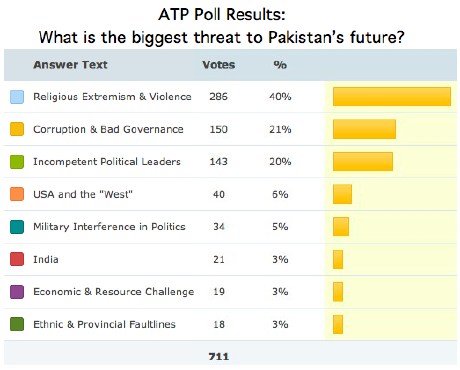
As in any poll one can quibble about which categories should or should not have been chosen. If, as some have suggested, we combine the category on “corruption and bad governance” (150 votes, 21%) with the category on “incompetent political leaders” (143 votes, 20%) then our own politicians, bureaucracy and establishment becomes the biggest threat (combined 293 votes, 41%). But even with that so, nearly as many people voted for what is now the top answer – religious extremism and violence is the biggest threat to Pakistan (286 votes, 40%). There is, indeed, a strong recognition of the internal wars being fought in and against Pakistan today!
Although 711 is a decent sized sample, this is a blog poll and should not be taken any more seriously than that because the sample is self-selected and non-scientific.
However, the real surprise here is not what people voted for, but what they did not vote for. For example, despite all the rhetoric and chest-beating one hears, only 40 votes (5%) felt that “USA and the West” are Pakistan’s biggest threat. Even more surprisingly, only 21 votes (3%) felt that India – the supposed arch-nemesis of Pakistan – is the main threat facing Pakistan today. With 19 and 18 votes (3% each) the categories of “Economic and resource challenges” including poverty and “Ethnic and Provincial fault-lines” make up the bottom.
So, what is happening here. Why did “India” or “The West” not get more votes even though the discourse most often talks about them? What does it say that the largest threats identified – more than 80 percent of the total vote – is in three categories that are all internally driven? Have new threats increased in size, or have old ones receded in impact? Thoughts, dear readers?




Looking forward to your next post!
Bookmarking this for later.
Thanks for sharing this insightful article.