Adil Najam
Our latest ATP Poll on which of Pakistan’s leaders did the most ‘good’ for Pakistan, generated quite a response. As many as 1,347 votes were cast and – more importantly – the discussion generated was intense as well as interesting. We intend to do a followup poll soon, but meanwhile analysis of the results may be in order.
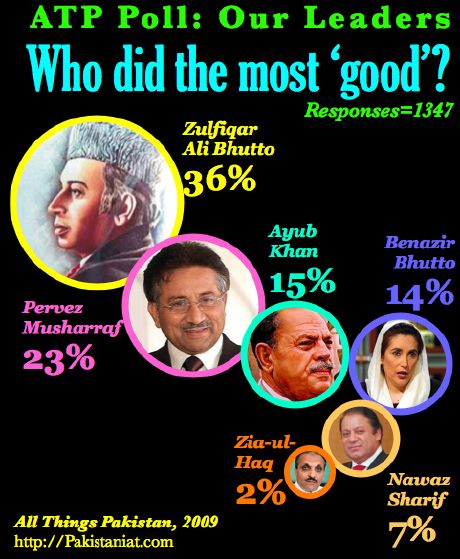
This poll focused on past leaders and it followed up on our previous poll that graded the current crop of leaders. It also followed up on an earlier poll we had conducted, on the same question, three years ago. While many did just vote for their ‘favorite’ leaders, the comments suggests that many others did actually take the question seriously and considered all the actions of these leaders – good and bad – and then voted by focusing only on the ‘good’ that they did.
Of course, like always, I would stress that no blog poll (or, really any web-based poll) should ever be taken too seriously. But such polls can be interesting – and even informative – reflections on the views of the cohort of Pakistanis who feel intensely about these issues and visit this particular blog.
Having said that, let me now highlight what I thought were a few of the interesting results. I hope others will add their own insights on what these results may or may not mean.
- With 1,347 votes cast in the poll, this ATP Poll did attract more responses than usual. The Poll was kept open for just under two days, which is also less than we usually leave polls open. However, as always, we closed it after the results had become fairly stable. Astute readers will note that the totals do not add up to 100. One assumes this is because the service we use simply truncates after the decimal point (instead of rounding it off). However, this quirk has been accommodated mathematically in all the analysis.
- Zulfiqar Ali Bhutto, with 36% of the votes, came out as the leader who our readers think did the most ‘good’ for Pakistan during his tenure. Pervez Musharraf also had an intense following, although not as intense. He comes in second, behind ZAB, with 23% of our readers believing that he did the most good for Pakistan. Ayub Khan came next with 15% of the votes, which also puts him about equal to Benazir Bhutto was ended with 14% of the votes, although these two remained neck to neck for most of the voting. Nawaz Sharif did start off much better and in the early counting was ahead of both Benazir Bhutto and Ayub Khan; however, he ended with just 7% of the votes when the Poll was closed. Ending dead last – and having remained in that position throughout the poll – was Zia-ul-Haq who ended with 2% of the votes after being at 1% for most of the voting period.
- It is intriguing to compare these results with the results we got three years ago when we had asked the same question. However, any comparison should be taken with a grain of salt. That poll was done very early in ATP’s history and only received 126 votes (at that time we thought that was a lot!). More importantly, the question was the same but the options were not: Gen. Pervez Musharraf was then in power and therefore was not one of the choices (just as Asif Ali Zardari was not one of the choices this time). A few points, however, are still note worthy. First, Ayub Khan had received 38% of the votes last time and emerged second after Z.A. Bhutto. As one reader commented, it does seem that some of these votes might have shifted to Gen. Musharraf. Second, some of Z.A. Bhutto’s votes from last time might have shifted to Benazir Bhutto, who had received only 4% of the votes last time and bagged 14% this time. Finally – and maybe this is a sign of the times we live in – Gen. Zia ul Haq was placed third last time with 9% of the votes. This time was lagged behind all and only got 2% of the votes.
- One of the readers had astutely pointed out that the ability to leave behind lasting impacts is at least partly dependent on the length of time one is in office. I thought this was a point worth exploring in the analysis. Therefore I calculated the total number of months each of these leaders was in power and then took the percentage of votes that they got and divided it by the number of months that they had power. Thus, the area of the rectangle in each case represents the total votes and the height of each bar the “goodwill per month in power” that the leader generated. This is clearly a very rough measure and I urge readers not to read too much into it. However, it does begin to give an indicative sense of the time factor (even though, for Benazir Bhutto and Nawaz Sharif we have lumped the time they served over two separate terms, which seems a little unfair to them).
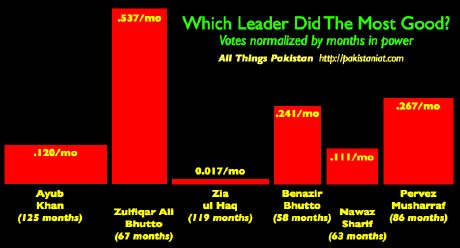
Despite all of the caveats above, the results of this exercise are quite striking. Given that Zulfiqar Ali Bhutto had power for much less than Pervez Musharraf, the ‘goodwill per month’ that Mr. Bhutto seems to have generated during his time in office (at least amongst our readers) was more than twice as much as that generated by Gen. Pervez Musharraf (0.537 v. 0.267). Similarly, and strikingly, since Benazir Bhutto was in office for the shortest period amongst all these leaders, the ‘goodwill per month’ Benazir Bhutto generated seems to have been just about the same as Gen. Pervez Musharraf (0.241 v. 0.267). In fact, by this measure the ‘goodwill per month’ for Nawaz Sharif was about the same as that for Ayub Khan (0.111 v. 0.120), since the later is the one who held on to power the longest. Stylistic as these numbers might be, they seem to be not unimportant.  Having done the above analysis also allowed us to do another interesting little calculation. First, it points to the fact that for the leaders that we polled for, military rulers (Ayub Khan, Zia ul Haq and Pervez Musharraf) had control of Pakistan for 330 months while civilian leaders (Zulfiqar Ali Bhutto, Benazir Bhutto, Nawaz Sharif) were in control for only 188 months. This is itself says something about Pakistan politics. More interestingly, the civilian leaders accounted for a total of 57% of the votes for having done ‘good’ for Pakistan, while military leaders – despite the much much longer stints in power – account for only 40% (see note above about the tital not adding to 100). That also means (see graph) that the ‘goodwill per month in power’ generated by the civilian leaders is 250% (2.5 times) more than the ‘goodwill per month in power’ generated by military leaders when they were in power (0.303 v. 0.121). Again, something worth thinking about!
I am sure that there is plenty that our readers will find to disagree with on the above, but more than that I hope they will add other interesting insights that might be derived from this or just continue the discussion.
So, do please tell us what you think!




Some comments on this from the ATP Facebook Page:
– “how did musharraf get 23%!!”
– “Nawaz Sharif de best……atleast he is loyal to Pak….”
– “yes he is loyal to pakistan and his brother is awesome.live long shahbaz”
– “Nawaz Sharif and loyality are two different things. Loyal politicians are already announced as endangered species, specially in Pakistan.”
– “ahhh…and the public did nothing, not fair, public share should be 100%, as we were responsible for bringing these people into power”
– “No body did good to Pakistan. They are just like Americans, they use Pakistan and in bad times ran from here to thier original countries”
– “good joke loyals hahahahaa roflol loyal hahaha dnt remmember wht happened in 1999 ran and hid lyk a jerk when he new he wud go to jaiL!!No one was more loyal to the country than the Bhuttos*keeping zardari as an xcption cuz he is not one of the Bhuttos’*they sacrificed their lyf for the country….”
– “abviously general pervaz mushraf……he iz the one who did the best for pakistan…….mushraf zindabad….”
– “no one is gud all r bad politition”
– “every one wants his or her own good noe feels for the nation because they all oly care forr their bank balances nd musharaf i want to say destroyed all the present progress and now zardari is wanting to simply stop the upcoming progress stop him nation before he over takes al”
– “Musharraf definitely made a few mistakes.. but he also definitely did good for Pakistan!”
– “In PAKIstaN EVEry POLItiCIAn WORks FOR HIs ”MEAN”, Its Quit EmbARissing…..”
– “45% Perwez Musharraf – 45% Ayub Khan – 10% Zulfiqar Ali Bhutto. Baqi saare Dust-bin Material hain… Sirf in teenon ne Sahi Maaino’n me Pakistan k liye kuch kiya hai…”
– “How we can chek someone he is loyal to Pakistan or loyal to his seat???”
– “nae i thnk ayub khan was the best… coz during his rule paks GDP boosted… which was 7% and paki rupee was expensive then indian rupee… so i go with Ayub Khan”
– “Ayub Khan n Zia-ul-Haq both were superb”
– “Mush, all the way.”
I agree with Khalid Hassan that an important factor is how long each of the leader has been out of public mind. Therefore my thinking is Mush’s numbers will come down as time goes by.
If this poll was conducted (say) in 1989, Zia’s percentage may’ve been higher than what it is now.
The dictators have absolute power therefore a much better chance of implementing development programs.Democracy on the other hand is a slow moving process has a handicap.
This poll proves beyond doubt democracy is better suited for Pakistan.
Thanks….ATP
Adil, the analysis is nicely done and while I would tend to agree with most of the conclusions, I think from a statistical point of view we might be trying to get blood from a turnip (the P-values are probably quite high).
Also, I think the only reason Benazir did as badly in the poll is that there is probably a huge overlap between her and ZAB.
The unscientific poll mirrors Pakistani general elections:
* Zia was an aberration and his negation is the rejection of the religiosity posture assumed by him. 2% is about the vote religious parties manage to get, election after election.
* Pakistanis are socially liberal (Ayub, ZAB) with a new generation of modernists and western orientation (PM, BB), and at ease and comfortable with centrist conservative outlook (NS).
Welcome to Sufi Republic of Pakistan.