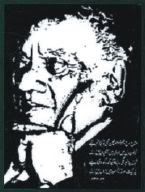
 The Mard-e-Momin as a form of national identity is overrated. So is the concept of the collective morality and the religious honor that gets everyone keyed up, ready to take up arms against an aggressor. The biggest aggressor, after all, remains poverty, bread within. Real tyranny is that which the state practices against its own citizenry, mostly by ignoring them.
Enough with the heroic machismo, I say. It hasn’t bought Pakistan any bread or butter, although it has surely strung us into becoming a state famous world over for its radicalism.
Zard Patto Ka Bann Jo Mera Dess Hai. Faiz Ahmed Faiz (1911-1984) brews in his poetry a gentle reminder of a wilting nation, he calls each of the forgotten, by their own name: the weary armed mother who can’t calm her crying child at night, the postmen, the clerk, the railway driver and the factory worker. These form the majority of our nation – they also form a group that we don’t like to talk about. Our ‘national poet’ Allama Mohammad Iqbal for instance has no mention of these no-name people. Neither does he mention shame, which is what a realistic self-introspection deserves. How can we talk of a national poetry without the people who form its working class?
Nisar teri gallion mey aye Watan, Key koi na saar utha key chaley. Faiz has asked for a soul check, a delving into what brings real honor to the country: protection of the rights of its citizens, a level playing field and recourse to justice. As a member of the International Labor Organization he was astute about the rights of the blue collar workers. His concept of patriotism wasn’t a jingoistic one. Evident in his piece mourning the death of the founding father Mohammad Ali Jinnah, he said: “Short-sighted fanaticism and heartless greed are preparing to plunge both the dominions into another suicidal devil-dance and the voice of the common man is getting feebler through exhaustion.”
Faiz’s nationalism focused more on the cultural aspects of what it was to be Pakistani, the art, the music, the folk tradition. In his compartmentalized life, between his work as a writer and his jail sentences, he was also the head of the Ministry of Culture in Islamabad where he established the Lok Virsa museum, chronicling the unique regional art embedded in our nationalism.
Umeed-e-Seher ki baat sunoo. Far from being a pessimist, he believed in the message of hope. Listen, he said to the dawn of the new morn.
What is missing today, especially among our youth is a concept to anchor them in. A cultural identity of what it is to be a Pakistani. Childishly we believe that fighting the other fulfills our need to congregate around a cause. Pakistan is in the search of Bulleh Shah, the Khudi of Iqbal, the voice of Reshma, the Horse and Cattle show, the Polo matches, the fashion shows, the billboards and the TV Serials, no matter how variant the spectrum, each contributant to the creativity form a mosaic of multiculturalism forms a piece of the modern Pakistan we have today. Anyone with a green passport can claim it as their own.
In the same eulogy Faiz adds that Pakistanis should, “complete the task that the Quaid-i-Azam began, the task of building a free, progressive and secure Pakistan, to restore our people the dignity and happiness for which the Quaid-i-Azam strove, to equip them with all the virtues that the nobility of freedom demands and to rid them of fear, suffering and want that have dogged their lives through the ages.”
The Pakistani cultural identity is infused with religious sentiment. It is important to divorce those two concepts because we have not one but many religious avenues which describe what it is to be a Pakistani, and these avenues cannot be excluded, because Pakistan was not created out of an exclusionary identity. Pakistan was formed for a minority community, through a democratic and constitutional process; it must therefore amongst all its principles uphold the protection of the underdog as its highest moral principle.
Tum yey Kehtey ho vo Jang ho bhi chuki, Jiss mey rakha nahi hey kissi ney kadaam. Vehemently anti-war, Faiz cautioned against those wars that were fought on the behalf of an unseen force, and lost at the cost of many lives and much blood. His focus instead was on educating the youth. As principal of a local school, he introduced at first education for women, brought enrollment to an all time high and instituted excellence at this school. His versatility as a nation builder was evident in the devotion with which he completed each assigned task, no matter what the field.
Bahar Aaee. Above all else, Faiz brought alive that Pakistan which bloomed endlessly, even after loss.




One of the most famous verses of Iqbal of which the author is totally ignorant about otherwise she would not have gone down this path
jis khet se dahqan ko mayassar nahin rozi
us khet k har khosha-e-gandum ko jala do
this just throws her premise about Iqbal and common man out of the window
This is a wonderful article not because of its content but what it shows about the mindset of our elite. To raise the stature of Faiz at the expense of Iqbal: it does not require a linguistic or a cultural genius to figure out what the author is aiming at. The poet who is called the visionary of Pakistan is relegated just because his poetry talks about Islam or uses islamic influences.
Exactly the kind of articles we need on Pakistaniat and forge our national identity.
Another masterpiece by Secular elite. I am amazed at the ignorance level of the author who is saying that
Pakistan was formed for a minority community…..
O really???? I thought it was other way round…. It was actually the MAJORITY community of present day Pakistan which was the focus of the concept, demand, struggle and creation of this homeland.
ATP, prior to posting, should at least consult the authors to edit possible errors, or perhaps, lies.
Did the author ever read Iqbal before she thought of demeaning him?
Does she know any “AWAAM” apart from her household employees? And by knowing i mean what the AWAAM thinks about religion, politics and more importantly the secular elite itself???
What goes through the mind of AWAAM waiting under scorching sun for an already overcrowded bus when he/she looks at the secular elite driving their air-conditioned cars (mostly alone) and always ignoring the desperate creatures outside their windows?
An interesting similarity:
Modern day media is hated by our secular elite for the same reasons Faiz was (or is) loved by the very secular elite, i.e. criticizing and exposing the way this secular elite is exploiting the not-so-fortunate AWAAM of Pakistan.
How? very simple:
The communists/socialists of the past, led by FAIZ, singing the mantra of red revolution, took a 180-degree turn after the fall of Berlin wall and since then have found refuge, backing and funding from the same capitalistic west FAIZ and his comrades “struggled” against.
And these so-called DAANISHWAR criticize any attempt to resist the western influences on the roots of Pakistan (religion and household values).
Previously they criticized the fundamentals of Pakistan movement in the hope of a anti-west socialist revolution, now they criticize those fundamentals to pursue western secularism.
Dollar kamaaney k liye wafadaari bhi to saabit karni hai na ji…
No offense but this article has set a new low for this website and its written by someone completely ill-informed. Never before today I had thought that a follower of Faiz would compare him with Iqbal in such a poor manner.
It doesnt need a genius to understand that though both poets were few decades apart from each other, they were in completely different times (pre and post partition) and thats what is represented in their poems. However, due to mostly unfortunate reasons both of them still stand as relevant as they ever were in past.
I have an advice for Aisha to please actually “read” complete poetry of Iqbal before making any comparisons. Reading Iqbal in high school text books doesnt give you the right to create such “master pieces”.
I wonder why there is such a great need to have a clear and defined single identity. It will be artificial by definition. Unless you embrace the diversity that exists you will never achieve the unity of identity that you seek.
Nice. In many ways Faiz captures the national spirit and identity, specially the struggles that have plagued the nation since it was born.