 The Mard-e-Momin as a form of national identity is overrated. So is the concept of the collective morality and the religious honor that gets everyone keyed up, ready to take up arms against an aggressor. The biggest aggressor, after all, remains poverty, bread within. Real tyranny is that which the state practices against its own citizenry, mostly by ignoring them.
Enough with the heroic machismo, I say. It hasn’t bought Pakistan any bread or butter, although it has surely strung us into becoming a state famous world over for its radicalism.
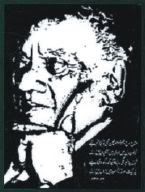
Zard Patto Ka Bann Jo Mera Dess Hai. Faiz Ahmed Faiz (1911-1984) brews in his poetry a gentle reminder of a wilting nation, he calls each of the forgotten, by their own name: the weary armed mother who can’t calm her crying child at night, the postmen, the clerk, the railway driver and the factory worker. These form the majority of our nation – they also form a group that we don’t like to talk about. Our ‘national poet’ Allama Mohammad Iqbal for instance has no mention of these no-name people. Neither does he mention shame, which is what a realistic self-introspection deserves. How can we talk of a national poetry without the people who form its working class?
Nisar teri gallion mey aye Watan, Key koi na saar utha key chaley. Faiz has asked for a soul check, a delving into what brings real honor to the country: protection of the rights of its citizens, a level playing field and recourse to justice. As a member of the International Labor Organization he was astute about the rights of the blue collar workers. His concept of patriotism wasn’t a jingoistic one. Evident in his piece mourning the death of the founding father Mohammad Ali Jinnah, he said: “Short-sighted fanaticism and heartless greed are preparing to plunge both the dominions into another suicidal devil-dance and the voice of the common man is getting feebler through exhaustion.”
Faiz’s nationalism focused more on the cultural aspects of what it was to be Pakistani, the art, the music, the folk tradition. In his compartmentalized life, between his work as a writer and his jail sentences, he was also the head of the Ministry of Culture in Islamabad where he established the Lok Virsa museum, chronicling the unique regional art embedded in our nationalism.
Umeed-e-Seher ki baat sunoo. Far from being a pessimist, he believed in the message of hope. Listen, he said to the dawn of the new morn.
What is missing today, especially among our youth is a concept to anchor them in. A cultural identity of what it is to be a Pakistani. Childishly we believe that fighting the other fulfills our need to congregate around a cause. Pakistan is in the search of Bulleh Shah, the Khudi of Iqbal, the voice of Reshma, the Horse and Cattle show, the Polo matches, the fashion shows, the billboards and the TV Serials, no matter how variant the spectrum, each contributant to the creativity form a mosaic of multiculturalism forms a piece of the modern Pakistan we have today. Anyone with a green passport can claim it as their own.
In the same eulogy Faiz adds that Pakistanis should, “complete the task that the Quaid-i-Azam began, the task of building a free, progressive and secure Pakistan, to restore our people the dignity and happiness for which the Quaid-i-Azam strove, to equip them with all the virtues that the nobility of freedom demands and to rid them of fear, suffering and want that have dogged their lives through the ages.”
The Pakistani cultural identity is infused with religious sentiment. It is important to divorce those two concepts because we have not one but many religious avenues which describe what it is to be a Pakistani, and these avenues cannot be excluded, because Pakistan was not created out of an exclusionary identity. Pakistan was formed for a minority community, through a democratic and constitutional process; it must therefore amongst all its principles uphold the protection of the underdog as its highest moral principle.
Tum yey Kehtey ho vo Jang ho bhi chuki, Jiss mey rakha nahi hey kissi ney kadaam. Vehemently anti-war, Faiz cautioned against those wars that were fought on the behalf of an unseen force, and lost at the cost of many lives and much blood. His focus instead was on educating the youth. As principal of a local school, he introduced at first education for women, brought enrollment to an all time high and instituted excellence at this school. His versatility as a nation builder was evident in the devotion with which he completed each assigned task, no matter what the field.
Bahar Aaee. Above all else, Faiz brought alive that Pakistan which bloomed endlessly, even after loss.



Leaving aside the subtleties of poet v poet debates for which I’m roundly unqualified, I can’t agree more with the main premise of the article framed so eloquently by Aisha. It’s a discussion I can certainly recall having and consuming many an after-dinner hour among fellow Pakistanis.
What does it mean to be Pakistani?
While I also concur with some of the loftier sentiments she raises, I think the role of national narrative and national myth in grounding the identity of any culture needs to be more clearly articulated. Every cohesive culture has these aplenty, and in modern times we have seen them also manifest in Hollywood and yes, Bollywood.
We mustn’t succumb to a potentially elitist dismissal of their identity shaping role. Over the past century, Hollywood has been central to the task of shaping an American identity out of the divisions of the post-civil war society, segregation and other social ills to which it has not been immune. The movies have done a great deal to break down stereotypes, envision the impossible becoming the improbable and then the possible, and to shape identity.
Likewise Bollywood’s role has been similar in forging some sense of nationality where India was, at one time at least, close to fracturing along quasi-national lines with all the different languages and customs it tried to bring under a single roof. Now that edifice is growing economically at 9% annually, an important indicator of what to expect in the next couple of decades for the blue-collar and agri-workers.
I only illustrate the point with the film industry owing to its relative ease of dissemination of narratives. Novels, fine art, architecture and of course, the ever important poetry, all serve similar purposes.
Pakistan has endured a persistent vacuum of leadership. Among the many shortcomings of all who purported to be leaders, was the failure to envision a meaning for the Pakistani identity, articulate it to the people and infuse it with hard investment in such endeavors as the arts. The result is a patchworks of local or ultra-local identities. I’m always struck by the propensity of every Pakistani organization or institution, large or small, to render its own derivation out of the national flag. It’s as if each of them has their own micro-Pakistani identity. Contrast that with the largely ubiquitous Stars and Stripes in the USA or the Tiranga Jhanda of India.
These are only symptoms of course. Deeper problems of provincial identities itching to separate one from another are more serious. Absent a real sense of national meaning and cohesion, our resilience not as individuals, but as a nation continues to erode. Now more than ever, we need to be stepping up to the challenge of articulating a practical vision for what it means to be Pakistani, that goes beyond the simple “Pakistan ka matlab kya? – La ilaha ilallah.”
I endorse what Mr. Adil has said!
Iqbal being a great visionary choose grand themes for his subject matter and had aesthetically drawn great lessons of lasting value from them. His similies, metaphors, heroes and historical figures, all are superlative. He introduced them with a new insight to arouse the Muslims particularly their leaders from their deep slumber to contribute positively towards the continuity of life. Iqbal verses gave a message of hope and great expectations to achieve the higher objectives of life. He wanted to restore the same self-confidence among Muslims, which led them to the heights of glory in the past.
Allama Muhammad Iqbal presented Islam as a revolutionary concept. In this respect, if even you overlook his poetry, which is the scale and medium of his thought, and go through the ‘New Year Message’, which he gave on January 1, 1938 – the year of his death, you find him saying, “the coercive and despotic monarchic system sustains under the veil of democracy, nationalism, socialism, fascism and the rest. Under these veils, the freedom values and human dignity are disgraced and ridiculed the world over, that one will not find a parallel to that even in the darkest phase of the history. There is only one creditable unity and that is of the human being, which is above (the prejudices of) colour, race and language. As long as the curse of this so-called democracy, the dirty nationalism and the disgraceful monarchy, is not sweeped and till the time a person gets convinced through his (or her) acts and deeds, of the principle that ‘all creatures are the family of Allah’, and the credibility of colour, creed and the geographic nationalism is obliterated, human being will stay deprived of the welfare and felicity in this worldly life”.
(You ask the wizened to know the elixir of life
That every thing is kept alive by perseverance in strife)
Bringing the ref to Iqbal was uncalled for. Actually, Iqbal has written about the common man too. You messed up an otherwise interesting writeup by that unnecessary reference.
A few more ancedotes,
1. Our zealots cry hoarse about the palestinian hardship. Faiz was the one during the Beirut bombing who was there editing the Palestinian journal Lotus.
2. Faiz and Iqbal was both taught by the same teacher Shamsul Ulema Moulvi Syed Mir Hassan. His command over religious issues was next to none.
3. One journalist when insisted on a question that why he didnt ever wrote a naat, he softly said, because i think that i am still not capable enough,. His last piece on Nuskha hai wafa is a naat.
Aisha, my own aqeedat for Faiz Sahib is well known to readers at ATP, but I wonder why we need to delegitimize the importance of Iqbal to our Pakistaniat in order to elevate the importance of that which Faiz contributes to it?
Faiz sahib, himself, was always cognizant of Iqbal’s greatness (as in the quote you cite); why can’t we be the same? The context and the times in which the two wrote were very different, and at different moments in our own existence different parts of the two’s poetry may speak more directly to us. Why must we seek to choose between the two?