Bilal Zuberi
Imagine 42 degrees celsius (107 degrees Farenheit) weather, no electricity, no fans, high humidity, no drinking water, and knee deep water on streets. Now imagine living through that for more than 24 hours. Terrible!
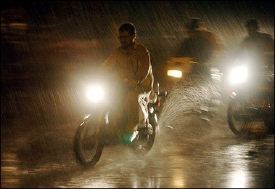 That is precisely what most Karachiites have been going through for more the past 2 days. A huge monsoonal storm hit the city yesterday, followed by torrential rains. And then the infrastructure of the city that had already suffered several major blows in the past 2 months simply came crashing down. The city now sits in a giant puddle, surrounded by fallen trees, billboards, traffic lights, and rooftops.
Due to the severity of the storm, several trees were pulled out of the ground and are now left stretched across streets, many large bill boards fell on top of passing cars and people, electricity wires were found dangling from the poles leading to several people dying of electrocution, roofs of poorly constructed homes fell killing the residents, rain-related traffic accidents led to further deaths, and now people are suffering without electricity and proper transportation in the maddening heat. Reports are indicating that more than 50 people have died and more than 200 have been injured in Karachi already in the aftermath of the storm. Even those who have lived in the city and watched many monsoons go by are claiming this storm to be among the worst they have weathered. It seems the first wave of the storm has passed by but the city is still struggling to play catch up from all the destruction that it caused.
Read Full Post
Owais Mughal
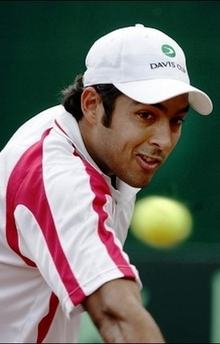 UPDATE June 26: Pakistan’s Aisam-ul-Haq won his first round Wimbledon match beating Briton Lee Childs 6-3 6-4 7-6. His second round match is a much tougher game where he will meet former Russian No. 1, Marat Safin . According to Guardian Unlimited, the 27-year-old from Lahore said after the game: “I am living my dream. Ever since I started playing, I wanted to play Wimbledon… I was very loose and relaxed on court today,” he said. “I don’t think Lee expected me to come out today so pumped up and fired up.”
ORIGINAL POST:
The news is 3 days old, but important enough that we are compelled to write about it here. Pakistan’s top tennis star Aisam-ul-Haq Qureshi on Thursday created history by becoming the Third Pakistani ever to qualify for Wimbledon men’s singles.
This moment has arrived for Pakistanis after a gap of 31 years. The first man to represent Pakistan at Wimbledon singles was Khwaja Saeed Hai who qualified for the main round of Wimbledon for 3 consecutive years, viz. 1954, 1955 and 1956. The last man to represent Pakistan at Wimbledon singles was Haroon Rahim in 1976.
Aisam hit the limelight after winning third and final qualifying round against Canadian No 1 Frank Dancevic in a four-set thriller, lasting two hours and 50 minutes, 4-6, 7-6 (11-9), 6-2, 7-6 (7-4). In Wimbledon 2007, as of June 26, Aisam has already won his first match against Britain’s Lee Childs by 6-3, 6-4, 7-6 and will now face Marat Safin of Russia in Round two.
It runs in the Family:
Aisam‘s mother Mrs Nausheen Ehtesham is also a tennis player and won first of her several Pakistan ladies singles title in 1982. She has also represented Pakistan in the Fed Cup, the women’s version of the Davis Cup.
Read Full Post
Raza Rumi
 The current controversy on Rushdie’s knighthood has several dimensions. Amid the knee-jerk reactions alluding to the grand-conspiracy-against-Islam, it brings out various layers and levels of literature’s role and position in societies and now in the globalized world.
I was once a fan of Rushdie and avidly devoured his books with great admiration. From Grimus to The Moor’s Last Sigh, I marveled at his playfulness with the English language and its idiom which undoubtedly he has enriched. The collection of essays titled Imaginary Homelands was a combination of disparate but original writings. Somewhere during this process came the ridiculous Satanic Verses which other than its blasphemous content and brazen disrespect for a vast majority of Muslims was a bad piece of writing!
The decline of Rushdie as a writer, finally, was confirmed by the trashy Ground Beneath Her Feet. Thereafter, one read strange, ignorant pieces of his non-fiction in the Western mainstream media that needed his stature to find a rationale for the imperial projects in Afghanistan and Iraq.
Shalimar the Clown, his recent novel was even worse as it proved to be bereft of subtlety and re-invoked all the crappy, soul-destroying images and cliches of our times. In a non-serious piece, published in the Friday Times (Pakistan) in December 2005, I wrote:
Salman Rushdie’s new novel, Shalimar the Clown, is enough to add to ones misery. I finished browsing it; what else can you do with such stuff posing as quality fiction? As if the name of the central character “Shalimar” was not enough to offend a native reader such as I, the heroine “India Ophuls” changing her name to “Kashmira” was the ultimate illustration of cheap exoticism and a hackneyed dive into passe magical realism. Alas, Rushdie has started believing in his own mantra and the twisting of historical narrative. It simply does not work now. He is more of a bard for the ascendancy of the global tide against Islamism and perhaps he should stick to that. Better if he were to provide some intellectual depth to Fox News, or even better, if he started writing scripts for his young wife’s tele-plays. Shalimar successfully completes the trilogy of Rushdie’s worst novels, the other two being The Ground Beneath Her Feet and Fury . Aijaz Ahmad, a US-based academic, argued a long time ago that Rushdie and Naipul were avatars of oriental consciousness. Small wonder that they are reviewed, exalted and globally hyped.
Much to my delight, a friend – an aspiring critic – sent me the review by Theo Tait of the London Review of Books: Noting what Rushdie’s style produces in the novel, Tait writes that it
… is a cross between a piece of magic realism which displays all the worst vices of the style, and the contemporary international thriller. It is passionate, well-informed and sometimes interesting; but also hackneyed, simplistic and often very, very silly…
Today, I read this brilliant article published in the Guardian written by a noted academic, Priyamvada Gopal that essentially is a lament of all that Rushdie and his new writings stand for:
Sir Salman, on the other hand, is partly the creation of the fatwa that played its role in strengthening the self-fulfilling “clash of civilisations” that both Bush and the other side find so handy. Driven underground and into despair by zealotry, Rushdie finally emerged blinking into New York sunshine shortly before the towers came tumbling down. Those formidable literary powers would now be deployed not against, but in the service of, an American regime that had declared its own fundamentalist monopoly on the meanings of “freedom” and “liberation.” The Sir Salman recognised for his services to literature is certainly no neocon but is iconic of a more pernicious trend: liberal literati who have assented to the notion that humane values, tolerance and freedom are fundamentally western ideas that have to be defended as such.
Vociferously supporting the invasions of Afghanistan and Iraq on “humane” grounds, condemning criticism of the war on terror as “petulant anti-Americanism” and above all, aligning tyranny and violence solely with Islam, Rushdie has abdicated his own understanding of the novelist’s task as “giving the lie to official facts.” Now he recalls his own creation Baal, the talented poet who becomes a giggling hack coralled into attacking his ruler’s enemies. Denuded of texture and complexity, it is no accident that this fiction since the early 90s has disappeared into a critical wasteland. The mutation of this relevant and stentorian writer into a pallid chorister is a tragic allegory of our benighted times, of the kind he once narrated so vividly.
In its editorial the daily DAWN rightly comments that “Like the Danish cartoons, Rushdie’s knighthood will widen the chasm [between Muslims and the West].” At the same time the newspaper condemns the talk of suicide bombing by responsbile quarters in Pakistan stating that such irresponsible talk overshadows the real issue that requires reflection and a well argued reaction to this provocative title.
This dubious honour is yet another endeavour to reward the constructed clash of civilizations. The fact that Rushdie has accepted it, further confirms his degeneration as another script writer of this “theory”. Meanwhile, the protests in Iran and Pakistan only reinforce this vicious cycle of neo-orientalism .
However, the sanest comment on Rushdie saga is from AD, a politically charged friend:
“Clearly, lack of self-awareness and an inability to be self-critical is a global phenomenon. Rushdie was just another Booker-prize winning author hailed by the British literary establishment and unknown otherwise. He is a western icon today, because he is the poster-boy for the Western construct of a Muslim-bashing “civilized Muslim.” That is why he has been knighted and why he is so hated. Just because he is the poster-boy of Western Islamophobia, Rushdie should not be awarded the status of hate-figure in the Muslim world. By elevating him so, it is in fact Muslim extremists who place him in a position of centrality instead of the insignificant and irrelevant place he deserves.”