Adil Najam
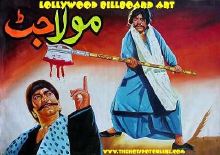 For a moment I flirted with the idea of using the title “The Greatest Pakistani Movie Ever?” (to match with the earlier ATP post on PTV show Fifty-Fifty). But even with the question mark at the end, that would have been unfair on the remarkable movies of the 1960s; particularly, for me, the Waheed Murad–Ahmad Rushdie hits.
That said, I do believe — and I know I am in a minority here — that Maulla Jatt is not just a remarkable but a milestone Pakistani film. Most people think of it as an ‘action’ film (and some would call it an over-action film), but for me it is a dialogue movie. Memorable for its dialogues and even more for how they were delivered by Sultan Rahi and Mustafa Qureshi.
This next clip is a good, although not the best, example of the barak (brawl) vernacular that is the hallmark of the Maulla series of movies.
Let me go out on a real limb here and suggest that Maula Jutt is to Pakistani cinema was Godfather was to Hollywood and what Shoalay was to Bollywood. I know, I know. That is too much to gulp. I am exagerating (on acting quality, for example); but only for effect! But play along and think of it….
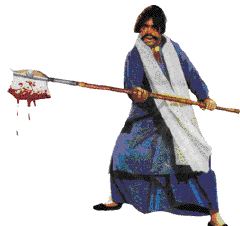 It is an action movie most memorable for its dialogue. It blurs the line between good guys and bad guys. It is thick with political and social commentary. And it leaves an imprint on everyday language that lives beyond the movie (“I’ll make them an offer they cannot refuse”, “kitnay aadmi th-ay?”, “nawa aaya hai, soonia?”).
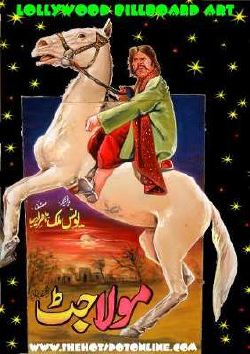
Produced by Sarwar Bhatti and written by Nasir Adib, Maulla Jatt is not only the biggest box-office hit ever in Pakistan’s history (it ran for five years straight), it is also a cultural, social and political icon; for good and for bad.
 Released at the height of the Zia-ul-Haq regime, it was full of political innuendo. Die-hard fans will talk about how the message of the movie was that when faced with oppression we sometimes have to take things in our own hand (as Maulla does) but this is a painful process (hence Maulla’s constant desire not to have to use his dreaded ganDassa). At least, this is what the myth became.
Anyhow, I have a feeling I am going to get into trouble for this one; always happens when I mention Maula Jatt.
Amongst a large segment of our educated elites there is a deeply ingrained (and cultivated) feeling that Maulla Jatt is the height of the uncouth, of the ‘paindoo.’ No surprisingly, I find that most who hold this view have never actually seen the movie. So, be it. If paindoo it is, then paindoo I am!




I have heard so much about this movie, thanks for uploading this clip. Although, I could not exactly follow the Punjabi dialogues, I could still make sense what was going on.
The point about rural-urban divide in movies indeed pertinent and Bollywood has been a victim of the same. I don’t much about Pakistan but it may also be a case of Urdu-Punjabi thing with Punjabi being considered ‘somehow’ rural by the elites.
In Bollywood the trend has changed slightly with movies like Bunty Aur Babli and Omkara either based in small-town India or the protagonists belonging to the same. The past couple of years have also seen a big upsurge in Bhojpuri (a Hindi dialect spoken in parts of Eastern U.P. and Bihar) film industry with even big stars like Amitabh Bacchan and Hema Malini featuring in the upcoming movies. With imaginative titles like ‘Daroga Babu, I Love You’ and ‘Sasura Bada Paisewala’ and shoe-string budgets, these movies have grossed millions at the box office.
@ Adil Najam saahab,
I heard this song ‘sanou nehr waaley pull tey bulla kar’ in the movie, Khamosh Paani, for the first time and really liked it. Now, it seems the original song is from some other movie. Could you please give me a reference about the same so that I can find it out on the net?
Thanks a lot,
Mohib
Roshan, I think you are on to something important here. One of the otehr ways in which Sultan Rahi (and Maula Jatt) was different was that it had a hero who simply did not look like (to many people still does notlook like) what a hero was supposed to look like; and yet, someone, who actually looked more beleievable to rural Punjab than the heros they were seeing. I have a post on urban-rural divide in Pakistan in cue for next week so I do not want to spill the beans, but what you are alerting us to is that maybe Sultan Rahi was as ‘unlikely’ a face for a hero to urban Pakistan as, say, Waheed Murad (my other favorite) was to rural Pakistan. Shaan, is after my time, so I won’t comment on.
Your other point about Punjabi movies not being the domain of male actors is also interesting. Unfortaunetly, a large chunk of Punjabi cinema is (and has been at least since the Zia days) really soft (and sometimes not-so-soft) porn. That is another – and a sad – story in itself. Earlier than that there were, of course, the great days of “sanou nehr waaley pull tey bulla kar” and “sunn wanjli di …” when remarkable Punjabi movies were being made… but those became a distant memory… though I hear (and as you suggest) that some things may be improving?
Adil,
But the thing is Punjabi film had never been a “showbiz” attraction for the male actors. Only because of the elite jargon “paindoo production”. While actors like Muhammad Ali, Waheed Murad, Shahid and Nadeem were the centre of attraction as they were in Urdu movies.
And Sultan Rahee was infact the younger among all his predecessors like Sudheer, Yousaf Khan and even Kaifee. And just after the death of Sultan Rahee, there was a vacum in the industry. Somehow Shaan tried to fill the space. And credit also goes to Syed Noor by producing Choorian (bangles), which changed the course of Punjabi film from brawling to love story.
I have also been the fan of Mustafa Qureshi. He has wonderful voice, best dialogue delivery and above all his expressions are awsome.
Roshan, laughing out loud at your describing Sultan Rahi as “young”… but, I guess in Pakistani movie years he was… afterall, the late Mohd. Ali was able to ‘pass’ his matric exam well into his 40s and come back and say to his mother (who could have been younger than him), “ma, ma, meiN pass ho giya!”
I was always a Mustafa Qureshi fan…. but I was always struck by the reverance that peopel in rural punjab had for Sultan Rahi…. for his fans he was a god….. as you rightly analyze, for peopel who saw no justice in their life, here was a guy who they say (even if in fictional circumstances) rising on behalf of the oppressed and getting them justice…. movies are in teh business of selling dreams…. for the poor of Pakistan, what dream could be better than that!
Maula Jat is a legend Punjabi film industry. There are some direction issues particularly about the thrill and stunt. But the best thing which i liked in this movie is its dialogues. The seasoned proclaimed offender (Mustafa Qureishi) infuriates the angry young man (Sultan Rahee) with his dialogues.
One of its famous dialogue :
“Maulay noon Muala naan maray tay Maula nayeen o’ marda”
(If God does not kill Maula, then Maula will not die).
Another dialogue by Noori Nut:
Jadoon main teri lat wadaan ga tay wisakian tun tuck tuck nayeen, Noori nut, nut, nut …. di awaz ayay gee
Once i will chop your limb and the crutches wont sound like Tuck, Tuck Tuck, rather it will sound like Noori Nut, Nut, Nut…..
Regarding the issue of Paindoo approach is concerned, I believe most of the elite does not have the exposure to typical rural cultural values. Though, there is some exaggeration in the movie but still the enemities in the rural areas were like that.
Once credit which i give to Sultan Rahee (Late) is that he was always accused of making the violent movies. But i believe that most of his viewers were the downtrodden and oppressed of the society. He gave them the message of empowerment against the feudal society.
Let me tell you very interesting story. I was coming by bus from Gujranwala to Islamabad. When i boarded in the cab in islamabad, and the informal discussion started with the cab driver. When he came to know that I am coming from Gujranwala, he told me that he would never ever go to Gujranwala in his life because “my hero Sultan Rahee was killed there”.