Adil Najam
What an amazingly poignant and powerful advertisement. And how timely.
Published in Dawn (11 August, 2006) as a full page ad for the radio station City FM 89 it highlights what I believe to be one of Mr. Jinnah’s most evocative and inspiring speeches. Certainly one that is most relevant to Pakistan’s present as well as future. The key quote is printed right below his photograph:
“You are free to go to your temples; you are free to go to your mosques or to any other place of worship in this state of Pakistan. You may belong to any caste or creed — that has nothing to do with the business of the state.”
Of course, his vision was not always followed. But on this, the eve of Pakistan’s Independence Day, there could not be a more timely moment to remind ourselves what the vision was.
City FM 89 also has a full day of special music planned for August 14, which by the looks of its sounds very enticing. For example, I would love to find out what their list of the ‘Top 50 Pakistani Songs’ look like. Whatever that list might look like, it is bound to have multiple entries from the incomparable Shahenshah-e-ghazal: Mehdi Hassan.
And that brings me to the second advertisement I saw, also in Dawn (12 August, 2006). This ad also spoke to my sensibilities.
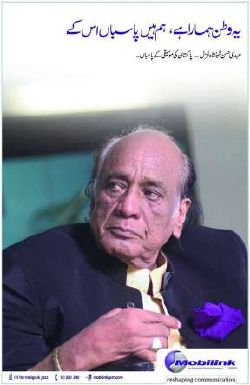
First, this advert from Mobilink pays tribute to one of our greatest artists. That is something we do not do often enough; and do not do very well when we do it.
Moreover, the Urdu verse at the top — yeh watan hamara hai, hum hain pasbaan iss kay — comes from what I think is one of the most moving Pakistani national songs ever (commentary and link to the song here; more ATP posts on this here and here).
Most of song is in the ‘words’ of Mr. Jinnah so that ‘humara‘ (ours) in that line is ‘tumhara‘ (yours) in the song. But the intent is quite clear: we have to make of this country what we make of it. Even as a kid, this song always mesmerized me both for how Mehdi Hassan sang it and even more so for the words…. hum tou mehz unwaaN thay, asl daastaN tum ho!
Unlike so many other milli naghmay which were really naara baazi set to music, this one had a clear and powerful message. It seemed to me that Jinnah was saying to all of us: ‘guys, my time is up, I have done what I could, now its your turn; do the best you can and make the best of what you have.’ Of course, neither he nor the song was saying exactly that. But that is what I took from the song.
It was always a poignant song, but also an uncomfortable song. Because one always knew that we had not really lived up to the responsibility placed on us.




hi
there isa famous milli song played a lot on national occasions .its called …….hum zinda qaum hai.painda qaum hai….hum sub ki hai shan .hamara pakistan pakistan pakistan…
the sad thing is that we evry year have to remind ourselves that we are a zinda qaum !!!
that means were half dead if not full. our national character is amply displayed by this song, the passion of those who think we are a zinda qaum and the inherent irony in the same song that in fact we are dead, morally, politically and economically.
Excellent choice Saima…
And this Part 1 of the same article… called “Jinnah in a League of his own”
http://www.bitsonline.net/eqbal/articles_by_eqbal_ view.asp?id=5&cid=5
The daily Dawn published an article in June 1995 written by late Iqbal Ahmed, a prolific writer, journalist and an intellectual, unintimidated by power or authority, under the heading “The Betrayed Promise.” The article is an analysis of so called Islamisation of Pakistan and how it had shattered Jinnah’s dream of modern and progressive Pakistan. He writes, “In less than three decades we had four ‘minorities’, each a little less Pakistani than the so-called Muslim majority. During this year alone Christian citizens had to take asylums abroad because even after a court had acquitted them of blasphemy charges, their safety was not assured; an Ahmadi was beaten to death inside a government building, and scores languish in prisons without trial. If he were to appear in my dream how shall I convey our shame to the lean old man whose life and work we celebrate every year with much fanfare and enthusiasm.” One can read the whole article in the link given below:
http://www.bitsonline.net/eqbal/articles_by_eqbal_ view.asp?id=6&cid=2
Dear Adnan Siddiqui,
Please note that your views are wholely irrelevant to the discussion here.
1. We’ve established what kind of state Jinnah wanted. If you think that the concepts given by Jinnah as quoted hereinabove, equal an Islamic state, good for you… but the vision stays the same.. and many like myself consider it secular. If Islam favors these principles, then Islam favors secularism.
2. I don’t care what George Jacob Holyoake said… he wasn’t born till the 19th century… whereas the concept of a separation of church and state has been around much longer than that… with Rhode Island formally putting this into writing as early as 1650s.
3. The issue is not about whether Islamic principles can be a source of secular law… all secular democracies of the west are essentially based on Judaeo-Christian sense of morality… the issue here is whether a Non-Muslim can be considered an equal citizen of the state or not… Jinnah thought a non-Muslim or non-believer could be as good a Pakistani as a Muslim…
4. Jinnah was against raising doctrinal issues because they divided Muslims around sectarian lines.
dear YLH!
Lets just quit wasting time about the term “secularism”.Atleast you and me both agree with that secularism was actually concept of seprating a religon from state business,right?I disagree with that too and I am not in favor of sepration of religion from state business.Please keep in mind that we are talkig about Islam here not christianity.I asked you before that do you equate Islam and Christianity or other religion?.You guys would have done researched that bible laws were not liked by aethists of America in late 60s and they demanded to exclude religous content from textbooks later it become a law to keep religious matter aside.Now A simple but a direct question,Do you guys believe that Islam is NOT capable to deal with non-muslims’ life and can not provide security,izzat and other necessary things required to lead life?If you say Yes then fine then no reason to extend this debate further but at the time same time it looks kinda funny that people claim that they are muslims too.I as muslim believe that Islam has 100% capability to deal with state business where non-muslims also lead life.There are several stories of Islamic history where non-muslims used to live under muslim law.I dont have any doubt that Islam cant protect minorities.Yes if i was a christian then i also favored keep religious matter seprately because I have read verses of different bible versions[old and new testmants] and sevral verses of Matthew,Deut,Numbers,Jhon and what not dont appear in favor of minorities,even for their own people[i quoted verses somwehrre on this site]
I have not met any muslim yet who is 5 times regular,read quran,follow islam and claim he is wiling to keep islam aside from state business.if one claims like that either he never read Quran and other sources or a liar.”Muslim” is not a award that it is given to someone,its all about practising a religion.There is no partial thing in Islam that one pick something which is good for him and leaves other.There is a very famous verse of Quran(2:85) which says that one has to completely enter into Islam or just ignore it.I fully believe tht Islam is unlike Christianity[which many non-muslims believed as well] and we dont need to throw iSlam aside and forumulate our own state laws.If one does feel that Islam is like christianity and cant handle state business then say without hesitation rather hiding under cover of secularism or anything else.Usually such people prefer to choose things from Islam, like I have met people who dont give Zakat,dont believe in salat,dont believe in shariah by saying that it was only for desert land 1400 yeas back and in last they say “I am a muslim”.
The core problem is that we dont consider ourselves educated unles we adapt some western stuff in our life and those who dont adapt are labelled as “Mullahs”.No offense but for me such people are very confused souls.At one side they want to keep their bonding with Islam so that they are not cursed by society and on other hand they believe in following west which would make them super.In urdu there are idioms like Adha teetar Adha bater etc etc.Intresting thing is that GOOD things of west are never adapted like their honesty,integrity,patriotism,discplined etc etc.we choose residue of their culture and life style.
In conclusion,If I am living in a state governed by non-Muslim religious law and is providing me all facilities and rights then I am more happy to live under such laws rather I prefer sepration of state and religion.I am sorry from all of you for yet another long post.Hope it wouldn’t happen again.Thanks again!
p.s:YLH,Read “principals of secularism” to understand what is secularism and 1867 was not mentioned his DOB it was the year he gave a public address abot secularism laws.
Again let me quote my own post… lets put aside for a second this distinction that you wish to draw between secularism and Islam… and just concentrate on the nitty gritties of Jinnah’s vision of Pakistan…
Do you disagree with any of the following:
[quote comment=”2801″]
Jinnah’s conception of Pakistan - as far as I have understood it- was as follows:
1. A state based on universal adult franchise where every citizen of the state would be equal citizen regardless of religion caste or creed (21st May 1947, 14th July 1947, 11th August 1947, March 1948 address to the people of the US via radio, March 1948 address to the people of Australia via radio and there are several others)
2. A state where a person’s religion does not matter and is not the business of the state. A state where faith is the personal business of a citizen (11th August 1947, 14th July 1947… several other pronouncements to the constituent assembly)
3. A state where there is no distinction in the eyes of law between Muslim and Non-Muslim…(17th December 1947)
4. A state where a Non-muslim/non-believer could become the constitutional head of the state… Jinnah reportedly struck off the words “in the name of god” from his oath of office not because he did not believe in god but because he wanted to lay down the principle that even a non-believer could become the head of the state in Pakistan.
5. A Pakistan “that would not be a theocracy to be run by priests with a divine mission”. Jinnah as a lawyer presumably was using these words in proper legal sense. A theocracy is a state which places scripture and doctrine over the will of the people… Contrary to this, Jinnah believed that the sovereignty rested with the people (as opposed to what our lawmakers said later)… thus by Jinnah’s standards.. Pakistan would qualify as exactly what he was opposed to.
[/quote]
If you agree with these issues… in my view, it is immaterial what you call such a state… a rose is rose by any name.
But for the record.. such a state legally and constitutionally falls in the purview of a secular state according to theory. If this is also an Islamic state, then your argument is that a secular state is an Islamic state.
Also… the historical development of secularism started in Cardinal Richellieu of France who was a Christian Priest as well as the Prime Minister… Anyone who deserves to be called the father of secularism is John Locke…
George Jacob Holyoake (born in 1817) is not the father of secularism by any definition, given that he hardly gave a theory that spoke of state organisation and given that completely secular states like the Rhode Island Colony had in been existence since the 1650s… the first amendment to the constitution of Unted States of America establishing the principle of separation of church and state came as early as 1789 … so to quote one definition as overriding definition is wrong.
Dear YLH
Thanks for your prompt response.You said:
[quote post=”26″]here is your view that secularism is essentially incompatible with Islam… when in my view it is not nor does it equal atheism. Bu[/quote]
That is certainly not my view.I rather prefer to burry my head in orignal source for referrence rather just beliving some XYZ’s defnition of anything.I quoted definition of SECULARISM given by founder or you say Baba-e-Secular George Jacob Holyoake in 1847 and did
spendwaste little time to learn more about reasons of secularism.You search google you will find about or else I can also give you link upon request.When the founders are clearly saying that secularism was introduced to protect aethists right then why one should believe in any other theory?Its like I ignore newton’s equations and theories and believe in some xyz.Sepration of Church and State,this is copied a lot by our educated desis to support secular govt but what do you understand about this?I am not sure but do you equate a Christian teaching equal to Islamic teaching?If yes then ok fine i would understand your source of information.If not then I really want to know that how secpration of church and state equal to sepration of masjid/madrasah and state.
Regarding Jinnah sahab,his speech you pointed in no 2 statment.I really dont find it a secularist statement anyway because even Quran also says similar things like There is no compulsion in religion and Lakum Denokum Waliyadin.Isn’t Islamic teaching capable to absord non-Muslims?
I think Jinnah was infinite time clear about secularism and Islam than current Pakistanis who always find difficulty to find freedom within relgiion.
Dear Adnan Siddiqui,
The problem here is your view that secularism is essentially incompatible with Islam… when in my view it is not nor does it equal atheism. But here lets discuss Jinnah’s idea of statehood …
When Jinnah spoke of Islamic Principles(and these references are few and far between) he spoke of equality fraternity and Justice… which are universal and secular principles… that they are Islamic principles (if they are and you believe they are) then Islam buttresses true principles of secularism.
Instead of quoting selectively and arguing about the words “secular” and “Islamic” … let us instead define what kind of state Jinnah wanted, without getting into the debate of whether this state is Islamic or secular …
Jinnah’s conception of Pakistan - as far as I have understood it- was as follows:
1. A state based on universal adult franchise where every citizen of the state would be equal citizen regardless of religion caste or creed (21st May 1947, 14th July 1947, 11th August 1947, March 1948 address to the people of the US via radio, March 1948 address to the people of Australia via radio and there are several others)
2. A state where a person’s religion does not matter and is not the business of the state. A state where faith is the personal business of a citizen (11th August 1947, 14th July 1947… several other pronouncements to the constituent assembly)
3. A state where there is no distinction in the eyes of law between Muslim and Non-Muslim…(17th December 1947)
4. A state where a Non-muslim/non-believer could become the constitutional head of the state… Jinnah reportedly struck off the words “in the name of god” from his oath of office not because he did not believe in god but because he wanted to lay down the principle that even a non-believer could become the head of the state in Pakistan.
5. A Pakistan “that would not be a theocracy to be run by priests with a divine mission”. Jinnah as a lawyer presumably was using these words in proper legal sense. A theocracy is a state which places scripture and doctrine over the will of the people… Contrary to this, Jinnah believed that the sovereignty rested with the people (as opposed to what our lawmakers said later)… thus by Jinnah’s standards.. Pakistan would qualify as exactly what he was opposed to.
Now consider…
Jinnah told several of his colleagues when asked… “Sharia?Whose Sharia”… the fact of the matter is that Jinnah was well aware that every time a doctrinal controversey is brought forth… it ends up dividing Muslims themselves.. recall his break with Gandhi was over the issue of religionization of the non-cooperation movement. Jinnah as the leader of the Muslims knew well that amongst his followers there are Shias and Sunnis and amongst them there are Ismailis, Ithna Asharis, Barelvis, Deobandis and above all, his staunchest supporters were Ahmadis…
Hence every time the issue of Sharia came up Jinnah vetoed it. He threw out Raja of Mahmudabad for raising doctrinal controversies which he felt would divide the Muslims. He vetoed Dr Kazi’s resolution in 1943 which wanted to commit Pakistan to Quran and Sunnah… He told his close colleagues, that Pakistan would be a modern state based on modern principles and reprimanded them for speaking in retrogressive terms… Now the statements you quote should be seen in their proper context. To Jinnah a modern egalitarian democratic state which is impartial to its citizens’ faith embodied essential Islamic principles.
Also consider…
Jinnah made it a point to appoint Jogindranath Mandal, a Hindu, first as the representative of Muslims on the interim government, then it was Mandal who opened the first legislative session of the new state of Pakistan- a unique honor, and finally Jinnah chose Jogindranath Mandal to become Pakistan’s first Law Minister..
And if the point wasn’t driven home, Jinnah got another Hindu to write Pakistan’s first national anthem which was played during Jinnah’s tenure…
The very fact that it was he who was asked to write the first national anthem of Pakistan within less than a week before its formal birth indicates the potentiality of its happening. It is interesting to recall that writing the national anthem of Pakistan was made at the behst of its founder Qaid-e-Azam Mohammad Ali Jinnah. The request was in conformity with his famous speech of 11th August 1947 in which he had said, “Hindus would cease to be Hindus and Muslims would cease to be Muslims, not in the religious sense, because that is the personal faith of each individual, but in the political sense as citizens of the State.” His request to a secular Hindu poet filled into his vision of Pakistan. Alas he did not live long to put that vision into practice.
http://www.milligazette.com/Archives/2004/16-31Aug 04-Print-Edition/163108200462.htm
There are several other nuggets which prove beyond a matter of any doubt as to what kind of state Jinnah wanted.