Adil Najam
Radio program Aap Ki Duniya on Voice of America’s (VOA’s) - now of the Wasi Zafar outburst fame - hosted an hour-long Round Table on blogging in Pakistan.
Hosted by Murtaza Solangi, the program featured a conversation on the state and future of blogging in Pakistan with four bloggers: Awab (of TeethMaestro and Karachi Metroblog) Ramla (of Next>), Hakim (of MicroPakistan) and myself (Pakistaniat). You can listen to it here:
Although framed in the context of the role of the Pakistan’s blogistan (’blogsphere’ for non-Pakistanis), the lively conversation was, in fact, broader and looked also at why people blog, whether it makes a difference, and what the future potential of blogging might be. It also looked at the issue of blog bans in Pakistan, and the follies of such policies. I enjoyed the conversation very much. Not only because I can now match ‘voices’ to names but also because it made me think more clearly about why we spend so much of our time on this, whether it is really worth doing, and what it might mean in a broader context.
I am not arrogant enough to assume that the world will change dramatically just because a few of us are writing blogs. On the other hand, I am convinced that at least for those few of us who write and read these things, a world with blogs is different from a world without - at the very least, it is different in how we interact with that world.
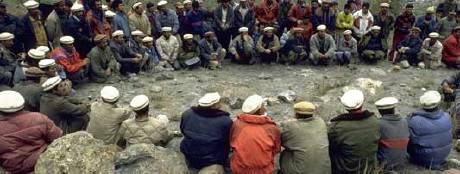
To blog, at least for me, is about conversation and about community. The magic moment comes when you realize that there are others out there who want to be part of your conversation of your community. For us at ATP, that has always been out motivation. This is why I chose the photogrpah above (I do not have a full reference for it, but it is an AKRSP photograph from the Gilgit area). The photograph too - just like blogging in general and certainly ATP - is about conversation and about community.
As I said during the show, at the very least this becomes a way of catharsis - bhaRass nikalna. But when your thoughts echo back to you and you realize that there is someone out there who is not only listening to you, but maybe even nodding their head. It is then that you realize that this is more than just bhaRass nikalna. And it can be - not yet, but one day - it can be much more.


adil — i hope you dont mind me pasting the editorial in full
http://www.thenews.com.pk/daily_detail.asp?id=4730 4
Editorial, The News, March 18, 2007
Dealing with dissent
One would have thought that going by the tumultuous events of Friday and the general response of the nation to them, on Saturday the police would have been ordered to be a little more circumspect in their dealing with those protesting the ’suspension’ of the chief justice. On Saturday, the ‘action’, so to speak, seems to have shifted to Lahore, with dozens of lawyers arrested, manhandled and lathi-charged by the trigger-happy Punjab police. And while the chief justice’s lawyers are now claiming that the tight security cordon around him has been relaxed, it should be remembered that this has happened (pending independent corroboration) only after the Supreme Judicial Council made it clear on Friday that there were no restrictions on the movement of Justice Iftikhar Mohammad Chaudhry. As for Saturday’s actions by the police, they were mostly unprovoked again, this time beginning when lawyers were prevented by the police from going inside the premises of the LHC to attend an all-Pakistan convention organised by the Lahore High Court Bar Association. The police lathi-charged the lawyers and fired tear gas shells and this rash action eventually snow-balled into a full-fledged street battle between the unarmed lawyers and the Punjab police constabulary.
The question that one would like to ask is why cannot the government let the lawyers meet if they want, why cannot it be okay with people protesting whatever it is they wish to protest against, provided it is peaceful and does not disturb public order. Surely by now, it should have realised that an all-out confrontation with either the lawyers’ community or the media is going to be a futile if not downright negative exercise in that it will only serve to further exacerbate an already tense situation and that this heightening of tension will only damage the government’s own credibility and lower its image in the eyes of Pakistanis in general as well as the outside world. As for the attack on the office of The News and Geo TV on Friday, the government has reportedly suspended 14 policemen who allegedly took part in the raid. A judicial inquiry has been promised as well one can only hope that it succeeds in unearthing the real perpetrators of this naked assault on press and media freedom. Again, it is worth reiterating that it defies common sense and logic to believe that junior-level policemen on their own would attack and ransack the offices of a national newspaper and a news channel in the heart of Islamabad, a stone’s throw from the Parliament House, the Prime Minister’s Secretariat and the Presidency.
The best way forward for the government would be to allow peaceful forms of protest. As it has already said, the matter is now before the SJC and the directives of this body should be followed. One of them relates to the coverage of the SJC’s proceedings and of the hearing of the reference. Here, as directed by the SJC print and electronic media have reported only the press release detailing Friday’s proceedings. The government, and especially the electronic media regulator PEMRA, should not seek to unnecessarily extend this directive, as has been done so far, to order newspapers and TV channels not to cover the events and incidents arising out of Justice Iftikhar’s suspension and to desist from giving him any coverage.
Such a blanket prohibition impedes the people’s right to be informed on all matters related to the chief justice’s ’suspension’ except of course those that are sub-judice, i.e. the contents of the reference against Justice Iftikhar and the proceedings of the SJC to examine it. Also, by prohibiting any coverage of the issue, a situation may well arise in which, because of absence of any information, rumours begin to gain currency and that only serves to destabilise things further. As a first step, the government should call off the police on the lawyers and permit them to exercise their democratic right to register a peaceful protest and this should be applicable for civil society in general. As has already been pointed out by some commentators, those at the helm of affairs should realise that the rise of the information age, characterised particularly by the coming of age of the country’s electronic media (and to some extent of the Internet, especially blogs and so on), has changed everything. Clamping down on the flow of information and on dissent is next to impossible and only counter-productive. Ban a TV channel and one will find the information on the Internet or on a blog, blackout a newspaper and get the story on a web forum. The dictum that the Internet is perhaps the biggest encourager of a democratic mindset (and certainly a facilitator of a level-playing field in terms of who controls and provides information) has never been as true as now in Pakistan’s case. Now only if the country’s polity was as democratic, with its head of state and head of government, both accountable solely to the people.
I second Maleeha.
BTW I strongly believe in blogs and their POTENTIAL to bring about change. the keyword is POTENTIAL - what blogs “can do” - should they choose to do it. E.G. Awab chose to voice his political views.
Also my blog NEXT> helped me choose a career I always wanted: open a consultancy about socially responsible, future-positive business.
I started my blog as a random expression of business ideas I felt no one in Pakistan would publish. Couple of months ago, I turned it into a business which is something I hadn’t planned.
I give this example to share a case study of how it’s REALLY HAPPENING - in Pakistan. Hopefully will inspire others.
Just like books, one blog on its own does not tilt the world off axis. Yet just as the printing press made a difference over time, so can, do, and will blogs.
Point is, we have a choice to take this medium seriously NOW, even though some of us may not be seeing the potential. Or we sit and let the opportunity go.
here’s something i quoted in this week’s column of mine from a blog — it’s at the end
http://jang.com.pk/thenews/mar2007-weekly/nos-18-0 3-2007/dia.htm#6
RIPPLE EFFECT
Madness unending
By Omar R. Quraishi
The sordid happenings of the past week in Islamabad with the suspension of the Chief Justice of Pakistan, Iftikhar Mohammad Chaudhry, and then putting him under virtual house arrest and not allowing people to visit him or access to the television, newspapers or telephones is probably one of the biggest blunders that the government (among quite a few others) has made since President Pervez Musharraf came to power in a bloodless coup in 1999. The fact of the matter is that the president does not have the right, under Article 209, to suspend a judge of the Supreme Court or the High Courts against whom a reference has been sent to the Supreme Judicial Council.
This was further compounded by the treatment meted out to Justice Chaudhry and his family over the next few days — from March 9 when he was ’suspended’ till the time he tried to walk out of his house and was disgracefully surrounded by police and law-enforcement personnel who literally refused to let him walk freely (so much for the government’s claims that he was a free man and that there was no prohibition on him of any kind) which he apparently wanted to, as he headed for the Supreme Court building.
This was of course preceded a day earlier by the attack of the police on a procession of lawyers on The Mall in Lahore. Reports have also emerged of a single lawyer who has filed a petition with the Lahore High Court asking that restrictions be placed by PEMRA on Geo TV and AAJ TV for showing footage of the police action on the lawyers (as if a confrontation with the lawyers was not enough, the government now wants to open another front with the media).
Here, perhaps, it is best to quote from any eyewitness to the attack by the police on the lawyers (this is from the www.proud-pakistani.com blog):
“The police attacked the peaceful procession, which was to go from the Lahore High Court to Faisal Chowk and back. In between, the lawyers were peacefully walking on one side of The Mall, while traffic was moving smoothly on the other side. The people in the cars driving by were honking their horns and showing the victory sign in support. When the procession reached Regal Chowk, the police, without warning and without provocation, lathi-charged the lawyers.
“About 200 or so lawyers were injured. After being attacked and seeing their fellow lawyers being brutally beaten, some lawyers retaliated, which they shouldn’t have. But the police is making it sound as if the lawyers attacked first. This is completely wrong. I myself received numerous injuries, including head and hand injuries. I was hit repeatedly (from behind) by police batons when I was simply walking back to the Lahore High Court… Even women and aged lawyers were not spared by the police. I counted at least two dozen lawyers whose shirts were drenched in blood. The police were using bamboo batons to strike at the lawyers’ heads. The electronic media was there and it was all captured on camera. This is what is happening in Pakistan. It has turned into a complete police state. The police used excessive and unwarranted force to disperse what was a peaceful procession. Even though I was personally at the receiving end of the batons of two policemen, I don’t hold any personal grudge against them because these poor guys are half-literate, poorly-paid recruits following orders. But I blame the Punjab government and the Punjab Police. Peaceful protest is a right [of every citizen] in a democratic country. I, too, was once pro-Musharraf. I confess that I welcomed the 1999 military take-over because of my disillusionment with Nawaz Sharif and Benazir Bhutto. But over the years, after seeing what has been happening to this country, I’ve been constrained to change my opinion of him and I have come to the conclusion that true democracy, no matter how bad, is still better than military rule because in democracy, even a bad prime minister can only transgress to a certain extent. When there is a military ruler, there are no limits to the transgression because there is no one to hold him accountable (except God).”
The writer is Op-ed Pages Editor of The News.
Email: omarq@cyber.net.pk
Oh Adil you totally rock for providing the handy link to the MP3 file.
BTW I was coughing and laughing throughout the interview Adnan - not been feeling well and the news of attack on Geo TV on the 16th (when the interview was recorded), where I have friends, got to me finally. Had to stuff my mouth with cloth half the time.
Adil - Awab - Hakim - audience: I was a bit unprepared - I thought this was about CJ news not as much about blogs. Blogs is such a huge topic, so many angles. Hence the ramble at times.
Do wish that we - bloggers and readers - can take such discussions about blogging and new media forward.
To me, blogs are a really important source for news - both Pakistani and global topical blogs.
Very good discussion…blog ban was painful when blogspot was blocked last year…so it was good to hear adil and awab on this issue…i wish there was a local forum where bloggers could meet say once a quarter
About how blogs are different from other media, I saw Adil a few weeks ago on GEO for the first time (may be after more than a decade after he left ptv)and I very happily told my wife “I know this guy!” I could say this for many others on this blog despite not having met them personally. I could not say the same for Ayaz Amir or Cawasjee even though I have read them for ages.
On a seperate note I have not visited dawn in a week like I used to and this is almost like missing my first cup of caffeine in the morning.
A few lion hearts from jang group have washed many of the stains they had carried from the 80s and 90s.
on a lighter note, I don’t know why Ramla laughed when Adil mentioned Omar Qureshi indirectly during conversation to discuss about the importance of blog in journalism.
anyways congrats to everyone who participated.
It was wonderful experience and I hope it will inspire others to blog.
I agree with Atif that we can also blog on Radio or TV, as we are doing on internet. It is wonderful idea and hope one day it will be as real as today’s internet blogs are.
I have started blogging in Urdu and think that blogging is a sincere effort to address current issues and offer corrective actions for betterment of our society.
Now Urdu blogging is on rise too and people have started to recognize blogging at all levels.