(UPDATE: You can view this movie here).
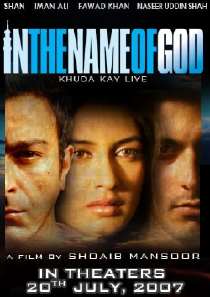
We had a preview of the movie Khuda Ke Liye at ATP where we had posed a question whether Shoaib Mansoor will be able to revive Pakistan cinema? A probable answer comes from myself who recently got chance to see this movie. The record breaking Pakistani film Khuda Ke Liye has become my favorite film overnight- Hollywood inclusive. Or more accurately I should say, that there hasn’t been a film in the past that has moved and affected me in this way.
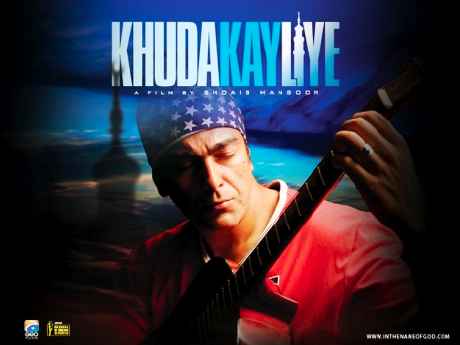
Given the standing ovation the film is getting in theatres all over Pakistan from rich and poor alike, one can safely say that I am not the only one. For one thing it is a uniquely Pakistani story, which could have only come out of Pakistan. To sum it up, it is about us – the people of Pakistan warts and all- take it or leave it.
The genius of Shoaib Mansoor was never in doubt for those who have seen his videos or for that matter the famous Alpha Bravo Charlie – the TV Drama on Pakistan Army. What I was unprepared for was the depth in his thought and the way he has managed to capture the Pakistani dilemma on screen. Ours is a complex and rich predicament which needs to be captured in all its nuances and appreciated in all its paradoxical colors. KKL did just that.
 I went to the theatre expecting to see the same old liberal v. fundo arguments. There were those, but unlike how these arguments play out in “The Friday Times” and the “Nawai Waqt“, this remarkable film is fully conscious of its Pakistani identity and the strong Islamic component that forms part thereof.
At the risk of spoiling it for those who haven’t seen it, this is the story of two brothers, Mansoor (played by Shaan) and Sarmad (played by theatre actor/musician Fawad of EP fame) both musicians, brought in a well to do Pakistani family. Mansoor and Sarmad are torn apart by the latter’s increased involvement with a certain Maulana Taheri (based most probably on Maulana Sami ul Haq of JUI-S component of the MMA), who turns the soft spoken Sarmad into full fledge Jehadi.
Things are complicated when the brothers’ cousin Mary arrives from London to spend a few days with them, only to discover that she has been tricked by her father into coming to Pakistan to avoid her marrying her Non-Muslim boyfriend Dave. Meanwhile Mansoor leaves for Chicago to enrol at the “School of Music” there. In an epic that switches from London to Lahore to Waziristan to Nangahar Afghanistan to Chicago, these ordinary Pakistanis are increasingly faced with both internal and external conflict. And then there is September 11.
Shoaib Mansoor does not miss a beat, he does not leave any stones unturned. While all characters have more or less the same significance in this plot, it is Mansoor who is at the centre of it: Mansoor who is a proud Pakistani and secure in his Muslim identity, Mansoor who warns Sarmad against extremism, Mansoor who puts the best Muslim and Pakistani foot forward, Mansoor who is abducted by FBI in the middle of the night and beaten and tortured to a pulp, humiliated and abused for being a Pakistani and a Muslim. He is the contrast to Sher Shah and Maulana Taheri. But there are contrasts on the other side as well… Jenny who loves Mansoor for being Mansoor, his classmates who spontaneously join in when Mansoor performs his “music from Pakistan”, his African American professor… all stand in contrast to the American torturers of Mansoor.
The dialogue reaches a fever pitch in a court room in Lahore, where Mary is engaged in a prolonged legal battle. Enter the Bollywood star Naseeruddin Shah. He plays the character of a long bearded progressive Islamic scholar (probably based on Maulana Ahmed Javed and Allama Javed Ahmed Ghamidi of Lahore). In what would be the localised version of “Inherit the wind” Courtroom drama, he engages Maulana Taheri and his coterie in an argument on Islamic law and Islamic dress code.
“There is beard in religion, but no religion in beard,”
declares Shah, adding that
“Two men who did the greatest service to Islam in Pakistan, Mahomed Ali Jinnah and Allama Iqbal, did so without a beard and out of the so called Islamic dresscode, in western dress.”
It was on this line that the entire hall filled with applause. Islam – the universal faith – has no uniform. This lays the stage for the final scene- the most poignant scene of the movie, filmed in Lahore’s beautiful Wazir Khan Mosque– the scene which once again made a Muslim out of me. I’ll let you watch it yourself to understand what I am talking about.
As for the film itself, there seem to be a few technical glitches earlier on but they are easily forgotten. Iman Ali‘s performance as Mary or Maryam in the beginning is annoying and one finds her concocted British accent a little annoying at first. However it grows on you and one discovers the fullness of her effort- which is by far the best I have come across by a Pakistani actress. As for the music, those of you who have only heard Bandaya, you are in for a surprise. The film is as a whole an incredible musical experience. What is more is that you discover how aptly Shoaib Mansoor has placed his music in the various scenes. Indeed, driving back from Lahore on the motorway, I could recount/recollect every scene just by listening to the soundtrack.
This is a movie no Pakistani can afford to miss.




Akif,
“being a fundamentalist is not a crime”
Of course not. But abduction and rape definitely is. I am not calling for a witch hunt but for the law to take its course. Don’t you think it conveys a dangerous message when a maulana who confesses to have forcibly married off a girl and goaded somebody to rape her is being let go off? I can understand your sympathies for the young man – though he should have been punished too according to the law of the land. I think this was a cop out by the director who didn’t want his neck on the line anymore than it may already be. Still a movie is worth watching.
It speaks what 95% of the Pakistanis want to say
I wonder how did you access 95% of Pakistanis. Can you provide your stats details?
Don’t ya think that our lame politicians are enough to give such lame “political” statements?
From the date of release, KKL has attracted 0.4 millions people from entire Pakistan not “Karachi”.(source GEO). The way they poured money for
propagandaadvertisement, the figure is not much. I think Syed Noor’s “Choorian” had attracted more during same period.I read almost all the comments on this article. It is the same article which is also present on Naseeb & Chowk by the same author.
Upfront, this movie is giving us a chance to visit Cinema Hose with family, because there is no such nude scene is observed in this presentation. But the fact is that the “Message” behind this film is extremely dangerous.
Those who are aware RAND Corporation & its reports on Islam must be well aware with their plans. KKL is also an output of that report.
I don?t want to go in detail here. If u can see movie then u should read the ?Reality of KKL? from following link & then provide comments after whole reading.
But read, in the name of God
http://kashifhafeez.com/mazameen.php
Khuda Key Liye is a monumental achievement. It speaks what 95% of the Pakistanis want to say. It has finally given a voice to the moderate Pakistanis, who know their boundaries.
I had not seen Shoaib Mansoor’s eariler works (only heard good things about him, however) and now I am an avid fan. He brilliantly balanced each side of the equation.
As said in the review “Its one Pakistani film that every Pakistani should see”
A “true Pakistani film” in every sense of the word.
P.S. Technically it is an achievement as well. Amazing cinematography and very restrained performances to get the message across. Shan was superb.
Go international by making it ‘For Gods Sake’