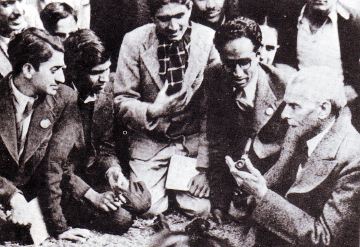
 Since we have been talking here about Jinnah’s vision for Pakistan, maybe we should also think about Jinnah’s vision on Pakistan’s governance. Particularly on the issue of ‘uniforms’ in politics, which is the concern of the day in Pakistan. Quaid-e-Azam Mohammad Ali Jinnah was thinking well ahead of his time. His following address has never been so pertinent as it is now.
On June 14, 1948, addressing the officer at the Military Staff College in Quetta, the Quaid-i Azam said:
During my talks with one or two very high-ranking officers I discovered that they did not know the implications of the oath taken by the troops of Pakistan. Of course, an oath is only a matter of form; what is more important is true spirit and heart. But it is an important form and I would like to take the opportunity of refreshing your memory by reading the prescribed oath to you:
“I solemnly affirm, in the presence of Almighty God, that I owe allegiance to the Constitution and the Dominion of Pakistan and that I will be duty bound honestly and faithfully serve.”
As I have said just now, the spirit is what really matters. I should like you to study the Constitution which is in force in Pakistan at present and understand its true constitutional and legal implications.
(Jinnah, Speeches and Statement 1947-1948, Oxford University Press, 2000).
Lets’ also take a few minutes to review the oath taken by members of the armed services and also the presidential oath, in terms of the constitution:
Oath of allegiance for armed services:
“I, do hereby solemnly swear that I will bear true faith and allegiance to Pakistan and uphold the Constitution of the Islamic Republic of Pakistan which embodies the will of the people, that I will not engage myself in any political activities whatsoever and that I will honestly and faithfully serve Pakistan in the Pakistan army by and under the law.”
Let me reiterate, the oath states, “not engage myself in any political activities whatsoever”.
Presidential oath:
“That I will not allow my personal interest to influence my official conduct or my official decisions. That I will preserve, protect and defend the Constitution of the Islamic Republic of Pakistan.”
Jinnah’s vision on the matter of governance of Pakistan and the supremacy of the Constitution and rule of law is very clear. Much more so than that of the rulers of today.




There are three versions of the Constitution of Pakistan, the government’s version, the opposition’s version and the real version. You will never ever find two rival politicians agreeing on one point which is black and white in the constitution, each will give his own justification and back his argument using the constitution using his own preception and of course change it to legitimize their own actions. If our leaders had stood for it and abided by it from the beginning instead of molesting it everytime they feel like doing so, we would not be having this discussion at this time and Pakistan would not be in such an anguish as it is right now.
BD,
I am unable to find the oath on the ISPR website. You may want to send them an email from:
http://www.ispr.gov.pk/WriteISPR.aspx
You can send them the oath and ask them if the following phrase is really included in the oath, it may be just indian or yahoodi propaganda:)
“that I will not engage myself in any political activities whatsoever”
According to Article 6 of the Constitution of Islamic Republic of Pakistan:
“Any person or persons who commit the act of mutiny against the parliament, judiciary and/or the elected members and officials of parliament is/are guilty of committing the highest treason. This person or persons committing such an act must be charged and prosecuted in the court of law and sentenced to death if found guilty”
Article 243.1 of the constitution of Pakistan states that ‘The Federal Government shall have control and command of the Armed Forces’ and when a person is commissioned as a member of the Armed Forces, takes the following oath:
“I ——, do solemnly swear that I will bear true faith and allegiance to Pakistan and uphold the Constitution of the Islamic Republic of Pakistan which embodies the will of the people, that I will not engage myself in any political activities whatsoever and that I will honestly and faithfully serve Pakistan Army (or Navy or Air Force) as required by and under the law.”
Thanks Raza Rumi, looks like there are few who still use head instead of stomach.
And Musharaf key ‘HAWIS’ – i love that when self appointed Gods judges others. Musharaf is no longer a professional who raise to top of his profession – leading 500 K + people, at least was able to produce his tax documentation (one year before that Mr Nawaz Shrif was paying less than myself – a person on job with 18 months of experience) . No this person cannot make an error, he has blinded by his HAWIS, and Mr God is here to tell us that. And to prove that we can now rely on Jewish influenced American media – oh my God – Mr you are supporting Jews now by opposing Musharaf. If Americans want Mush out that means Yahoodi Sazish and hence you are part of this – you are not a muslim…and perhaps paid by Isreal to publically bash Mush.
Kruman: thanks for this post. Indeed, the Quaid had a different vision for Pakistan than his followers ..
However, I see that the comments are in sync with the anti-authoritarian mood of Pakistan these days. However, we should remember that the failure to uphold the Constitution and civilian rule is in effect collective failure. Ayub Khan was inducted in the Cabinet by a civilian government and often politicians have invited the army to take over.
Even General Musharraf was greeted by most political forces! And, today’s anti-Musharraf and anti-army sloganeers were supporting him for several years, his referendum not to mention the 17th amendment that legalised the uniformed presidency once again..
I am not defending military rule (God forbid!) but just want to put things in perspective _
Let us hope that the current struggle to keep army out of power succeeds and establishes civilian supremacy.
Oh..I am glad that this forum is finally going to stop supporting Musharraf blindly….These quotes have been there for years..where were you Mr. Adil najam, Owais Mughal, Bilal Zubairi..is your love for musharraf getting over already!!! Let me see if you sensor this messge or you respond to it ‘politely’!!!