Owais Mughal
Last month there have been several news items about the Lahore Rapid Mass Transit (LRMT) Rail project. We have tried to gather key information from many of these news items and will present it in the following as one concise post on the topic.
The proposed rail service is the main part of the Lahore Mass Transit System (LRMTS). Other components of this project include the now under construction Lahore Ring Road Project.
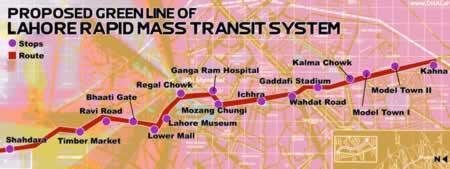
The Photo above shows the Route Map of LRMT Phase I – Green Line
The LRMT is a Two-phase, 97 kilometes long project. A Hong Kong based company called MVA Asia Consultancy was hired the government of Punjab as consultants to prepare the project feasibility. The study of MVA Asia Consultancy completed 5% of project design and proposed four Rail lines in the city to share the traffic burden. The proposed capacity of LRMT is going to be able to move 35000 passengers per hour in the city. Funding for the project will be provided by the Asian Development Bank (ADB).
PHASE I:
In Phase-I two tracks will be constructed. One will be a North-South route called the Green Line and other will be a East-West route called the Orange Line.
Green Line:
Green Line is going to cost US $2.4 billion to construct.
The Green Line would extend from Shahdara to Hamza Town via Ravi Road, Lower Mall, Mall Road, Fatima Jinnah Road, Qartaba Chowk and Ferozepur Road areas.
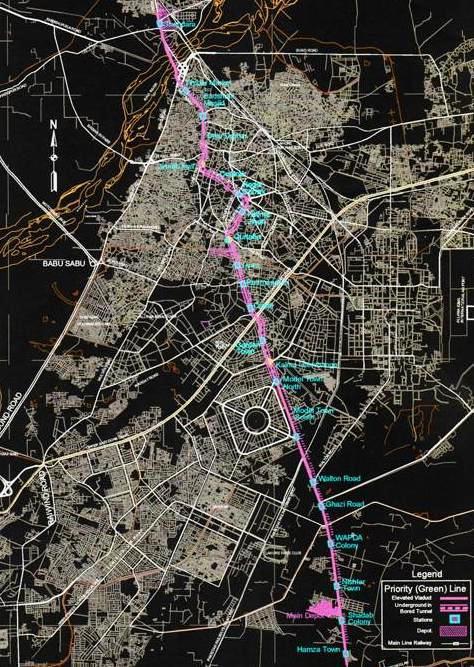
The Photo above shows the Route Map of LRMT Phase I – Green Line
The length of Green Line is going to be 27 km. 11.6 km long Green Line route would be underground, while 15.4 km long would be overhead.
There will be 12 underground and 10 overhead stations built on the Green Line route.

The completion dates of ‘Green Line’ is in 2011. Initially the project was supposed to finish in 2012 but due to Cricket World Cup od 2012 wher Lahore will be hosting few matches, the Green Line completion date has been pulled in to 2011. Initial estimates are that 227,000 people annually would benefit from the Green line.
In March 2007, Punjab Government invited Dr E. Sreedharan who is the managing director of successfully operating Delhi Metro Rail. After studying the project details Dr Sreedharan has declared Green Line Project as a viable one. He has inspected the first priority line’s route from Shahdara to Hamza Town. In his view, the implementation of the Green Line project (Phase I) would face no major technical difficulty because the soil condition en route was good and roads were wide, having room for underground construction without creating any serious inconvenience to the city.
Orange Line:
Orange Line is going to cost US $1.9 billion.
 Its route would extend from Pakistan Mint to Sabzazar via Shahnur, Awan Town, Hinjarwal, Niaz Beg, Canal View, Wahdat Road, Ali Town, Salahuddin Road, Bund Road, Islam Park, Dera Gujjran Depot, Mahmood Booti, Salamatpura, Samanabad, Gulshan Ravi, Chauburji, Lake Road, Lakshami Chowk, Railway Station, Sultanpura, UET, Baghbanpura and Shalimar Garden areas.
The length of Orange Line would also be 27-km out of which, 6.9 km long tracks would be underground, while 20.2 km-long would be overhead upon which six underground and 20 overhead stations would be established.
The central interchange station of Green and Orange lines would also be established besides linking these lines at Ring Road, railway station, airport, and Sports City.
The completion dates of ‘Orange Line’ is in 2015. Initial estimates are that 245,000 people annually would benefit from the Orange Train.
PHASE II:
The completion year for phase II is 2020.
In Phase-II, two more tracks will be laid out. These routes will be called Blue Line and Purple Line.
Blue Line:
 The route length of blue line is going to be 24 km. The ‘Blue Line’ will start from Chauburji and end at College Road, sources said, adding that from Chauburji the line would pass through Mozang Chungi, Shadman Chowk, Jail Road, Mian Boulevard Gulberg, Mian Boulevard Garden Town, Faisal Town and end at College Road.
Purple Line:
The route length of Purple line is going to be 19 km. Purple line would start from Bhaati Chowk and end at Allama Iqbal International Airport. The line would pass through Bhaati Chowk, Brandreth Road, Railway Station, Allama Iqbal Road, Dharampura, Ghazi Road and end at Allama Iqbal International Airport
The Train Capacity:
One unit of air-conditioned train will have the seating capacity of 500 passengers.
Stations:
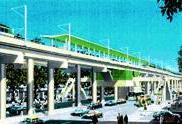 Train stations on the elevated route would be designed like overhead bridges while train stations on the underground route would have two entranceways and two exits.
Environmental Concerns?
Just like with every Mega project, voices of dissent have started appearing for the project where people have shown concern for environment and noise levels of elevated trains. Dawn‘s editorial on Jult 12, 2007 covers these voices very concisely and I’ll quite the editorial here:
The first two lines will cost $3.3 billion. In real terms, the cost of the project is yet to be worked out. Surely, notes of dissent are expected to start pouring in. The economists are going to question the heavy debt the project will incur for the government and the citizens, while the opposition politicians are most definitely going to give their own colour to these lines and the sabza group may soon be out to enumerate the effects of this development on Lahore’s environment. Some of these points may be very valid and should elicit a thoughtful response from the government. There can be no moving ahead without this exercise. The sooner this essential exercise is carried out the better it would be for everyone.
Noise: I couldn’t find the details on expected noise levels around elevated portions of the track but noise is definitely going to travel far and away if sound barriers are not constructed around the tracks. More than normal decibels of noise are already witnessed around Pakistan Railway’s elevated track which runs from Lahore Station to Badami Bagh.
Previous Light Rail Studies or Projects:
 The current project is definitely not the first attempt to build a rail based mass transit for Lahore. In 1991 during Nawaz Sharif’s termas prime minister, the feasibility of a light rail transit system was determined by Japanese development organisation (JICA). It had proposed a 13 kilometre long system. The study was reviewed and updated as part of the World Bank funded “Lahore traffic and transport studies” in 1993.
The system’s cost was estimated at about US $400 million, but with better network coverage. In 1995 Japan proposed financing the original scheme with grants and loans of about US $495 million, but the project could not be implemented due to many reasons.
Fares: Back in July 2007, it was reported in Daily Times that Passengers of the Lahore Rapid Mass Transit (LRMT) would be charged Rs 125 to Rs 140 to travel from one end to the other of the 27 kilometre-long Green Line.
“Sources associated with the project told Daily Times on Thursday that this (Rs 125-Rs 140) one-side fare had been calculated after taking into account the rendered $2.5 billion cost of the project, which is expected to be completed by 2011. Sources said that to pay back the loan likely to be incurred on the LRMT project, the government would have to charge high fares from the passengers. Currently, the public transport fare from Kahna to Shahdara is between Rs 20 to 25. By 2011, it would rise between Rs 25 and Rs 30. They said that to charge a passenger of the LRMT Rs 30 for a one-side visit, the government would have to give a subsidy of at least Rs 100 per person, which was not possible for the government.
While Rs 140 one way fare indeed looks ridiculous right now, passengers may end up paying much more than road transport. The benefiit however will be ease of travel, no traffic jams and hopefully a strict adherence to time table.
Hope: Many years ago I took a course in Engineering Economics. I still remember one sentence from my text book. It read as:
“All mega projects should be built as soon as possible after their design is done and funding is secured otherwise opposition to the project grows on POLITICAL basis.”
When we look around the mega projects of Pakistan, it appears so true. If big projecs are not started quickly they never will because somebody will always find a reason to do politics on the issue. In the end we sincerely hope the project sees the light of the day and does not end like the one in works for Karachi (called KMTP/KCR) for the past 33 years. Lets all hope for the best and we will continue to add updates on this project in the comments section below.
References
(1) Metroblogging Lahore
(2) Dawn Editorial of July 12, 2007 here.
(3) The News, February 26, 2006 here.
(4) MVA Consultancy
(5) Business Recorder Edition of June 10, 2007
(6) The Daily Times Edition of March 14, 2006
(7) ZeeNews edition of March 5, 2007
(8) Lahore Signs Light Rail MoU: September 1, 2002.
(9) Daily Times Edition of July 7, 2007





why did light train project fail, any clue?
Very informative post, very nicely put together.
The cost of the project need not be paid back by the consumers alone. I see a lot of opportunities for advertisement related revenue to be earned through this project.
Most such stations in foregin countries have hawker stalls which also pay back some of the cost of development.
The government will also save a lot of money because the transit system will reduce pressure on the roads and spending can be saved on road maintenance and update.
Aqil,
seems there is something missing in your calculation. It cant be 35000 commuters per hour. Secondly metros usually dont operate 24 hours ( at least those I have travelled on in Thailand, Singapore, Malaysia and USA).
But still 120-130 rupees a journey as of 2007 seems quite over priced. On Delhi metro you can get a whole day pass for Rs. 70 ( pakistani rupees 95 or less). In Bangkok the sky train single journey fair for minium distance is 15 -20 Bht ( 1 Bht = 1.6 rupees) whereas the maximum fare was 40 or 45 bhat ( dont remeber exactly). According to my calculation the metros in all these countries fall cheaper than a taxi ride of the same distance.
Phase I of the Delhi Metro has a peak requirement (all lights on, trains at highest frequency of 3 mins) of about 75MW, or an average of 1.125MW per km.
Sridhar and Owais:
Thanks for the responses. One more question: how many mega watts of power will the system require? Any figures for Dehli?