Adil Najam
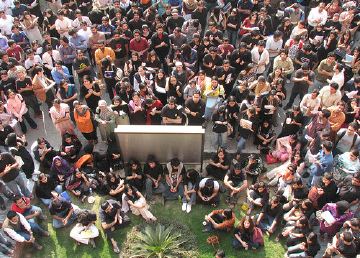 The frustration and anger that one finds in the comments on the Emergency imposed by Gen. Musharraf in Pakistan is mirrored everywhere. In every conversation one has with any Pakistani anywhere. I was in Pakistan till last weekend and this pent-up feeling of frustration was evident in every conversation even before the Emergency was imposed.
It is, of course, a complex feeling emanating from the complex dynamics of our complex politics. At its very core, however, is the burning desire to be able to “do something” about what is happening made all the intense by a sense of helplessness about exactly what it is that we as citizens might, in fact, be able to do that might make a difference.
Since Saturday every conversation I have had with Pakistanis ends in exactly this question. What can we do? I have an in-box full of emails asking me to sign a petition, attend a meeting, say this or that to the media if I speak to them, join a protest, pass on a message, do this or that on ATP, join a conference call to plan a strategy, send out notes to my contacts, and so much more. There have been call after call from friends and acquaintance many of whom not even Pakistanis who just want to talk and share the intensity of their disgust at how the events are unfolding.
Of course, at the basest level doing anything – anything at all – has a cathartic effect and makes one feel that at least we did not do nothing. But the desire to do something is more intense. The desire not to just be a spectator to history. The desire to have contributed something, somehow. As one watches the heroic struggle of the lawyers, and now the students, to stand up and speak out – despite the brutality they are met with – makes this desire even more intense.
We each do what we can. We speak out to the media (I have had more than a dozen media interviews and comments already, we give talks (I have been giving multiple talks on this a day), we send out messages of support to those on the front lines in Pakistan to let them know that they are not alone, we sign petitions, and above all we hold hands in solidarity and vent our feelings where ever we can – on blogs, on phone calls to friends, in gatherings. All of this helps some, but one keeps wondering if it really makes a difference to the big picture?
Even if it is not, it is clearly worth doing. But can more be done? What? How? We would like to hear from our readers on that. Please let us know what is already happening as well as suggest what more could happen.
 Are there to many petitions going around; so many that they might lose their efficacy? Are some of us crossing the line between that which is anti-Musharraf and that which is anti-Pakistan? Even if they mean the same thing, strategically would a message that is pro-constitution, pro-democracy, pro-Pakistani resistance be better than one that is anti-individual? How can one best support those lawyers and students and others who are on the front-line of action, especially those who are not physically there? What, if any, are the dangers of focusing our attention too much of external actors rather than those in Pakistan itself? How does one explain to the media and policy-makers abroad that the events we are seeing is not the failure of a nation (the Pakistani people) these are the failure of a person and a particular government? (I personally have been saying to friends and to the media that I remain bullish on Pakistan and bearish on Musharraf).
These and many others are the questions that boil in ones head. There must be other questions too. Share these with us, but more importantly point us towards answers. Share with our readers what you are doing. How others can help. What should be done.
Note to commentors: My own views on the subject have been pretty clear and I feel no compulsion to either defend them or amend them. While I consider thsi emergency an anti-Pakistan and anti-Pakistani act, I do not doubt the patriotism or integrity of those who disagree. Pakistaniat is based on the premise that there can be, have to be, multiple views and they all must be respected, even when we disagree with them. Those of us who resent the emergency because it has tried to silence certain voices cannot then silence or disempower those who disagree with our views.
I say all this because over the last few days we have had to moderate out too many comments. More, in fact, from people we might agree with than those who we do not. One realizes that the moment is tense and passions are flared, but we stand committed to implementing our comment policy as best as we can. We have moderated, and will continue to do so, not because of content but because of infringements of our comment policy. We are, and will remain, especially careful about inappropriate language, personal attacks, inflammatory and disrespectful tactics, uncivil and slanderous language, and irrelevant diatribes. Please help us in not moderating your comment out by resisting these things. (And, please stop sending us notes about why you can misbehave because someone else did; we try to catch these things as best as we can and even if we miss them sometimes that does not give others a liscence to misbehavior). We remain committed to having a civil discourse and no matter whether we agree with you or not, no matter if you are an old friend or anew acquaintance, we will do our best to maintain that civility. If and when we feel that we are unable to do so, we are more likely to just close down the blog then to give in to people’s tantrums and badtameezi.




“do you believe that the lawyers and human rights activists should be arrested and put behind bars under the draconian laws of this dictatorship?”
No, I don’t support any of Musharraf’s policies… but I believe in freedom of speech and tolerance and that is the only way you can tackle this problem. Or I will want to see how we are able to do away with Musharraf and his policies by making personal attacks on each other!
It’s a tricky situation with no easy solutions. Here’s perhaps what we can do:
– We must make an effort to introduce fresh blood into politics. Benazir is a hoax; Nawaz is a nincompoop of the highest order. The jagirdas, the waderas, the maliks and so on should give way to the educated class of individuals who are for all intents and purposes enlightened enough to understand Pakistan’s needs and interests. How can this be achieved? The answer to this question is hard to find. May be, just may be, someone like Imran Khan may not be a bad idea. The guy is straightforward, honest and well intentioned.
– Urge Washington to stop trusting Musharraf. The US media is receptive to all kinds of viewpoints and we must all apprise the Bush administration about the hollowness of the Musharraf regime through the free media.
– Judicial independence is a must. CJ Iftikhar’s restoration is essential.
– Musharraf should handover power to General Kiyani and exit the scene ASAP. Kiyani must create a body of reliable and trustworthy individuals who see to it that elections are conducted in a fair and free manner. Perhaps Amnesty International can ensure the smooth carrying out of the process of elections.
To be honest, Pakistan is running out of options with little or no hope of reversal of fortunes.
“Today, it seems to me that there is extremism in Pakistan even in the educated class!”
Sara, don
Sara mohtarma, do you believe that the lawyers and human rights activists should be arrested and put behind bars under the draconian laws of this dictatorship? I don’t want lectures on ethics, moral dictations, comment policies, playing nice with traitors, educated class and extremism, etc. A simple yes or no would suffice. Because it seems to me that you’re glad that lawyers and human rights activists are behind bars. If so, why don’t you come out and say so which will speak volumes about where your allegiances lie? Why sit on the fence and lecture about some supposed moral high ground?
Since it looks that Mr. Bilal has announced that there is no moral dictation present at the moment so I would also like to point out something. If you are such a strong supporter of democracy and human rights in Pakistan, why aren’t you out on streets with your fellow lawyers and students who protesting? Or better still with them behind bars? Looks like they can stay behind bars while we can sit in the comfort of our house and make tall claims.
Its time for us to go forward, listening to each others views and countering in an ethical way. If what Mushrraf and the PCO judges are doing is wrong, your comments are also not ‘fair’.
Today, it seems to me that there is extremism in Pakistan even in the educated class!