People often describe Islamabad as a city without a soul. Actually, Islamabad’s soul is not to be found in the city itself, but on the fringes of the city. In the little hamlets and hills.
Fauzia Minallah, an Islamabad based artist, has recently published a delightful coffee-table book titled ‘Glimpses into Islamabad’s Soul’. She describes many such places in and around Islamabad with long history and heritage, myths and folklore.
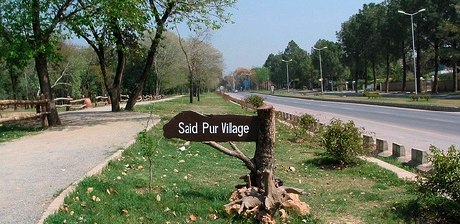
One such village is Saidpur, situated just off the Margalla Road, hardly a 5 five minutes drive from the upscale neighborhoods of Islamabad. I knew Saidpur only as a place one ordered garden-manure from. You didn’t have to go there. You just called the guy on his cell phone and he would have a Suzuki-full of manure delivered at your doorstep – literally, sometime.
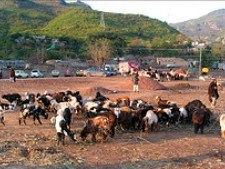
Or you knew Saidpur as a place where one bought bakras (goats), particularly black bakras, for slaughtering to seek divine help on occasions such as groundbreaking of a house, birth of a baby boy, an upcoming exam or a possible promotion, a serious sickness, or to ward off any evil one suspects might befall him or her. Poor black bakra!
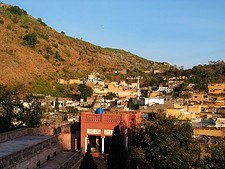
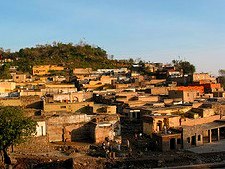
I drive past the sign pointing to the Saidpur village almost daily but I never bothered to venture into the village. (Perhaps, because I had not faced the need or an occasion to slaughter a black bakra.)
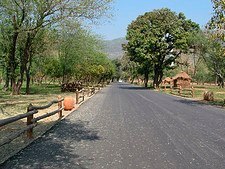
Recently I noticed a lot of development activity in the area. The road to the village was being carpeted with a fresh layer of tarmac; wooded areas were being cleaned of the undergrowth; a rustic fence was erected along the road leading to the village, and haystacks suddenly sprouted along the road to give a rural look to the area.
Actually, the Capital Development Authority (CDA) is developing Saidpur into a tourist attraction, and is spending a lot of money (nearly 400 million rupees) and efforts on resurrecting the old village and giving it a quaint look.

A newly built adobe gate welcomes you to the village. Built somewhat in Pueblo style, the gate seems to have been virtually lifted from Santa Fe, New Mexico and planted in Saidpur, Islamabad. While the CDA’s intentions and efforts to revamp Saidpur are commendable, there is this danger that they might end up reinventing it.
Saidpur is a very old village — 4 or 5 hundred years old — with a history and heritage and, of course, its own myths and folklore.
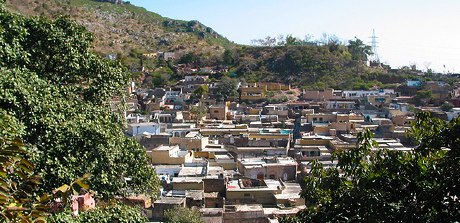
It is nestled in the Margallah hills overlooking Islamabad. Built along the slope of the hills, and gradually creeping upwards, the village presents a picturesque view, particularly in the soft light of morning or afternoon sun.
Saidpur is named after Said Khan, the son of Sultan Sarang Khan, the Gakhar chief of the Potohar region during Emperor Babur’s time. Emperor Jahangir’s memoir, Tuzke Jahangiri, mentions Jahangir halting at a place “beyond Rawalpindi”, on his way to Kabul. From his description it seems the place was Saidpur.
According to Fauzia Minallah:
“The Persian book ‘Kaigor Namah’ beautifully describes the place [Saidpur] during the visit of the Mughal commander Raja Man Singh in about 1580. It was a garden resort with a number of natural streams supplying water for drinking and irrigation…Raja Man Singh was so enamored by the village that he turned it into a place of religious worship. He constructed raised platforms, walled enclosures and a number of kunds (ponds) called Rama kunda, Sita kunda, Lakshaman kunda and Hanuman kunda named after the characters of the Hindu epic Ramayana. Saidpur was declared a pilgrim center and Rama kunda was preserved right up to 1947.”
The first thing you notice when you enter the village (and that is a big surprise), past a green domed mosque, is a Hindu temple, prominently situated and newly restored and painted. A little removed from the temple, to the left, is a small building with two orange colored domes. A plaque on this building, written in what appears to be Gurmukhi, suggests it might have been a gurdwara or a Sikh shrine. Between the temple and the ‘gurdwara’ is a neat, 2-storey building that was an orphanage (dharamsala) at one time. The temple is mentioned in the Punjab Gazetteer of Rawalpindi district of 1893-94, which suggests it is over a hundred years old. It’s amazing that a temple and gurdwara survived in a village that had no Hindu or Sikh population since 1947.
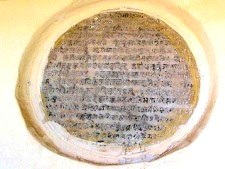
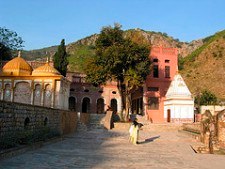
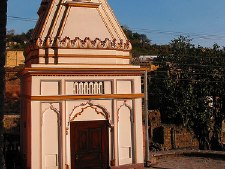
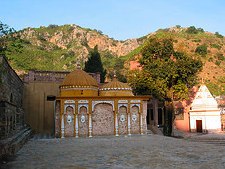
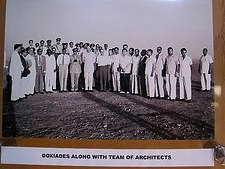
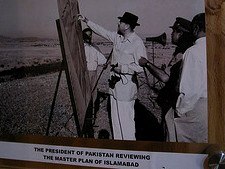
The secret of survival of the temple and the attached buildings, I found, was that soon after the Partition they were converted into a government school, and thus saved from being vandalized. Only recently the school was shifted and the temple and the ‘gurdwara’ renovated in their original form (a little overdone, though), and the orphanage was converted into a ‘gallery’ where old photographs of Islamabad, when it was just being built, are displayed.
Saidpur is also known for making unglazed pottery. According to Fauzia Minallah, “The distinct cultural identity of Saidpur has always been its pottery and it has always been known as the potters’ village.” She also mentions two old potters of the village, Niaz Muhammad and Rahim Dad, who still run their workshops in the village.
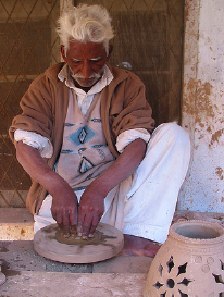 During my visit to the village I literally stumbled on Rahim Dad while he was sitting in the sun chatting with friends. He eagerly took me to his workshop and gave me a demonstration of how he turned a lump of wet clay into an interesting piece of pottery in a few minutes (we will have a separate post on that soon). Rahim Dad (he pronounced his name as Rakhim Dad) is a white haired man with a sun burnt and weathered face. He said he was 70 years old and a potter for several generations.
Other than being an old potter, Rahim Dad is also a repository of information about the village. What was the population of the village, I asked him. Two thousand registered voters, was his precise answer. (Who said our rural folks are politically ignorant?) Among other things, he told me about the shrine of Zinda Pir or the Living Saint, which was located just a couple of hundred feet above the temple on the hill slope under a pair of old banyan trees. Who was Zinda Pir, I asked. Khawaja Khizar, replied Rahim Dad categorically.
I was aware of the tradition of Khizar but never knew that he had spent time in the hills of Islamabad. According to some Muslim traditions, Khizar or Khidar, having drunk from Aab-i-Hayat or “the fountain of life” attained immortality and roams the earth incognito, usually along riverbanks, lakes and mountain streams. Some also believe him to be a prophet. He is believed to help people who have lost their way. In Urdu poetry, Khizar is often used as a metaphor for a person who guides lost people. Iqbal frequently mentions Khizar in his poetry and wrote two poems, Khizar-e-Rah and Jawab-e-Khizar highlighting some of the Muslim beliefs about Khizar. Ghalib also mentions Khizar, but iconoclast that he was, he addresses Khizar in a rather mischievous manner in one of his well known couplets:
Woh zinda hum haiN, keh haiN rooshanaas-i-khalq, aye Khizr
Na tum keh chor banay umr-e-javedaaN kay liyeKhizar, we are alive, for we are known to everyone
Not you, who slunk away unseen to steal eternal life[Translation by Ralph Russel]
I requested Rahim Dad to show me Khizar’s shrine. He readily agreed and guided me up the hill. In spite of his years and the inadequate shoes he was wearing he walked up the stony slope with the ease of a mountain goat while I clumsily slipped, stumbled and lagged behind.
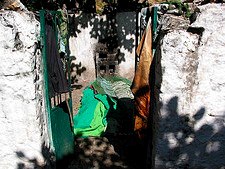
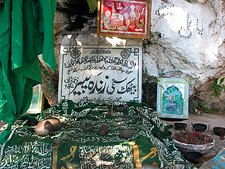
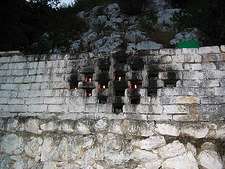
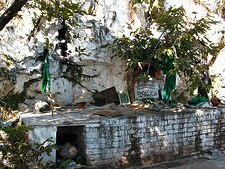
Zinda Pir’s bethak or the “sitting place of the living saint”, as the place is called, is the spot where the saint is supposed to have sat and worshipped. The place is situated at the base of a rock and is enclosed by a low brick wall with decorative holes in it. Two large banyan trees cover the whole place like a huge umbrella. Several layers of satin chadors (cloth sheets), inscribed with holy verses, are spread on top of each other at the spot where the saint is believed to have sat, each chador placed by a devotee in return for a prayer fulfilled by the saint.
I entered the enclosure first and Rakhim Dad followed me. I noticed that he took off his shoes before stepping in. He glanced at my shoes but didn’t say anything. It was too late for me to take off my shoes, for I was already in. I stayed there for sometime taking in the surroundings while Rahim Dad raised his hands and whispered a prayer.
Outside the enclosure, there is a grave of a woman who is believed to have spent all her life sitting and praying at the shrine. She is known simply as Mai Ji.
Every Thursday evening, folks visit the shrine, light candles or ‘diyas’, place them in the holes in the walls, say a prayer and go away presumably with a lighter heart. They also light candles at the Mai Ji’s grave.
Looking down at the village from the hillside shrine, in the soft light of the setting sun, it is truly an uplifting sight.
Tailpiece: When I came home from my trip to Saidpur and the shrine I felt a shooting pain in my left leg and also noticed a severe rash on the upper part of the leg. I thought it must be the result of the exertion of climbing up the hill. But when the pain didn’t go away for a couple of days I was assailed with an awful thought. Could this possibly be a punishment for my walking into the shrine with my shoes on? (We are all superstitious to some extent. Aren’t we?) When I mentioned this to a friend he had no doubt in his mind that it was a punishment for the irreverence I had shown to to the Zinda Pir. The only way to atone for my ‘sin’, he said, was to go back to the shrine and ask for forgiveness. Or, still better, slaughter a black bakra!
When I checked with the doctor, he said it was Shingles (Herpes Zoster) – a nasty, painful and disabling viral disease that may last for several weeks.
Photos are by the author himself and his complete collection can be seen here.





Very Very Respected & unforgettable
very respected place Zinda Pir the change of life the desires of life the issues of all solution I saw very closely I saw with true eye and the eye of heart .
Thanks to you
Very Very Respected & unforgettable
very respected place Zinda Pir the change of life the desires of life the issues of all solution I saw very closely I with true eye and the eye of heart .
Thanks to you
Hello Shivani shehkar, im currently making a documentary on Saudpur village and its old culture and i need some information. Can you please help me with that. Ill be really thankful.
hello,pakistan.This is shivani shekhar searching saidpur in pakistan ,actually my grandfatherand and his sister belongs to saidpur only,before 1947 one fight had occured between hindu and muslim so after that only they shifted india . Ineed a small help here i don’t know why this curiosity suddenly come up in me but i really want to search their home may be their home r not still there but by god grace this may b there hence i only want that if any people of saidpur read this pleassssssssse give me some information about this my nanu name is shri laxmi narayan lal,ryt now he is86and not welland he really want to go saidpur to search out some his belove so please help me pn behalf of him i’m here.You can contact me through my email.THANK U.