Adil Najam
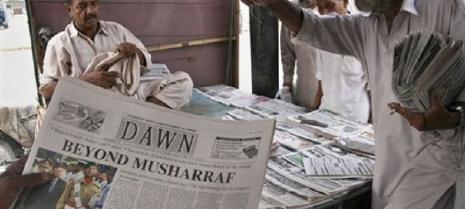
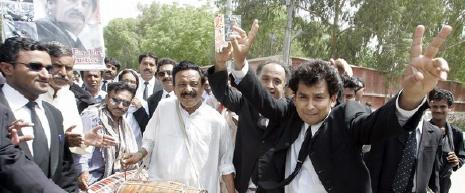
One of the most important decision in Pakistan’s political history was made yesterday when Gen. Pervez Musharraf was made to resign from the Presidency. Equally, and possibly more, important decisions are being made right now by the political leadership of the ruling coalition. It is these decisions being made now that will ultimately effect not only the immediate but the long-term future of the country and which will, in many ways, determine the real significance of the decision made yesterday.
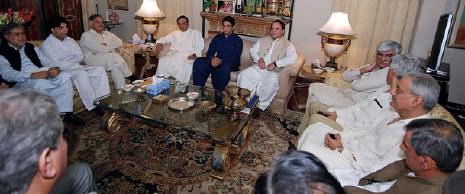
As the political leadership of the country continues its deliberations four questions in particular seem critical. The answers they come up will will impact what happens to Pakistan politics as well as what happens to Pakistan’s political leadership itself.
On each of the following four key decision points, what do you think will happen? What do you think should happen?
![]()
Question #1. Who will replace Gen. Pervez Musharraf as President of Pakistan?
The names being thrown around, some I think less seriously than others, include those of Afsaryab Khattak, Afsandyar Wali Khan, Fazlur Rahman, Dr Fehmida Mirza, Aftab Shaaban Mirani, Faryal Talpur, Attaullah Mengal, Saeeduz Zaman Siddiqui, Mehmood Achakzai, Aitizaz Ahsan, Rana Bhagwandas, Fakharuddin Ibrahim, and many others. As important as the choice of the President is the signal it will send about whether the nature and powers of the President will also be cut down or not. What do you think will happen? What do you think should happen?
Question #2. Will Chief Justice Iftikhar Chaudhry and his fellow judges be restored? And when?
The really important question here is the “when”. PML(N) wants the judges to be restored immediately. If they are not, what signal will this send to the PML(N) and the country about their role and power within the ruling coalition? What, really, are the pros and cons of an early restoration, and for whom? The one question that may be even more important than the “when” question here, is the “under what conditions” question. That is the question one hears less about but will may ultimately determine what comes, or does not come, out of the judges moevement. What do you think will happen? What do you think should happen?
Question #3. What is the future of the ruling coalition itself?
The ruling coalition was really constructed as a coalition against Gen. Musharraf. Its primary purpose was to remove Gen. Musharraf from office. It has been spectacularly successful in doing that. What now? Will it survive? In what form? Should it survive at all? Will it be more healthy if PML(N) now becomes a parliamentary opposition which, in a functioning democracy, is as important as a government? What do you think will happen? What do you think should happen?
Question #4. What about the survival issues of the Pakistani awam: Bijli, Paani, Nokri, Naan?
Ultimately, this is the most important question of all. Till now, with a visibly divided government, the political parties could ward of part of the economic woes faced by ordinary Pakistanis to Gen. Musharraf and his past policies. Now, they will have to - and quickly - demonstrate that they can and will do something about these major crises. It is not clear what they plan to, or even can, do. But if they don’t their popularity will be seriously imperiled. What do you think will happen? What do you think should happen?



You can visit ATP on your Mobile Phone. Here's how!
WOW!!! as I predicted.
The Illiterate Masses have spoken and we a new leader , a new day /dawn has arrived.
Quaid-E-Azam’s dream will be fullfilled now.
All sarcasm above :)
Lets see how long these jokers stay in power and stagnate the “progress”. I hope we end this dynasty era of Sharif and Bhutto Wannabe’s.
I hope Nawaz Sharif gets indicted for storming the Supreme court when he was in power because everyone has conveniently forgotten that. What ever happened to Surrey Palace that Zardari made with Pakistan’s treasury as the down payment/collateral.
I hope Supreme Court Judge gets reinstated and I predict the first thing he is going to do is to open corruption cases against Nawaz and Zardari.
History will repeat itself if we fail to learn from it.
As the minority Pakistanis we are in this forum we should all work towards supporting the supreme court judge and people like Imran Khan.
Imran Khan is like the Ralph Nader of Pakistan. He keeps the Politicians in Check.
I don’t know how anyone with half a brain can see any intellect coming out these Politicians. At least Musharraf spoke well and we could relate to him.
from
lida( the raw agent)
The resolution will collpase in National Assesmbly.
Zardari have made it loud & clear.
Restoration of Judiciary is eminenent
LESS
Iftekhar Chohdary & Khalil Ur-Rehman Ramday
Take it or LEAVE IT.
So Nawaz Shareef have a choice ! either way,
Cheers !
I wonder a President elected from NA and Senate votes is the same as one elected from a public referendum. Obviously seeking validation from a referendum after assuming power as President is not very democratic.However if you do it before assuming office you can be elected democratically through a referendum on the nominees from public.
@Pakistani !
Hahah dude get a life! Are you a moderator of this post. Get a life and stop behaving like a child.
Ahmad good responses Faraz good questions, but tribal or fuedal whats the difference same crap no need to over analyse this please.
As I said forget musharref, nawaz, bhutto I really dont care about that at all! I need a stable Pakistan and Democracy is good but also its not a virasat of 2 famlilies. Aik jata hai doosra ata hai!
Someone commented to me silly joke or azad poetry. I dont have time if you have you can do.
Bottom line, I want a stronger better Pakistan and I dont see that happeneing if these 2 people are in power or these parties.
Plus again some guy here commented to my post that I am supporting a person well I am not. Musharref mayra chacha nahin hai, jo her waqt us ki support karna zaroori hai. Even if the current government can do good I dont care as long as they show little respect to the poeple of pakistan and not to there pockets!
Me again. Sorry, forgot the last part of your last set of questions:
> Are NS and Zardari not the last two people you would want to run this country?
>>> The first of this is not a question it is your opinion. I may share it as an opinion, but asa fact neither you nor I know if it is true or not. Nor can we know. Actually, to think about it, I can think of MANY worse people than them. Think hard, and so may you.
> Will it get better in the future, given the dynastic nature of politics (Bilawal being a recent example of this).
>>> I have no way of knowing. Nor do you. Conceptually, there is no reason to assume that Bilawal will either be better or worse or even similar to his mother or father. That can only be determined from performance and performance will only become evident when he has position. So all of this is sheer speculation. One can, of course, learn from history. John Quincy Adams turns out to be as good (and some say better) President than his father John Adams. Indira Gandhi was as good (and some say better) than her father. Asad Amanat Ali Khan was not as good as his father but he was still very very good. So, yes, in many cases having parents in the same field can obviously help. But in politics you have to prove yourself eventually. So, again, the basic proposition you are making is wrong.
Unfortunately, I am going to disappoint you - because you will not get the answers you expect (your question structure still makes it very easy to discern what answers you seek). Anyhow, let me give it a shot… just to amuse you:
> Large areas of Pakistan are still under the feudal system. If that’s true (you can disagree) does that hinder a true democracy?
>>>No, this is not true. Has not been true for at least 40 years now. All of the NWFP and 3/4th of Punjab (Northern) and 3/4th of Sindh (Southern) is no longer feudal at all. A simple look at land-holding size will show that. Balochistan was always tribal, but never feudal. People there, and in NWFP, have been fiercely independent. While the tribal bonds give local leaders a lot of clout, this is not the type of political feudalism where a person can just dictate who gets the vote. Proof of this is that different leaders from different tribes have been winning different elections. The same is actually true for that small part of Southern Punjab/Northern Sindh where land holdings are large enough. Previous leaders have seen a rotation of local leaders in different elections and many many instances of feudal powerhouses (Jatois, Khars, Abida Hussains, etc.) losing. People from historically strong political families do win. But that is true everywhere in the world (in USA, having a name like Bush, or Kennedy, or Clinton helps; in India, being a Gandhi helps and do many former feudal or local rulers; in Multan having the name of Gillani or Makhdoom is not bad either). But your essential proposition is clearly wrong. Historically, there is no evidence that even if society is feudal (the USA was the first 100+ years of its existence; i.e., very large land-holders with near absolute control over those working for them) it should necessarily hamper democracy. What you are repeating here is a long-held myth amongst Pakistani urban technocrat types, who perpetuate this myth to ‘diss’ rural Pakistan.
>Are people allowed to vote freely? Or are they intimidated and forced to vote against their will? Is this phenomenon widespead enough to have an impact on the election results.
>>>Only the first of these is an honest question. A good one, but also an easy one. Clearly, the last many elections people have been allowed to vote freely. Certainly in 5 of the last 6 elections no massive rigging or forcing of votes has not been reported by independent observers. Institutional rigging has been sometimes reported but this myth of the “Chaudhry” telling his “muzzara” that he must only vote for a certain candidate and no other has not been true (except in PTV dramas) for a very long time. On this people have done the research and the results are clear. People who do vote, vote freely. There is certainly very little “forcing” of votes. Obviously, I speak at the broad level. A stray incidence here or there does not count. For your proposition to be true we would need independent verifiable reports from widespread constituencies (25-30% at least). Nothing near that has been reported in recent elections. Someone convincing voters that they should vote for their tribe or biradri, etc., is not forcing or intimidation; it is politics (listen to Obama and McCain in the US doing the same with black/ white/ religious/ Mid-Western/etc. votes.
> The literacy rate of Pakistan is among the lowest in the world. Is that a problem? Does literacy significantly affect a person’s ability to vote for the best possible candidate? Is an “illiterate” person more easily deceived than a “literate” person?
>>>No. Yes (but not in the way you imply). No. Certainly not. This one is also one of those myths that our parents taught us because they actually believed that the “parha likha” was SUPERIOR. Its a kind of educational apartheid and racism. First, our literacy level is NOt amongst the lowest. Although it is low. The easy example is India whose literacy rate has until recently been lower than ours and they seem to have done OK. Yes,literacy is a problem. But it is a development problem, not an electoral one. Literacy brings lots of other good things in development but there is no evidence at all from anywhere (just assertions from the so-called parha-likha types) that it actually effects electoral stability. There is no reason to assume, conceptually, that a literate person votes better than an illiterate person or is less able to choose good leaders. Countries with high literacy levels can choose very bad leaders (the US choose Bush) and a very low literacy South Africa choose Mandela. The South Africa case is interesting. The educated minority wanted Aparthied, it was the uneducated (more uneducated than in Pakistan) who wanted democracy and choose Mandela. So, the evidence from their suggests that literacy does not hamper good decisons, but education (and the false sense of superirity) might :-)
> During elections people often use the phrase “chose the lesser of the two evils.” Were any of the candidates during the recent elections sincere? Do people even have the option of electing decent legislators? Are NS and Zardari not the last two people you would want to run this country? Will it get better in the future, given the dynastic nature of politics (Bilawal being a recent example of this).
>>> I am sorry, these are not questions but assertions. There is no way that either I or you can know about someone’s sincerity. That is not a ‘knowable’ variable. We can have opinions, but those are personal and not empirical. Similarly, I cannot answer whether there were decent options or not. One will have to analyze each constituency and full slate of candidates in each constituency. There is a lot of useless chatter and generalization, but that is not analysis, its just venting. I know that in a few constituencies that I know at least some of the candidates seemed very sincere (TO ME). Many of them did not win. But the point of elections is not to choose the “best” person (e.g., G.W. Bush) it is to select someone that people want to represent them. When people vote for someone, whether we consider them good or bad, they are obviously saying they want that person to represent them. Only God knows who is really good or sincere or decent. These qualities or brightness or smart is not what elections are about. They are about representation, and by all indications our representatives are no worse or better than the rest of the country. So, elections obviously work in Pakistan.
I AM SORRY FOR THE LONG ANSWER. AND IT REALLY WILL BE MY LAST. ITS NEARLY MIDNIGHT HERE AND I SHOULD SLEEP NOW.
I think Faraz has a very legitimate questions. Please dont over analyse them like everything else and come to con~senses.
To answer his questions, yes democracy should prevail!
Pakistani AWAMs hands may be tied due to economy, personal insecurities or religion but they are not dumb
If Zaradari name his son as a cochair of the party, it wont fly for too long unless son shows the ability.
Leaders will soon act as leaders and not the masters.
Ahmad, of course your responses were full of insults. So thanks for a clean response this time and for clarifying your argument/concerns. Now we can move on. I agree with your explanation and I do see problems with how my question was phrased. So back to my original post, and let me try to rephrase my question to comply with your standards:
> Large areas of Pakistan are still under the feudal system. If that’s true (you can disagree) does that hinder a true democracy? Are people allowed to vote freely? Or are they intimidated and forced to vote against their will? Is this phenomenon widespead enough to have an impact on the election results.
> The literacy rate of Pakistan is among the lowest in the world. Is that a problem? Does literacy significantly affect a person’s ability to vote for the best possible candidate? Is an “illiterate” person more easily deceived than a “literate” person?
> During elections people often use the phrase “chose the lesser of the two evils.” Were any of the candidates during the recent elections sincere? Do people even have the option of electing decent legislators? Are NS and Zardari not the last two people you would want to run this country? Will it get better in the future, given the dynastic nature of politics (Bilawal being a recent example of this).