Adil Najam
Benazir Bhutto was assassinated one year ago today, December 27.
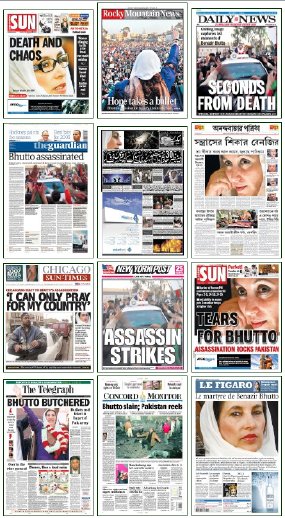
I remember being in utter shock when I first heard that news. In some ways I am still in shock. Indeed, as our wall of newspaper covers showed, the whole world was in shock. That shock, I believe, is also still alive.
And, yet, so much - so very much - has changed. An elected government holds power. Benazir Bhutto’s arch-nemesis Gen. Pervez Musharraf is no longer President of Pakistan. Her husband, Asif Ali Zardari, is. We still do not know who was behind her death, but speculation remains rife. The economy remains in nosedive. An energy crisis is upon us. One Chief Justice still awaits reinstatement. Another is embroiled in scandal. War talk with India on the East is the rage. Drones pound us on the West. And Pakistan continues to lose both territory and citizens to the extremists who continue to wage a war within Pakistan and on Pakistan. Most of all, anger and angst still define the social disposition.

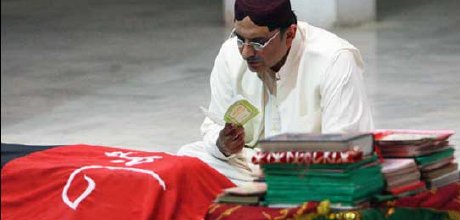
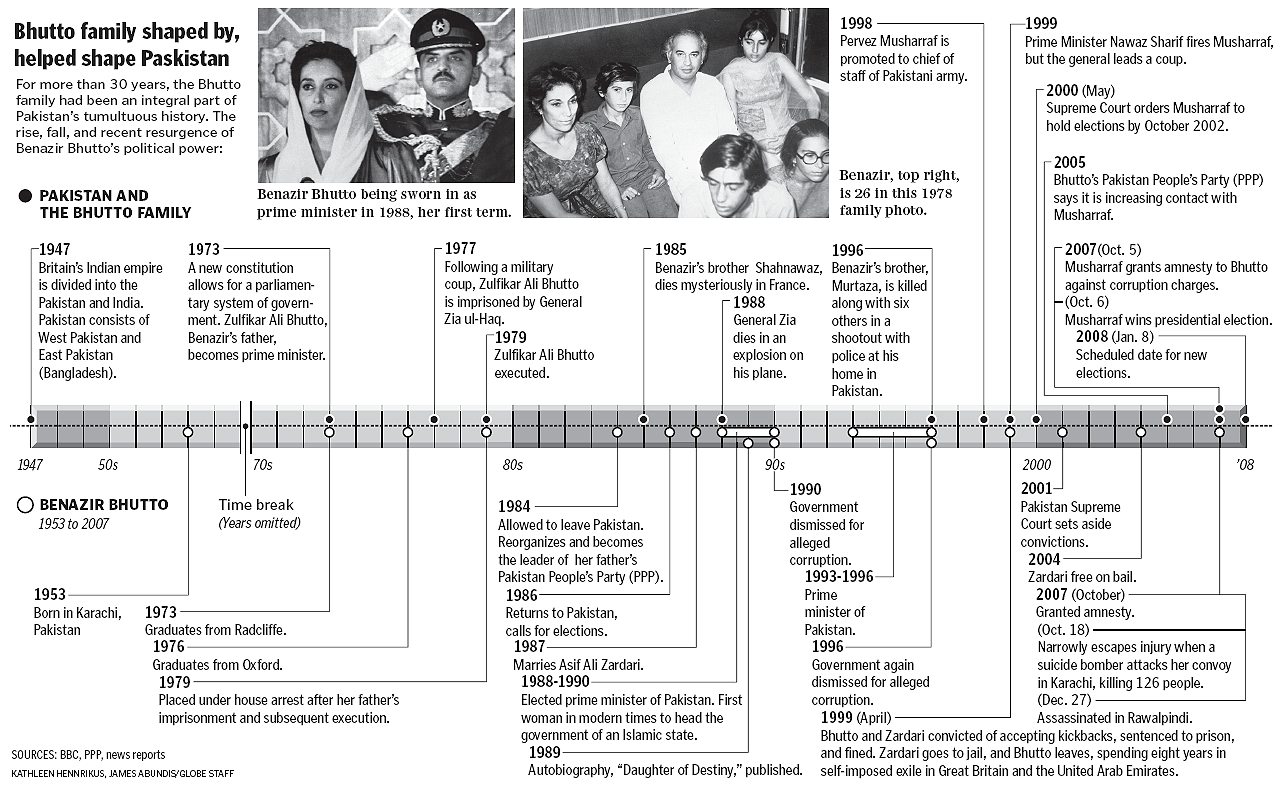
None of this is new. As a re-reading of our review of 2007 would show there is no evidence that 2008 was any more depressing than 2007 was. It just feels that way. Good things have happened (including elections) but so many bad things have piled on that it becomes difficult to remember what they were. Each new day brings new headlines of death, depression and despondency. And each headline chips away at the national psyche. The angst compounds within us. Gloom adds to gloom and the emergent analysis becomes ever more gloomy.
Speculative it surely is, but even if only for speculation’s sake, what if she had not been killed on that fateful day a year ago?
What if she had survived the attack? Would things have been different? Would the nature of the government she would have formed or run have been different from Mr. Zardari’s government? Would Gen. Musharraf’s fate have been different? Would Justice Iftikhar’s fate have been different? Would the pressure on Pakistan from abroad have been different? Would Pakistan’s response to extremists have been different? All of this, of course, assumes that she would have won the elections and assumed power had she lived. But, would even that have been so?
I do not know the answers to any of these. No one does. But a part of me would like to believe (for the sake of my own sanity) that things in Pakistan would, indeed, have been different - and better - if she had not been killed, even if nothing else had been any different from what it is today. Simply, because the blot of her assassination would have been one less stain for our collective soul to cleanse off. And she would still be there to give hope to at least a few!




Pakistan was sacrificed by founder of PPP to come into power.God knows what was his daughter up to after her sponsored return.The only persons who can answer these questions are Pervez Mushrraf and Rehman Malik who are privy to the whole scheme of things prior to October 2007.But then who would take up this task?
The loss of Benazir and the way she died put the whole country into a depression, even those who did not agree with her, and we have not been able to come out of it yet. I have never been a PPP supporter, but I think her death was a great blow to the nation. It robbed us of Benazir and instead gave us Zardari. A double blow.
It’s hard to answer most of the questions asked in the post, but one thing is for sure. Mr. 10% would not have been our head of state if BB had been around today. She was planning to keep him at a distance this time.
Benazir Bhutto was born on 21-6-1953.Hence her fate number is 27(2+1+6+1+9+5+3=27).She was assassinated on her fate number.
This number adds up to 9.Similar is the case with 2007(2+0+0+7=9).The first attempt on her life was on October 18(1+8=9).
At the time of assassination she was 54 years old(5+4=9)
BB we will always miss you
You are in our hearts
@Eideeman:
“But why single out the uneducated extremists, when our highly ‘educated’ elite holds only a slightly different opinion. They will always come up with the same shameful, pathetic excuse, that she stole money from Pakistan. But they never care to consider why someone whose sole intention is to commit financial fraud would repeatedly endanger her life by taking on military dictators and religious zealots.”
Points to ponder.
Back to this topic:
1) I don’t think there was much ’sympathy vote’ for the PPP in the Feb. 2008 elections: In a hopeless elections of 2002 the PPP got %28 popular votes. In 2008, it was about 30%. In 2002, there was no Benazir on the ground to campaign and it was understood that Musharraf would not allow anyone else power. But in 2008, Benazir would be campaigning on the ground with an implicit backing from Musharraf and so would certainly improve upon the 28%.
2) Give Zardari some credit, will you? After the 2008 elections the PPP could have formed govts. in all 4 provinces if it resorted to the old ways. Do some math after looking at the Provincial Assemblies results in NWFP and Punjab. But Zardari chose not to.
3) Despite autocratic tendencies in all political parties (except may be Jamaat e Islami), the PPP is the only party in Pakistan which has come to power in Islamabad 4 times since 1971 where it did not have all provincial assemblies of its own. Compare that with the various govts. of military backed Muslim Leagues (A to Z flavors!): They almost always managed to get all 4 provincial govts. under their control.
4) In 2008, for the 3rd time a tired, dispirited military junta has given power to the PPP after leaving the country in utter mess. Let the govt. complete its tenure and don’t wish like these myopic journalists like Shaheen Sehbai who are earning for the military rule again.
5) So long as Nawaz Sharif challenges the military ascendancy in Pakistan he will remain my potential choice, despite his autocratic, fundamentalist ways. But do not underestimate the alienation in rural Sindh against the center, especially after BB’s assassination. NS must make gains in rural Sindh.
6) I don’t know if Benazir would have fared better than Zardari or not in current circumstances. My educated opinion is that Zardari is by far the smarter and more compromising one. Zardari, unlike Benazir, is not too feudal and he is a ‘businessman at heart’.
7) Currently, there are no widespread accusations of corruption against ‘Mr. 10%’. One reason could be that those hounded him, incarcerated him, tortured him are themselves being decommissioned in some ways by a weaker Establishment.
Benazir we mourn you. You will be remembered in history for many, many centuries, if not for ever.
Rest in peace.
An op-ed in The News today tries to answer your question:
HOW THINGS COULD HAVE BEEN
Rahimullah Yusufzai
One year ago on this day, Pakistan lost one of its top politicians in tragic circumstances. Benazir Bhutto’s assassination was the latest in the list of political murders that this country has suffered. If the past is any guide, her real killers would remain unknown and go unpunished. Even though her PPP is now in power and her husband, Asif Ali Zardari, has become one of Pakistan’s most powerful rulers in history, there has been little progress in tracking down the sponsors of the plan to assassinate her.
It is a moot point how Pakistan would have fared had Benazir Bhutto been alive today. In fact, the PPP couldn’t have won the February 2008 election without the sympathy vote that was generated by her untimely death. At best, her presence in the election campaign would have enabled her party to do well and equally share victory and then power with Nawaz Sharif’s PML-N instead of winning more assembly seats and dominating the coalition government.
On hindsight, one could say that a balance of power between the PPP and the PML-N would have been a better arrangement for the country because the latter would have been in a stronger position to force the former to allow restoration of an independent judiciary and agree to reinstatement of Iftikhar Mohammad Chaudhry as the rightful chief justice of Pakistan. This would have removed a major irritant in domestic politics and prolonged the life of their coalition government and, in the process, strengthened the rule of law and democracy. Though it may appear wishful thinking, one would like to think that a stronger PML-N presence in parliament could have prompted the coalition government to strive for a slightly more independent foreign policy instead of toeing the US line and entangling Pakistan in America’s disastrous “war on terror.”
Much is made of late Benazir Bhutto’s public statement outside Iftikhar Chaudhry’s official Islamabad residence that he was her chief justice as well and would be restored to his position with the return of true democracy in the country. It is important to remember that she wasn’t always very enthusiastic in demanding Chief Justice Iftikhar Chaudhry’s reinstatement and was prone to adjusting her position on this issue in keeping with the public mood, her political goals, her deal-making with the then president General Pervez Musharraf and her tendency to listen to the signals coming from Washington. Asfandyar Wali Khan’s ANP and Maulana Fazlur Rahman’s JUI-F had almost a similar take on the issue as they didn’t want to make their politics subservient to the deposed chief justice’s fate. Theirs was a clever line, which no doubt underlined the independence of the judiciary but detached their parties from demanding reinstatement of a particular judge, whether it was the chief justice or someone else. No ruling politician likes checks on their power, more so those dictated by an assertive judiciary.
Given the fate of previous coalition governments in Pakistan, it would still be naïve to believe that the one between the PPP and the PML-N could have lasted longer in view of their bitter political rivalry in the past. That their coalition collapsed sooner than expected was due to the choices available to the Asif Zardari-led government, which had other political allies ready and eager to fill the vacuum created by the PML-N decision to quit the alliance. For a price, the ANP, the JUI-F and even the MQM were accommodated to win their support for the PPP-led coalition and it was clear that sections of the PML-Q too were ready to offer backing to Mr Zardari in case of need.
Benazir Bhutto’s elimination from the political scene not only influenced the outcome of the subsequent polls but it also brought changes in the PPP leadership and its style of politics. Mr Zardari despite his limitations was catapulted to the top and he settled for the presidency out of the many prized positions that were his for the asking. He could have become prime minister and made this office the most powerful. That perhaps would have made parliament more assertive than he wanted it to be. His decision to become president of Pakistan meant that everyone from the prime minister to the members of the federal cabinet, all the governors and most chief ministers and even the army chief became answerable to him in his capacity as the PPP head and the commander-in-chief of the armed forces. He has refused to give up his position as PPP co-chairman even though the country in these difficult times on account of tensions with India is desperately in need of a non-partisan president capable of uniting the people and leading and bailing out Pakistan.
There have been other shortcomings as well. Apart from his liking for friends and loyalists and trusting them with some of the choicest public offices even if they lack merit, President Zardari’s other drawbacks include a serious lack of credibility. If the recent, and not always credible, the IRI public opinion survey is to be believed, his approval ratings with those interviewed are hopelessly poor. In comparison, Nawaz Sharif remains the most popular politician primarily due to his principled stand on the reinstatement of deposed Chief Justice Iftikhar Chaudhry and his willingness to criticize, howsoever feebly, the US for interfering in Pakistan’s affairs and resorting to missile strikes in Pakistani territory.
No real step has been taken to repeal the 17th Amendment despite President Zardari’s promise to do so in his inaugural speech to the parliament and reminding everyone that nobody in power in Pakistan in the past has willingly agreed to give up authority or place limitations on his or her powers. Parliament resolutions such as the one on formulating a new dialogue-based policy while tackling militancy in NWFP appear more as a move to buy time and delay decision-making on vital issues affecting Pakistan.
It would be unfair to blame the president for every thing that has gone wrong since the installation of the PPP-led coalition. Economic woes of the people aren’t of President Zardari’s making. The lawlessness and surge in militancy-linked violence and the problems with India in the wake of the terrorist strikes in Mumbai also cannot be squarely placed at the door of the government. But the people have a habit of blaming the government for their plight and it is easy to blame an unpopular president and all those around him at a time when the masses are suffering.
One issue that apparently has hurt President Zardari and the PPP the most is his decision to retain Chief Justice Abdul Hameed Dogar in office and keep out the popular Iftikhar Chaudhry. Compared to President General Musharraf, the PPP government has been defending him even more aggressively much to the chagrin of most Pakistanis who were angered by Chief Justice Dogar’s support for the former military dictator. In the case of his daughter Farah Dogar, the government tried to justify the award of extra marks to her and in the process earned reputation as a government that doesn’t believe in merit and instead favours favouritism. Some PPP leaders from Sindh even went to the extent of giving an ethnic colour to the opposition to Chief Justice Dogar and started defending him for being a Sindhi. It was something most unfortunate because Chief Justice Dogar’s ethnic identity has never been an issue. In fact, deposed Chief Justice Iftikhar Chaudhry wasn’t backed by most Pakistanis because he was a Punjabi or that he hailed from Balochistan. He won the admiration of the people due to his courage for standing up to a military ruler and sacrificing his most prized job for the sake of independence of judiciary and rule of law.
The sooner the PPP leadership grasped this truth the better it would be for the future of its faltering government. Much of the dissatisfaction being seen against President Zardari and his government would hopefully go away if the promise made by the late Benazir Bhutto for reinstating Iftikhar Chaudhry as chief justice of Pakistan is honoured. And by fulfilling the promises that President Zardari made to parliament in his maiden speech for repealing the 17th Amendment and thereby sticking to a true parliamentary form of government, the PPP-headed coalition government would still be able to redeem itself and prolong its stay in power.
Congratulations to Adil Bhai and Owais Bhai for being named the two top Pakistani bloggers for 2008
http://sajshirazi.blogspot.com/2008/12/top-ten-pak istani-bloggers.html