According to a recent Yahoo news update:
The government (of Pakistan) agreed to impose Islamic law and suspend a military offensive across much of northwest Pakistan on Monday in concessions aimed at pacifying the Taliban insurgency spreading from the border region to the country’s interior.
In my opinion, the devil is really in the details and the implementation of this agreement. I have mixed feeling on this: It is hard to see how the situation in Swat can be controlled only through the military means; there has to be a political dimension. This is what the U.S. is also learning the hard way in Afghanistan where there is already a talk of having some sort of adjustment with “moderate Afghan Taliban”.
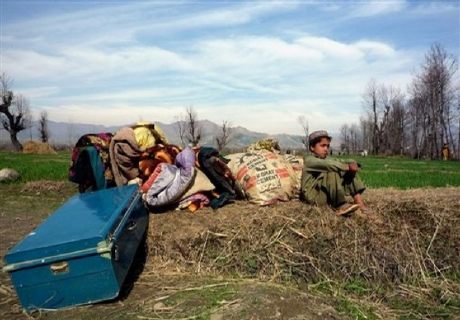
In an ideal world, you would have hoped that Pakistan army would have gained the upper hand in Swat and then they could have negotiated from the position of strength. Unfortunately this is not the case. Despite several attempts, the army could not make any significant gains in Swat. Part of this is due to bad strategy and partly due the nature of guerrilla-warfare. Pakistan army was never trained to fight a counter-insurgency; fighting against India is what the focus has been so it does’t come as a surprise that it didn’t perform very well.
As far as their strategy goes, it was based primarily on using gunships and (artillery) shelling against suspected militant hide-outs. This approach is not very conducive to counter-insurgency because it leads to a lot of collateral damage. As the U.S. experience in Iraq shows, your mission in such a situation must really be to “secure the population”. This was the fundamental change in strategy that U.S. Gen. David Petraeus made but such a change requires putting a lot of boots on the ground, taking a lot more causalities and better intelligence. Unfortunately the Pak army was unwilling and incapable to take this approach which resulted in the bloody Swat stalemate.
Against this backdrop, the agreement can offer a way out if government can play its cards correctly. It should also be noted that this is not the first time that Swat will be under the so-called Shari’s law. This was the case for decades when Swat/Dir region was part of the princely state and life was governed by “Customary law”. The elected representatives of the Swat region have also been in favor of incorporating some populist militant demands such as Qazi courts and quick and simply justice with a 6 months deadline to process all cases.
One can hope that by incorporating the populist demands and a willingness to understand and work with local sensitivities, the authorities can gain credibility with the local population and take some of the wind out of the insurgency’s sails. I am under no illusion that the likes of Molana Fazlullah will be willing to give up their weapons and stop fighting but hopefully such a agreement will isolate the hard core extremist elements from the deeply conservative local population and deprive them from one of their main arguments. It is a lot easier to deal with insurgents when they don’t enjoy widespread local support.




I think this move is a bit late. They should have applied this law when the army had the upper hand in 2007 and early 2008. Applying it now gives an impression of weakness.
Having said that, all these areas, FATA and ex Princely states of Dir, Swat, Chitral etc are conservative societies. And the local jirga or riwaj system gives no value of life especially to the poor people. The current system is based on the colonial era English system, which, excuse my languauge, is basically rotten. Its does not work, does not give justice at all and sucks the two parties dry. Anyone who has the experience will not disagree.
A replacement system of speedy justice is the need of the hour. It could be based on shariah or any other source of knowledge. However the shariah based system has an added advantage of being able to deny the militants any moral high ground. If played intelligently it could take the steam out of the militant’s drive, and ultimately their insurgency. (Which I hope, but do not believe will happen because of the half hearted steps this government is so fond of taking).
It should also be noted that Shariah should not be equated only to flogging and executions. Flogging falls under the laws of “Hadd” and applicable only to infidelity (fornication) and consumption of alcohol (in certain cases). Execution is applicable only in case of murder, armed robbery and in certain cases with infidelity (only in the case of four eye witnesses being present. Also not everyone agrees with awarding the death sentence in case of infidelity of a married man or woman, however rape is awarded the death) penalty). This is in no way different from the laws that are already in force.
As regards cutting off of hands, that too is applied in extreme cases. It is not applicable to the theft of food, medicines or theft for providing for ones family. In cases of valuable being stolen without justification (health or hunger) one has three chances given to him “WITH ABSOLUTELY NO PUNISHMENT, ONLY ADVICE”. Also it is documented that in times of famine Hazrat Umar (RA) had suspended this punishment, so it is not considered as a punishment to be applied without question.
Shariah covers others laws including but not limited to rights of inheritance (I do not believe any mulah will agree to sharing his wealth or land with the women folk of his household), taxes, protection of life and property, businesses, interest less banking, divorce, la’an etc.
I have not read the document that has been signed but I believe none of these will be covered in the peace deal or implementation of shariah in Swat and it will be a mere whitewash. Thus limiting its capacity to control the law and order situation. Shariah also guides how to control miscreants on the face of the earth and those whoo do not listen to their governments, and believe if imposed properly, Shariah could be very effective (and perhaps a bit ruthless) in dealing with dissent, which is not tolerated. Any ATC (Anit terrorist court) judge would practically envie haveing this imposed in place of our current ineffective laws.
So ladies and gentlemen, I wish one would understand what we are talking about. The problem lies not in the Shariah law but hose who will be imposing it. No one is imposing it for Allah or Muhammad (PBUH), only for political purposes. And as long as the people who are the guradians of the law of the land do not change, this will make abolutely no difference in the miseries of the people of Malakand and Swat. I do wish fate proves me wrong.
The yahoo news quoted here says “The government (of Pakistan) agreed to impose Islamic law and suspend a military offensive across much of northwest Pakistan…” What idiocy?
The Northwest (barring Northern Areas) is 74,521 km
A SAD DAY
Govt, TNSM agree on Nizam-e-Adl in Malakand (Daily Times Feb. 16, 2009)
NWFP govt unveils Nizam-e-Adl (Daily Times Feb. 17, 2009)
It is indeed a Sad Day for all those sincere (but naive), secular and democratic Pakistanis who believed in the declaration of Mr. Muhammad Ali Jinnah when in his speech of 11th August, 1947, he said:
My entire life I was led to believe that Pak Armed forces are the best and the bravest
This truce was so uncalled for. The Sawatians were anyways killed by Talibans even before the Pakistani Army called a war on them. So basically why this truce?
Probably it means that for 10 days, the Talibanis should take rest so that they are fresh for a new assault from the 11th day. Probably there is some thing important going on in Sawat, something which has to be done without interference. Probably assembly of a dirty bomb.
This truce definately has no positive implications for Sawatians, but there is definately something more, that needs to be investigated.