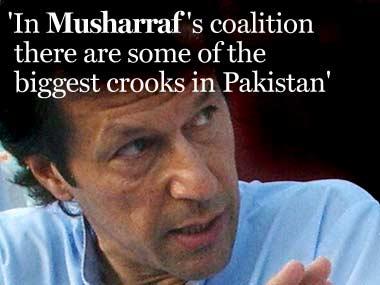
 Everyone seems to be talking about Imran Khan’s interview in the Sunday Observer (2 July, 2006).
It is interesting and well worth the read. The piece captures Imran’s essential persona; fiercely independent, consistently principled and completely committed but a little self-righteous and indeed somewhat politically naive.
It has to be said that, despite his muddle-headed ‘spirituality’ that sometimes brings him close to unsavory elements like the Jamaat-e-Islami, his ideas for Pakistan’s political system are fundamentally sound.
He is most insistent on an independent judiciary, election commission and accountability bureau; all institutions whose strengthening is critical for Pakistan’s democratic advancement. Despite his early support for Musharraf, he is now vehemently opposed to military’s role in government. In Pakistan, there is almost no disagreement in thinking circles now that as long as military remains the dominant force on the Pakistani political scene, democracy has little chance of taking root.
Imran’s instincts in the arena of foreign policy are reflexively anti-western and many times flawed. Of course, there is plenty wrong with Musharraf’s self-preserving genuflection to the West and a harder Pakistani line toward the west if it is in its national interest (such as free trade agreements, opposition to the roughshod execution of the ‘war on terror’ etc.) is entirely appropriate. However, Imran’s public utterances extolling local virtues and criticisms of ‘kala sahibs’ seem to me a raw reflection of his personal evolution from a playboy to a politician and not any well thought out views about the virtuous life or a hard-headed understanding of foreign policy goals and objectives.
Some excerpts from the interview:
On his farmhouse outside Islamabad: “This place was just a jungle area when I found it… It was very cheap… I sold my London flat to buy this whole place and build this house… I have fruit trees. Cows for fresh milk, yoghurt. My own wheat. I’m basically self-sufficient. I have made my boys a little cricket ground.
On elections: “It is not easy to win against a military dictator in an election that is being run by the security services… My contention now is that there is no way anyone should fight an election while Musharraf is in charge… Therefore I will be out on the streets beginning in September against him. It is the only way. I am preparing my party for a street movement. What we are hoping is that the other parties will come out too.”
On his ‘political naiveity’: “A lot of people here in the press call me naive… Musharraf told them I was his prime ministerial candidate in 2002 but had turned him down, I was too full of myself. He said I was a terrorist without a beard. But I would have failed if I had joined them. Look at the way they live: big palaces, Lear jets. People here have no drinking water; 70 per cent of the schools are closed in my constituency. But I’m more hopeful than ever. One of the reasons I was a successful cricketer was I felt nothing was impossible. I never signed more than a one-year contract, because I always thought I would be better the next year. I feel that now, too.”
On ‘extremists’ and democracy: “The pseudo-liberals here will tell the West: save us or the mullahs are coming; that is not the problem. You will have no problem with extremists in Pakistan if you have democracy.”
On spirituality: “Spirituality does two things for you. One, you are forced to become more selfless, two, you trust to providence. The opposite of a spiritual man is a materialist. If I was a materialist I would be making lots of money doing endorsements, doing cricket commentary. I have no interest in that.”
On marraige and divorce: “I decided I would never marry while I was playing cricket. I watched other cricketers and saw the wives
going through a torrid time, and the children, which was even worse. When I had my children I was completely hands on…. I always thought I would marry a Pakistani girl just because it would be so difficult for a girl to come here. To try to balance everything was certainly the hardest thing I ever did. The hospital opened, I was involved in politics and then kids came. I had known pressure on the cricket field, but that sort of pressure was very new to me. And though she tried for a long time, it was very difficult for Jemima to live that life… For one-and-a-half years she was in England and I was here. She felt she could not live here, there was increasing difficulty, and I could not be anywhere but here. I am rooted to a cause. I hated the divorce and the last thing I wanted was for my children to grow up without me. I would like the boys to be Pakistani as much as they are English. And they are Muslims; I take them to Friday prayers as often as I can…. There is never really a positive side to these things but, if there is, at least being alone allows me to be more fearless…. My marriage was tough, but I still think the highs I got in marriage were much greater than those I got as a bachelor.” [Would he like to marry again?]: “One day, but not now.”
Fawad is based in California and manages the blog ‘Moments of Tranquility,’ where a version of this was first posted.




Loved the tone and clarity.