Custom Search

Pakistan's Battle of Bandwidth Rates

Posted on October 3, 2006
Filed Under >Babar Bhatti, Economy & Development, Science and Technology
15 Comments
Total Views: 11344

Share

Guest Post by Babar Bhatti

With some luck the Pakistani Internet user base may get a long overdue and much deserved break. That is, if the recent bandwidth rate cuts proposed by PTA are implemented and that’s where the battle is. Here’s a bit of history of the PTA vs. PTCL bandwidth rates controversy.

PTA is the Pakistan Telecommunication Authority, the autonomous regulatory agency; and PTCL is the, now privatised and run by Etisalat, Pakistan Telecommunication Corporation Limited, the leading telecommuinication provider in the country. (See earlier ATP Post on foriegn interest in Pakistan’s telecom sector).

In an effort to accelerate the spread of broadband services in Pakistan, PTA cut bandwidth rates significantly in June and asked PTCL to apply the new tariff rates. This decision was based on a policy paper (PDF version here) by PTA in April – which concluded that lack of competition and high international bandwidth rates are harming consumers and businesses.

The drastic reduction in bandwidth rates created a chain of events. Instead of complying with the PTA decision, the Etisalat-run PTCL took the legal course. In August, the Lahore High Court reversed the PTA decision on reduced bandwidth rates. In essence, then, the consumers have not yet recieved the benefit of the rate cut by PTA.
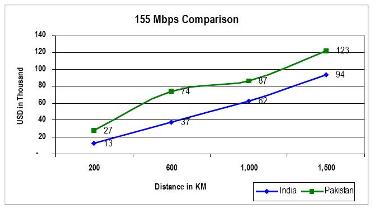


The chart (taken from PTA paper referred above) shows the comparison of domestic leased circuit tariffs between India and Pakistan.

As reported by the Pakcdma site:

Based on the LHC verdict, the PTA has called the LDIs, ISPs, software companies’ representatives and PTCL for a review meeting on its determination. In its August 7 decision, the LHC gave the regulator 60 days to reach a fresh plan of bandwidth rate cut, which has been long over due for the Pakistani market. The PTA was also directed to adopt the proper procedure for price determination by asking parties to submit and exchange their respective cases; holding a formal hearing; and issue fresh determination this time avoiding the pitfalls.

Read the PTCL response here. PTCL argued that the tariffs should be based on cost criteria.

Whatever the results may be, at least there is a process and some progress. Let’s hope for the best!

Babar Bhatti is a Telecom professional based in Dallas, Texas. See more at Babar’s blog: State of Telecom Industry in Pakistan.

Phillip Lionel Barton: Map Librarian, Alexander Turnbull Library, Wellington.(Obituary)

The Globe July 1, 2011 | Marshall, Brian Phil Barton was born in Cleathorpes, Lincolnshire, England, in 1925. He spent the last year of his formal education studying navigation at the Nautical School in Grimsby. Phil served with the Royal Air Force from 1943 to 1952, and the Royal New Zealand Air Force from 1952 to 1965. At one time Phil was the Administration Sergeant for the Air Force, and one of his tasks was maintaining a large collection of aeronautical manuals and maps covering airways and military and civilian airfields. The maintenance of this collection involved indexing, and dealing with the numerous replacements and amendments. When this job came to an end Phil arranged a transfer from administration to the RNZAF Education Service as a librarian. This he did from 1958 to 1965, at both Wigram and Whenuapai. Phil obtained his New Zealand Library Association Certificate in 1963 (and was granted an Associateship of the New Zealand Library Association in 1971).

Phil joined the National Library Service (NZ) in 1965, and worked on Graham Bagnall’s retrospective New Zealand National Bibliography to the year 1960. He became Map Librarian at the Alexander Turnbull Library in 1973, and held that position until August 1986, when he retired.

His mapping interests included Maori cartography, and mapping the Tararua Ranges, and he had papers published on these topics. He contributed a chapter to volume 2 of the History of Cartography (University of Chicago Press, 1998) titled ‘Maori cartography and the European Encounter’. Phil was a keen and accomplished tramper, and occasionally was involved in search and rescue operations when others got into trouble. His other interests included photography, navigation and book collecting. He managed to build up a magnificent collection of books relating to mapping and navigation. He was keen on radio, and was a member of the New Zealand Radio DX League. Phil had an impressive receiver which allowed him to listen to radio stations from many exotic places. As his health deteriorated Phil realised that he would have to dispose of his radio equipment, and much of it was donated to the Wellington Amateur Radio Club. see here new zealand map

He acted as Secretary and President of the New Zealand Map Keepers Circle / NZ Map Society at various times, and was a life member of the NZ Map Society. He was a regular attendee at the Society’s seminars. He also served on the committee of the New Zealand Cartographic Society, and on the ARANZ Cartographic Archives Committee.

The last annual seminar of the New Zealand Map Society that Phil attended was in 2004. After that he lost touch with the Society, and rather sadly suffered from memory loss in his later years.

Phil belonged to a variety of other cartographic organisations. These included, from time to time, the Australian Institute of Cartographers, the British Cartographic Society, the Australian Map Curators’ Circle, and the Society of University Cartographers. He was a Fellow of the Royal Geographical Society, and a member of the Hakluyt Society and the Society for the History of Discoveries.

Phil will be remembered for his enormous passion for maps, his considerable knowledge of them, and for always asking questions of speakers at Map Society conferences. He will be remembered as a slender wiry and amazingly fit man, always leading the way (from way out in front) when on a Map Society fieldtrip. Phil will be remembered for his interesting attire–even in the middle of winter he would wear shorts. He will also be remembered for his loud laugh, which was easily heard above the noise of any pub gathering.

Phillip Lionel Barton was born on 4 December 1925. He died peacefully on 17 June 2010 at Elizabeth Memorial Hospital, in his 85th year.

Publications about Barton:

SCADDEN, KEN, 1990, ‘The Barton Years’, New Zealand Map Society Journal, 4: 7.

[MARSHALL, BRIAN], 2001, ‘Cartobibliographies 2: Phil Barton’, Datum, 14: 9-10.

Publications by Barton:

1975, ‘Maps and Maori settlement to 1860′, New Zealand Cartographic Journal, 5(1): 2-3.

1976, ‘Bishop Selwyn’s Map’, Turnbull Library Record, 9:49.

1977, Aotearoa takes shape: an exhibition of maps and charts from the collection of the Alexander Turnbull Library illustrating the supposed great southern continent and the destruction of this myth and the emergence and mapping of New Zealand, Alexander Turnbull Library, Wellington, 20pp. web site new zealand map

1977, ‘A bibliography of material relating to the surveying and mapping of New Zealand’, The Globe, 8: 14-22. Also appears in New Zealand Cartographic Journal 7(1): 28-33 & 7(2): 19-23 and Bulletin, Geography & Map Division, Special Libraries Association, 109: 24-32.

1978, ‘New Zealand topographical maps: a status report’, Information Bulletin, Western Association of Map Librarians, 9: 219-220.

1978, ‘N.Z. maps: selection and acquisition’, New Zealand Libraries, 41:76-77 1978, ‘Maori geographical knowledge and maps of New Zealand’, Papers from the 45th Conference, Hamilton … 1978, compiled by A.P.U. Millett. NZ Library Assoc., Wellington, 181-189.

1979, ‘New Zealand metric topographical maps: 1:50,000 & 1:250,000′, New Zealand Geographer, 34: 110. Reprinted 1980, The Globe, 12: 78-81.

1979, ‘The National Map Collection’, New Zealand Mapkeepers Circle Newsletter, 7: 17.

1979, ‘A guide to the selection and acquisition of New Zealand maps’, Bulletin, Geography & Map Division, Special Libraries Association, 116: 36-39.

1980, ‘Maori geographical knowledge and mapping: a synopsis’, Turnbull Library Record, 13(1): 1-25. reprinted 1988, New Zealand Map Society Journal, 2: 2-21.

1980, ‘A National Union Catalogue of Maps (New Zealand): NUCM (NZ)’, The Globe, 12: 17-23; New Zealand Mapkeepers Circle Newsletter, 8: 14-17 and two other sources.

1980, ‘New Zealand National Bibliography’, New Zealand Mapkeepers Circle Newsletter, 8: 29-30.

1980, ‘The concept of a national map collection: Is it possible? Is it obsolete?’, The Globe, 12: 24-29; New Zealand Mapkeepers Circle Newsletter, 10: 17-20 & two other sources.

1980, ’5th New Zealand Mapkeepers Circle seminar’ (report), The Globe, 12: 35-36.

1980, ‘The history of the mapping of New Zealand’, The Map Collector, 11: 28-35.

1980, ‘Maps and New Zealand archaeologists’, New Zealand Archaeological Association Newsletter, 23(3): 178-183.

1981, The surveying and mapping of Wellington province 1840-76; an exhibition of manuscript maps, field books, sketches and water colours, photographs, a textbook and survey instruments … Alexander Turnbull Library, Wellington, 19pp.

1981, ‘Map collections and map librarianship in New Zealand: a synopsis’, Library Trends, 29: 537-545.

1982, ‘Map transit and storage’, Archifacts, 22:591-596.

1982, ‘Major national mapping agencies of New Zealand’, Bulletin, Geography & Map Division, Special Libraries Association, 129:58.

1982, ‘Report of Seventh New Zealand Map Keepers Seminar’, The Globe, 17: 66-67.

1983, ‘New Zealand historical map collections’, ImagoMundi, 35: 102.

1983, ‘Aspects of New Zealand national cartobibliography 1933-82′, New Zealand Mapkeepers Circle Newsletter, 15: 3-9.

1983, Letter [re.: Limits of Oceans and Seas, ed.3, International Hydrographic Bureau, 1953], The Globe, 20: 59.

1984, ‘Maps for direction finding and navigation with emphasis on those held in the map collection of the Alexander Turnbull Library’, New Zealand Mapkeepers Circle Newsletter, 17: 2-7.

1985, ‘Of maps and men!’, Archifacts, 1985(3): 5-8.

1986, ‘James Cook’s charts and draughtsmen’, Archifacts, 1986(3): 26.

1987, ‘Opening Address, 12th New Zealand Map Keepers Circle Seminar’, New Zealand Map Society Journal, 1: 2.

1991, ‘The map and place name concepts of pre-literate peoples with special reference to Maori map concepts and place names’, New Zealand Cartographic and Geographic Information systems, 21(1): 1016. Also appeared as ‘Map and place name concepts of pre-literate peoples’, New Zealand Map Society Journal, 5:13-17.

1995, ‘History of Cartography: Indigenous Mapping’, New Zealand Map Society Journal, 9:61-62.

1996/7, ‘Surveying and mapping the Tararua Mountain system’, Historical Journal, Otaki Historical Society, 19: 16-27 & 20: 40-50.

1998, ‘Maori Cartography and the European Encounter’, The History of Cartography, vol.2, pt.3 Traditional cartography in African, American, Arctic, Australian and Pacific Societies, David Woodward & G. Malcolm Lewis (eds.), University of Chicago Press, Chicago & London, pp.493-536.

Marshall, Brian

Related Posts with Thumbnails

15 comments posted

Comment Pages: [2] 1 » Show All

  1. aslam says:
    September 21st, 2007 6:45 pm

    this sale of PTCL was a selling junk to innocent eitisalat, the fact is that with the new technologies like WLL and VOIP the existing structure was already obsolete, and just mere junk, rubbish, and scrap, the exchanges were scrap,, tha lines were no use over used, dirty mess, PTCL was a big ugly junk yard,
    they have put this dirty mess in eitesalats neck,

    the VOIP and WLL is far much advanced and easy to use , mainntain , establish, and at fraction of the cost of current set up, so instead of throwing this junk in to gutter they cleverly put it into someone elses pocket,

    the disadvantage is that ultimately people will have to pay for it all, eiteslat will manage to get out what it has spent, governement has sold tha junk,

    but people will suffer becaus this will delay the VOIP and WLL , these things should have been widely installed by now and in common use, but government and eitisalat will delay them till they eat to their full tummy,

    the ptcl was a institution which was made to serve public,
    but what happened was that public was made to suffer for the intrests of the instition of ptcl.

    ptcl never allowed private internet companies to establish, they always boosed the isps, all isps have to buy form ptcl,

    if tata or other international companies were allowed we would be on fiber optic 10mb per second connection,

  2. Barkan Saeed says:
    February 17th, 2007 10:49 am

    Just read the news that PTCL stay has been cancalled by the high court..

    Any ideas on what the new tarrifs are going to be ??

  3. December 5th, 2006 10:14 am

    The battle goes on. This just in: The Lahore High Court (Rawalpindi bench) has granted PTCL stay against the Pakistan Telecommunication Authority’s decision to reduce bandwidth prices after an Etisalat-run company challenged the determination for the second time. See:
    http://www.thenews.com.pk/daily_detail.asp?id=3421 7

  4. HS says:
    October 16th, 2006 4:50 pm

    This is not about free market or anything. The goevrnment reddices teh rates for teh expliccit purpsoe taht the savings are passed on to teh customer. BUt they were not. That is what this is all about.

  5. Asif says:
    October 16th, 2006 1:29 am

    I am not sure what the big deal is. We have now privatised the company. Lets stop interfering in their work. Why should they not make a profit. This is not communism!

  6. PakiNetizen says:
    October 15th, 2006 8:21 pm

    I believe this is still being worked on and no decisions have been made yet.

  7. Abrar says:
    October 15th, 2006 12:35 am

    Does anyone have a sense of how this issue was finally resolved… or has it not been resolved yet

Comment Pages: [2] 1 » Show All


Have Your Say (Bol, magar piyar say)

Please respect the ATP Comment Policy.

Keep comments on topic; no personal attacks; don't submit indecent, inflammatory, slanderous, uncivil or irrelevant comments; flamers and trolls are not welcome; inappropriate comments will be removed or edited.

If you won't say it to someone's face, then don't say it here!

Readers who want to use a URL should please use the TINY URL program.

Thanks, and keep the comments coming!