ATP Poll Results: Chief Justice Chaudhry Iftikhar’s Removal

Posted on March 16, 2007
Filed Under >> Adil Najam, ATP Poll, Politics, People, Law and Justice
77 Comments
Total Views: 16756

Adil Najam

Today Chief Justice Chaudhry Mohammed Iftikhar is to appear again in front of the Supreme Judicial Council (SJC). It is not at all clear what will happen today or in the days to follow. But the verdict from ATP readers does seem to be quite clear.

(Click above to view larger image)

The last week has been a whirlwind of disturbing development. Starting with the removal of Chief Justice Chaudhry Mohammad Iftikhar by the President, things just kept going from bad to worse. Protesting lawyers were mistreated, as was the Chief Justice, Minister Wasi Zafar embarrassed himself as well as the nation yet again, and most recently we saw that not just the judiciary but also the press is under stress as private TV channels are told to cool off and the GEO TV news show by Kamran Khan was banned.

We have tried to look at and make sense of these events fromvarious angles, including the poetic. But like Pakistanis everywhere we remain confused and concerned about the direction of events. Things seem to be spinning out of control. The government seems to be panicking. And public frustration with the turn of events is escalating.

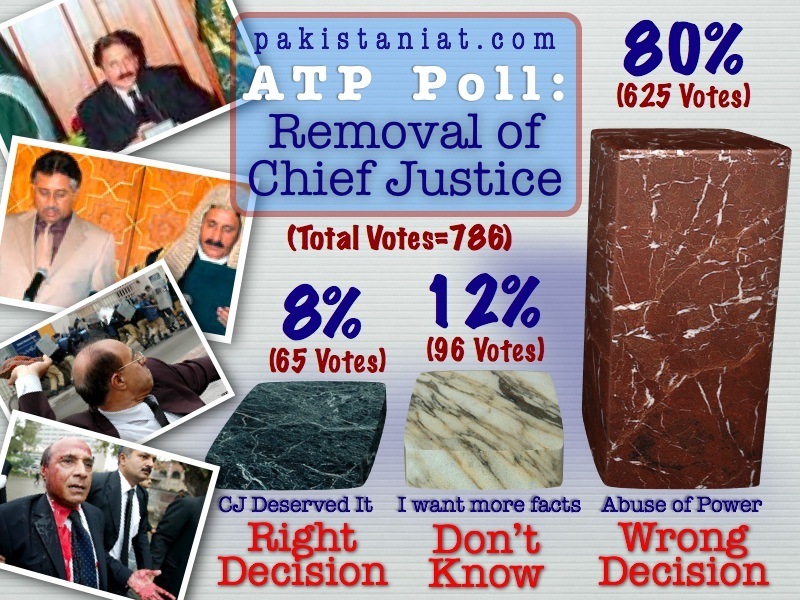
But one thing is very clear. Much more clear, in fact, than one might have imagined. It is not just that these events have left Pakistanis rattled, it is also that the sacking of Chief Justice Chaudhry Mohammad Iftikhar is not supported by many - and possibly most - Pakistanis. At least this has been the result of the ATP Poll that we have been running the last many days and which we today closed. Notwithstanding the fact that this was not a scientific poll and was subject to all the (many) limitations and problems of web-based polls, this is a result one can be quite confident of. Indeed, one did not need to run a poll to come to this conclusion. It is obvious from the reaction of the lawyers, of judges, of shopkeepers, of the media, of bloggers, and just about everyone else. However, our poll results do strongly validate the all-too-evident view. Here are some highlights:

  • At the time of closing the Poll a total of 786 responses had been recorded (not including some 60 duplicate responses that were discarded).
  • Of these 625 votes - a whopping 80 per cent - believe that the decision to remove teh Chief Justice was a wrong one and an expression of abuse of power by the President.
  • Only 65 people - a mere 8 per cent - believe this to have been the right decision.
  • 96 votes - 12 per cent - were for the ‘Don’t Know’ option; signifying that these people wanted more facts before they made up their mind.
  • Votes were still trickling in at a steady pace when we closed the poll, but the interesting - and very surprising - finding is that the proportions for the three options have remained steady and nearly unchanged from the very beginning. Between 78-80% consider the decision wrong; around 8-9% consider it right. From the very beginning, this proportion never really changed even as events took many unforeseen twists and turns. (Compare this, for example, to our current cricket poll, where the response proportions have fluctuated widely over about the same period). This, in fact, is one reason why we closed the poll; it seems that what needs to be learned from it has been learnt - i.e., this decision is strongly rejected at least by the type of Pakistanis who woudl visit bogs like this!
  • If one looks at the comments that go with the various posts on the subject, it is very striking that many people say that they were Musharraf supporters but are no more; that this and other recent events have pushed them out of that camp. Indeed, it seems from the comments that this vote is more ‘against’ Gen. Musharraf than ‘for’ Chief Justice Iftikhar.
While one must never over-analyze such non-scientific web-based polls that necessarily give only a snapshot of a limited internet-savvy community, the rather decisive numbers and the content of the accompanying comments suggests that the result is, in fact, rather robust. Long time readers of ATP will also realize that although the reader participation has been very enthusiastic, excited and even emotional, for most part most people have actually been in strong agreement. Indeed, while this has been an emotional discussion, it has not been a confrontational or even controversial one!

To end on a personal note, I want to say something about comments of despair for Pakistan that some people left here or are being made at other blogs. I must confess, I do not feel despair. Indeed, I think ordinary public - particularly lawyers, but also others including bloggers - have demonstrated that at our core we as a society DO WANT DEMOCRACY. Earlier this evening I was giving a lecture at Harvard University (Kennedy School of Government) on democracy in Pakistan and there I introduced the notion that “Pakistan is a democratic society trapped inside an undemocratic state” and that “this moment we are living through right now is a quinessentially democratic moment; a moment of turbulence, but also of hope.”

While the abuse of democratic norms by state institutions should be rightly condemned, let us not forget to celebrate the courageous and honest demonstration of democratic values by societal forces, including the legal profession, journalists, and ordinary citizens. Ultimately, it is not as much a question of ‘who will win’ as a question of whether the societal urge for democracy will overwhelm the statal desire for control… and, in that process, transform the state.

P.S. This video news report clip from GEO includes Gen. Pervez Musharraf’s response to the current state of affairs. In fairness, we should also give this a hearing.

77 comments posted

Comment Pages: « 10 9 [8] 7 6 5 4 3 2 1 »

  1. KAWA1 says:
    March 29th, 2007 4:10 pm

    I just saw the picture of CJ being harassed by the police. The picture posted by Adil Najam, March 16.

    If this can happen to CJ, can you imagine what they can do to the likes of you and me (ordinary citizens). The picture is disgusting and shows the true character of the people in uniform, who have always somehow considered themselves to be above the law.

  2. KAWA1 says:
    March 28th, 2007 3:14 pm

    moazzam raza tabassam Mar 21st, 2007 at 6:41 am

    Your article was worth reading. Thanks for sharing your views. I don’t know what more to add except feel a strong sense of frustration.

    It scares me with the thought that this country will fragment. We already lost 1/2 of the country by army rule. Baluchistan and NWFP will be next!! Sindh is already alienated so that leaves Punjab.

    MAYBE ONE DAY PUNJAB WILL BE KNOWN AS PAKISTAN AND THEN WE CAN KEEP JUST ONE PERSON AS ARMY HEAD/HEAD OF STATE.

  3. Anwaar says:
    March 27th, 2007 8:00 pm

    I am surprised tha now that teh CJ can speak freely, why dont we hear anything from him. Has he made deal with govt?

  4. The Patriot says:
    March 26th, 2007 3:23 am

    Look how beautifully this topic has been described on this page:
    http://www.frihost.com/forums/vt-68465.html

    But the reply to it is not very beautiful

  5. Realist says:
    March 22nd, 2007 12:06 pm

    Here is a prediction. The government will back off and the CJ will be reinstated. He will make a deal with the government and will eventually preside over the continuation of Musharraf in uniform. He has become a hero for the moment but this is not a man who has proved to be a man of principles and he will not emerge as one now. God save Pakistan.

  6. Lahori says:
    March 21st, 2007 12:18 pm

    The new video you have on the side is great show….. but the video part does not work for me, only audio…. is that our friend Wasi Zafar in the audio!!!! Seems like he is to his old games!

  7. moazzam raza tabassam says:
    March 21st, 2007 6:41 am

    Islamabad and other Pakistani cities have seen violent confrontations in recent days between security forces and lawyers, opposition political activists, and ordinary Pakistanis opposing the attempt of the country’s US-backed military strongman, General Pervez Musharraf, to fire the head of the Supreme Court, Chief Justice Iftikhar Mohammad Chaudhry.

    To prevent protests last Friday when Chief Justice Chaudhry was to appear before the Supreme Judicial Council, the police detained scores of political leaders. Then, in an attempt to stop live broadcast of the protests, which occurred nonetheless, the police raided the private GEO television station, ransacked the facility, and roughed up many of the station’s personnel.

    Later that day, Musharraf, who seized power in a military coup in October 1999 and is touted by the Bush administration as one of its chief allies in the “war on terror,� found it politic to appear on television and condemn the police raid. While some low-level police were subsequently suspended, according to eyewitnesses the raid was led by senior police officials.

    On March 9, Musharraf suspended Chief Justice Chaudhry, accusing him of “misconduct and misuse of authority,� ordered the judicial council to investigate corruption allegations, named an interim head justice, and effectively placed Chaudhry under house arrest.

    The corruption charges are a transparent ploy. It is well known that the current cabinet and the government benches in the Pakistani parliament are stacked with politicians whom Musharraf induced to defect from Benazir Bhutto’s Pakistan People’s Party (PPP) and Nawaz Sharif’s Pakistan Muslim League (Nawaz) by gathering, then suppressing, evidence of their corrupt practices.

    If Chaudhry has been targeted by Musharraf it is because the president, who doubles as the head of Pakistan’s chief of armed services (COAS), views him as politically unreliable. This at a time when Musharraf needs a pliant Supreme Court since he is planning to stage-manage his reelection for a further five year-term and remain COAS head indefinitely, both in flagrant violation of the country’s constitution.

    Under the Pakistani constitution, the provincial and national legislatures constitute the electoral college that chooses the country’s president. Convention calls for the president to be chosen shortly after the electorate has selected Pakistan’s provincial and national legislators.

    However, Musharraf’s underlings have let it be known that the general-president is preparing to have the current provincial and national legislaturesâ€â€?chosen in 2002â€â€?“reelectâ⠂¬Â? him president later this year. Not only is the mandate of these legislatures five years old, the elections that gave rise to them were a travesty of democracy.

    Neither Benazir Bhutto nor Nawaz Sharif was allowed to participate and the military regime placed all manner of restrictions on the election campaigns of the PPP and the other opposition parties. Meanwhile, the state machinery was mobilized behind the pro-government parties and the MMA�an alliance of Islamic fundamentalist parties that have traditionally enjoyed the patronage of the military and have frequently come to Musharraf’s aid�was allowed to campaign freely.

    Musharraf knows full well that his attempt to fix his reelection and to cling to the post of head of Pakistan’s armed forces will be subject to court challenge. If he is to have any chance of withstanding the surge of popular opposition that this latest blatant attempt to perpetuate his dictatorship and rob the Pakistani people of their basic democratic rights will provoke he will need the Supreme Court’s stamp of approval.

    Pakistan’s opposition parties, human rights organizations and virtually all lawyers’ organizations in the country have denounced Musharraf’s moves against Chief Justice Chaudhry as unconstitutional. The president can, they say, initiate a misconduct case against a chief justice, but he cannot prevent a justice from performing judicial functions, let alone stop him from moving freely about the country.

    Even elements in the pro-Musharraf Pakistan Muslim League (Quaid-e-Azam) have sought to distance themselves from the president’s handling of the Chaudhry affair. PML-Q President Chaudhury Shujaat Hussain said last week, while on a visit to New York, that the suspension of the chief justice was an “internal matter between the army and the judiciary.�

    The Musharraf regime is enveloped by multiple crises. While the Bush administration is demanding that Islamabad do more to crush the Taliban and expects Pakistan to be on-side in any US military action against its western neighbor Iran, popular opposition to Musharraf’s complicity in US aggression is mounting. According to the findings of a recent poll conducted by Gallup Pakistan, 83 percent of Pakistanis say that in the conflict between America and Taliban, their sympathies are with the Taliban and 75 percent are opposed to the US’s use of Pakistani air bases.

    The resource rich province of Baluchistan has been rocked by a nationalist insurgency for the past two years. And the army was forced to accept a humiliating truce with tribal groups, after losing some 800 troops in an attempt to extend the government’s writ into tribal areas that border Afghanistan and have traditionally enjoyed autonomy.

    Last but not least, there is growing popular anger over the increased economic insecurity and poverty that have resulted from the Musharraf regime’s neo-liberal economic policies. The price of essential commodities has risen by an average of about 50 percent in the past five years.

    If Musharraf has survived, it is because of the strong support of Washington and because the bourgeois opposition is terrified that any popular movement will threaten the unity of the military and the power of the Pakistani state that is the bulwark of their own privileges.

    Pakistan’s courts have traditionally acquiesced before the military and military rulers.

    Chaudhry himself has been a party to a number of rulings that provided a legal fig-leaf for the Musharraf dictatorship, including the Supreme Court decision that legitimized his 1999 coup and another upholding the 2002 referendum that installed him as president.

    But since becoming the head of Pakistan’s judiciary in 2005, he has issued a number of rulings that have cut across the government’s agenda, clearly raising doubts in Musharraf’s mind as to whether he can be relied on to rubber-stamp the general’s “reelection� and, should the need arise, the brutal suppression of any challenge to his rule.

    According to BBC, Chaudhry told trainee military officers in February that, in his opinion, “General Musharraf could not continue as army chief beyond his present term as president.�

    Just a day before his removal, the chief justice heard a case related to “forced disappearances� of persons whom the authorities suspect of ties to Islamacist terrorist groups and expressed strong disappointment over the government’s failure to locate the whereabouts of the disappeared. Hundreds of people have reputedly been illegally abducted by shadowy security forces, held without trial, and tortured.

    Chaudhry was also the principal author of an August 8, 2006 decision that struck down a deal the government had made to sell Pakistan Steel Mills, the country’s largest industrial concern, to Russian, Saudi and Pakistani investors for what most observers considered a fire-sale price. In his judgment, the chief justice said the entire transaction was a “violation of law� and raft with “gross irregularities,� fueling public suspicions that members of the government and their business friends stood to benefit handsomely from the privatization deal.

    In a judgment earlier this year, Chaudhry further riled the military and government by directing the Balochistan government to submit a detailed report about illegal allotments of 241,600 acres of land to ministers, politicians and other bureaucrats in Gwadar, the site of a massive new port facility.

    Musharraf’s attempt to sack the chief justice has clearly gone awry. According to Stratfor, a private intelligence firm with close ties to US security agencies, “Musharraf might not be the only casualty to this crisis; the military’s hold on power could be weakened once the dust settles.�

    The Bush administration remains determined, however, to prop up Pakistan’s authoritarian regime.

    After making a ritualistic appeal for Pakistani police to “allow for free protest,� US State Department spokesman Sean McCormack lauded Pakistan’s military strongman last Friday: “President Musharraf is a good friend and ally in the war on terror. He has a vision for Pakistan in terms of political and economic and social reforms, and he is proceeding along that pathway.

    “Is there more to do? Yes, absolutely.

    “But President Musharraf is acting in the best interests of Pakistan and the Pakistani people.�

  8. Saad says:
    March 21st, 2007 2:59 am

    You’re most welcome Samdani.

    Capital Talk - Sudden delay in trial, why? - political alliances

    Part1:
    Part2:
    Part3:

Comment Pages: « 10 9 [8] 7 6 5 4 3 2 1 »


Have Your Say (Bol, magar piyar say)

Please respect the ATP Comment Policy.

Keep comments on topic; no personal attacks; don't submit indecent, inflammatory, slanderous, uncivil or irrelevant comments; flamers and trolls are not welcome; inappropriate comments will be removed or edited.

If you won't say it to someone's face, then don't say it here!

Readers who want to use a URL should please use the TINY URL program.

Thanks, and keep the comments coming!