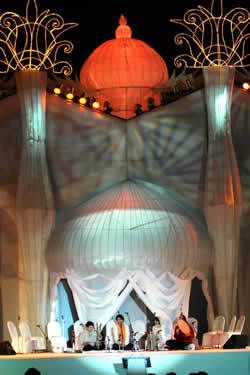
I had heard of Doctors without Borders and Reporters without Borders, but when I saw a headline in a Pakistani newspaper about Mystics without Borders, it was a first for me and certainly caught my attention.
It turns out a fascinating festival by the name of the “International Mystic Music Sufi Festival” is currently being celebrated in Karachi at the Bara Dari. The festival is being organized by the Rafi Peer Theatre Workshop, which is also the group that has been responsible for the popular World Performing Arts and Theatre Festival held annually in Lahore.
This Sufi festival is the first of its kind in Karachi and certainly an encouraging sign that people are able to express and share their sentiments, devotion, spirituality and passion in diverse ways. This festival is expected to last until May 7, and with an entrance fee of just Rs 300, it promises a lot of entertainment and education to Karachiites. According to the organizers, performers from over 70 countries have been invited to present their specialties in muslim sufi rituals, including music, songs and dances. There are performers from as far away as Syria which can be a delight to watch.
ATP has written before (here, here, here, here, here and here) on some of the great mystic poets and we wish to join the participants in this festival in spirit.
According to the media report:
Usman Peerzada of the Rafi Peer Theatre Workshop said that the group’s main aim had been to bring festivals to Pakistan since 1992 and now, as a result of their efforts, the World Performing Arts Festival had become the largest festival of Asia. “Festivals are living festivals and we aim to make the Sufi festival into just that. So please, own the festival,” he said in his address to the audience.
Daily Times spoke to Faizan Peerzada, the master-mind behind the show, to ask him what his audience could expect out of this festival. “A lot of variety. Some of these performers, like the Syrian performers can alone perform for four hours, but we have condensed it into a performance of 32 minutes so that we can manage 17 performances in one day. We have tried to bring together as many performers here as was possible and each one of them is performing a different Islamic tradition, so there’s a collection of so many aspects, which makes this festival unique.”
and the performances so far seem to have kept up to their high expectations:
The curtain raiser began with a performance by Zain-ul-Abideen Shah also known as Jumman Shah and his troupe of five people who sang a qafi by Shah Abdul Latif Bhittai. Their performance was followed by a mind-blowing performance by Mithoo and Goonga Saeein, who presented an instrumental using dhols while three of their members whirled around, representing the ecstasy so indispensable to the Sufi tradition. The next performance was by an Iranian four-member group called Bidaat, after which Kathak dancer Sheema Kirmani stole the show with her brilliant performance on Ameer Khusro’s aaj rang hai. With her group of two male dancers and two female, she brought the words to life and used the vacuum of the stage as a canvas portraying a beautiful painting that she successfully displayed to an audience that erupted in a round of applause for her.
Another one of the most appreciated performances of the curtain raiser was by Saeein Zahoor who performed a kalaam by Baba Bulleh Shah. Zahoor is a recipient of the BBC World Music Award and performed for an approximate 10 minutes, not a single second of which could be termed as a ‘drag’. A Syrian group called “Sham group of Syrian and Andalusian Music” performed next and recited verses from the Holy Quran.
We hope this Sufi Festival will become a local tradition, and that such art, folk, mystic, music, poetic, dance, and religious festivals will be held regularly in a city that still hosts one of the most diverse and culturally steeped citizenry.




Someone might like to read lengthy RAND report which I mentioned on other post. There is also a section titled “Sufiism” that how west is keen to promote fake suffism and ‘enlightment and moderation’ in ME and Pakistan. I have uploded on my site:
adynan.googlepages.com/RAND_MG574.pdf
[quote post=”695″]the “sufismâ€
Salamalikum,
Just to reinforce what zakoota had to say above. In the book Tahqeeq ma li’l-Hind (translated in English under the title “Albernui’s India”), Mohammad ibn Ahmed al-Biruni writes (translation):
“The Indians in our time make numerous distinctions among human beings. We differ from them in this, for we regard all men as equal except in piety. This is the greatest barrier between them and Islam.”
Of course, Alhamdulillah, for part of India al-Biruni’s (died 1050) fears didn’t come to pass. But, his analysis was dead on. Also, note that al-Biruni was talking about India as a whole. Islam had already spread in western and northern Hind a few centuries before (~700 CE). Note that al-Biruni wasn’t an Islamic scholar but historian/mathematician, etc. But, most probably understood Islam better than any of us today.
Salamalikum,
Mahi, as I said the answers might seem simple to you because it won’t involve paradoxes, but rest assure it would be a sound answer based on evidence, inshaAllah. That you don’t find ambiguity in Bilal’s questions is simply amazing. May Allah increase our knowledge in Islam.
Adnan: There are two issues here. I’m not denying the fact that sufism took hold in Hind but I’m challenging that it was spread through sufis exclusively. Indeed, some sort of sufism has taken hold in almost all Muslim areas from Marakash to Indonesia. But, to say that Islam spread because of sufis is defintely not correct. But, we can agree on this: the “sufism” that involves halwa making, praying in shrines, dancing, music, qawalli, dhammal, shaking heads, looking like “malang”, etc. isn’t part of Islam.
la hol: Ameen, may Allah make my heart soft and hearts of all of us, inshaAllah. But, I want to know how did you get the idea that I was picking on “innocent people”? Please do explain. Of course, this is not the forum to discuss theologically the merits of tasawwuf in Islam, but clearly, as Adnan has been saying, dancing, music and such isn’t part of Islam or tasawwuf. The tasawwuf defined by Deobandis or Al-azhar or in Damascus—the type Adnan has been talking about—its legitimacy can be analyzed/debated but dancing and music being part of Islam? Please think about it.
[quote post=”695″]Questions like these becomne reasons for Bidat[Innovations] in Islam when people try to justify their personal fantasies by associating with religion.[/quote]
MashaAllah, great sentence as zakoota acknowledged. Beautifully put. May Allah increase your knowledge and knowledge of all of us.
[quote post=”695″]The system in which there was no castes, no discrimination on colour or race. Karen Armstrong in one of her books gave an excellent statement, she said, “Islam is intolerant of injusticeâ€
[quote comment=”46395″]Salamalikum,
[quote post=”695″]If I am not wrong, Islam mostly spread in the Indian subcontinent through the efforts of Sufis
100% true.[/quote]
No, not 100% true. It’s very sad that I couldn’t find the reference but if you buy a book called “Sunnat aur Bidaat ki kashmakash”, janab Mahirul Qadri explains in it somewhere that this is propaganda that Islam was only spread through Sufis. I looked through the book but couldn’t exactly find it there, but did read it in this book and other places.
[quote post=”695″]Until Saudi Arabian oil boom started funding Salafiism worldwide, it was the Sufis’ Islam (which is softer, non-violent and more palatable) was predominantly practiced in Pakistan. [/quote]
See, here’s the problem. You guys just don’t have enough knowledge on these topics and then write whatever you think. You mix current affairs with history. Read some history, if only of Sub-continent. I’m from ahl-e-hadith/wahabi/salafi/whatever you want to call it, and I’ve read the tareekh of ahl-e-hadith. The ahl-e-hadith movement is as old as Islam itself. In fact, as the tradition of all scholars of Islam, Shaykh Muhammad bin Abdul Wahab also traveled to learn knowledge and he came to Hind as well to from scholars here. Now, how could it be that “Wahabism” came after ibn Abdul Wahab through oil money, huh? Below, are some of the names of ahl-e-hadith “wahabi” people in Hind long before Saudi Arab or their oil money:
*Imam alfazal adamti (died 1386). Note that again, 1386 AD. Long, long before ibn Abdul Wahab was born.
*Hafiz Nuruddin Haithami (died 1387)
*Allama Majiduddin Ferozabadi (died 1406)
*Shah Abdul Aziz Muhadith Dhelwi (son of Shah Waliullah)
*The great Nawab Sideeq Hasan Khan Bohpali who revived the tradition of ahl-e-hadith in Hind (died 1886—long before SA oil money!!)
*The great Shah Ismail Shaheed–writer of Taqwiatul Iman.
And there are many in between and if you want I can post ALL the names I know from each century. But, due to space and this forum I didn’t. So, read and gain knowledge before you speak. Extrapolating history from current affairs is not the way to go. Just because you came to know about ahl-e-hadith/wahabi in the last few decades or so doesn’t mean it was spread outside of what’s now Saudi Arabia because of SA and its oil money.
[quote post=”695″]Had the invaders brought along the puritanical Salafi/Wahabi version of Islam, I doubt there would have been so many takers of that religion in India.[/quote]
What are you saying? So that when Muhammad bin Qasim or Mahmood Ghaznawi came, they brought “wahabi”,puritanical school of thought with them, huh? The practices of bidaat practiced in India were very similar to being practiced in what’s now Saudi Arabia and Shaykh ibn Abdul Wahab fought against removing those horrible bidaat from his land. So, your assertion that India’s Muslims have these bidaat because of the background of the land is completely unfounded. Go to Syria, parts of lower Egypt, etc. and you’ll see the same ghaleez actions taking place.
[quote post=”695″]Why can’t we have a local tinge to Islam, which was primarily evolved in an Arabian milieu, to adapt it to local conditions?[/quote]
Islam is universal in its teaching and practices and self-adapting. Yes, if a cultural thing doesn’t go against Islam’s teaching, nobody says that’s wrong (the idea of urf). But, these practices mentioned here about music, dancing, etc. (and on top of it calling them religious) violate the rules of Islam.[/quote]
Ibrahim I’m glad you explained it very well. The biggest influence of Islam on the people of Subcontinent was the extensive and comprehensive system of justice, which the people living in the region never saw before. The system in which there was no castes, no discrimination on colour or race. Karen Armstrong in one of her books gave an excellent statement, she said, “Islam is intolerant of injustice”. I agree with her 100%. It was the justice in Islam that helped spread it everywhere including the subcontinent.