Adil Najam
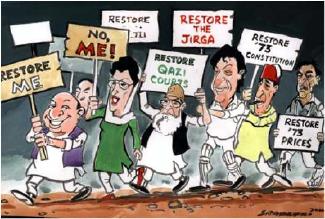 I was going to use the term APC – All Parties Conference – in the headline but just realized that Dawn is now using the term MPC – Multi-Party Conference – to describe the meeting of opposition parties which is to begin in London within a few hours.
This is not just a semantic issue, it highlights one of the many challenges faced by this very important meeting which was already postponed once and will now be held under the shadow of the ongoing Lal Masjid operation in Islamabad.
An editorial in The Nation, lays out some of the key challenges.
DESPITE the diversion created by the Lal Masjid operation, many in Pakistan are keenly waiting for the outcome of the two-day APC convened by Mian Nawaz Sharif in London. Besides the ARD and MMA it is being attended by the nationalist parties and minority representatives. While Ms Bhutto has declined to attend the meeting despite being in London, she will be represented by a PPP delegation led by Makhdoom Amin Fahim. A committee of PML-N and PPP leaders has reportedly finalised the joint document to be issued at the end of the conference. This is likely to underline commonly agreed points like the restoration of the 1973 constitution as it existed prior to the military take over on October 12, 1999, formation of an interim set up and a neutral Election Commission in consultation with the opposition, an independent judiciary and the return of the exiled leaders.
What remains to be seen is how the participants resolve some of the issues and overcome suspicions that continue to divide them. The MMA has accused Ms Bhutto of trying to broker a power sharing deal with General Musharraf. The PPP, on the other hand, has challenged the religious alliance to resign from the Balochistan cabinet to prove its credentials as an opposition party. The nationalist parties accuse the others of ignoring the key issue of autonomy and want ironclad guarantees on it, while on their way to London, some of the MMA leaders have again condemned the PPP leadership in a veiled manner. To pre-empt criticism by the sort, Makhdoom Amin Fahim categorically ruled out on the eve of the APC any possibility of understanding with General Musharraf. He also maintained that the party would abide by all decisions taken by the APC with consensus.
Those participating in the APC hope to produce an action plan to remove Gen. Musharraf. It is here that the opposition stands badly divided. The PPP disagrees with the proposal to resign from the Assemblies in case the President was to seek election from them. Similarly, it insists on taking part in elections even if they are held under him. Most of the opposition parties, however, take a different stand on the issue. They also favour initiating a countrywide movement to remove the government. The PPP, on the other hand, maintains that nothing should be done to provide an excuse to the government to impose emergency and postpone the elections. Unless the opposition leaders devise an agreed action plan, and the exiled leaders announce a final date of their return, the APC is likely to be considered an uninspiring exercise.
Lets explore some of these points.
Much is, of course, being made of the timing of the Lal Masjid operation and how it might divert diverts attention from this meeting of the opposition. The timing is, indeed, suspicious. But then, given the state of current Pakistan politics, just about any timing would have been suspicious given that the government had let the Lal Masjid militancy brew for so long. The head of the Alliance for Restoration of Democracy (ARD), Makhdoom Amin Fahim of PPP believes that the timing will affect the APC but is probably not a conspiracy.
Indeed, the distraction – which is very real – may well be the least of the challenges that the assembled leaders will have to face and resolve. The meeting has already been postponed once (in March, because of the Chief Justice issue) and postponing it again woudl not have been well-received. However, the real significance of the Lal Masjid operation is NOT the distraction, it is the very real differences amongst the assembled parties that it brings to fore. The issue is whether they can agree on dealing with religious extremism. It is not at all clear that they can; nor is it clear how their constituencies will react if they do. Tactically, the best approach for them would be unite against the ‘way the operation was carried out’ (on which they can agree) rather than to try to find a consensus on their views about the Lal Masjid and its leadership (on which they may not be able to agree).
.jpg) There are also other significant differences within the opposition parties. The only thing that binds them is a desire to oust the Musharraf government, and even on that they seem unsure. Benazir Bhutto is refusing to attend even though she is in London right now. She argues that MMA is not really an opposition party because it is a government partner in two provinces. MMA for its part has raised the issue of whether there are any ‘deals’ between Benazir Bhutto and Pervaiz Musharraf. It has also been argued that if she can ‘talk’ to the government she should also be able to ‘talk’ to MMA. This rift and these mutual doubts are serious but will not be show stoppers, PPP will be represented but not by Benazir Bhutto. If steered rightly, the meeting will focus on what they can agree on rather than what they disagree on.
There are also other significant differences within the opposition parties. The only thing that binds them is a desire to oust the Musharraf government, and even on that they seem unsure. Benazir Bhutto is refusing to attend even though she is in London right now. She argues that MMA is not really an opposition party because it is a government partner in two provinces. MMA for its part has raised the issue of whether there are any ‘deals’ between Benazir Bhutto and Pervaiz Musharraf. It has also been argued that if she can ‘talk’ to the government she should also be able to ‘talk’ to MMA. This rift and these mutual doubts are serious but will not be show stoppers, PPP will be represented but not by Benazir Bhutto. If steered rightly, the meeting will focus on what they can agree on rather than what they disagree on.
 The real momentum behind the meeting comes from the Lawyers’ Movement in support of the Chief Justice. Till now the opposition parties have, literally, held on the coat tails of the lawyers who are clearly the leaders of this movement. The political reality is that it is the lawyers and not any political party that has captured the public imagination on this issue; not yet. But on the issue of the restoration of the institutional integrity of the judiciary, the parties do agree. The success of this London meeting will depend in great extent of whether they can build on this agreement to craft agreement on other issues, especially on the issue of the uniform and the next election.
 And the next election, including the uniform issue, is really what this meeting is really about. The success of this meeting will – and should – be judged by whether the opposition parties can agree on a clear and united strategy on these issues. It is far from clear whether they can. They all have stated a public support for democracy, an opposition to the future of the presidency in uniform, and to transparent elections. However, too many Pakistanis doubt the level of their commitment. The real challenge before the leaders assembling in London is to convince Pakistanis that such doubts are unfounded.
.jpg) Will this meeting be able to demonstrate resoundly that such commitment actually exists? Will the parties be able to arrive at and state clearly a common position and a clear strategy on these issues? Will they be able to excite the public and convince them that the parties goal is not simply to get back to power but a deep and real commitment to democracy?
Will this meeting be able to demonstrate resoundly that such commitment actually exists? Will the parties be able to arrive at and state clearly a common position and a clear strategy on these issues? Will they be able to excite the public and convince them that the parties goal is not simply to get back to power but a deep and real commitment to democracy?
If the meeting is able to do so, it will indeed be historic. If not, it will soon be forgotten; and not because of the Lal Masjid distraction.




Fazlur Rahman is there to represent the mulla military alliance. His statement to not support the CJP is disgraceful. He is a traitor to the nation. The same mullas opposed the Pakistan movement, now they are opposing the movement by the lawyers to save Pakistan
BB sent her goon Jahangir Badar to sabotage the APC. So far he has clashed with Mr Bilour and Sajid Mir.
The worst leaders are Benazir and Moulana Fazlur Rahman. Its shameful that they are blaming each other when they were partner in the past. Benazir is still looking to get something from Mush at any cost. Her actions and words have proved that she is selfishness embodied.
I think the role of the opposition in bringing change to the country is over-stated. Parties are nothing but the manifestation of the will of the people. If people change, parties would too. Pakistan is just too big to be left to the whims of the Generals, political leaders, mullahs or the lawyers. 160 million people can’t just be shepharded by these self-proclamied shephards. Change would come once people change and I see many signs of it.
1) Unlike the 1950’s, Pakistan is much more urban today. Eight of the Pakistani cities have populations of 1 million or more. I wonder if the waderas hold any sway on these urbanites or are they really as naive to believe any General who tries to “command” them. I think they are not.
2) Economically Pakistan is much different now. Not just because of the “more than 7% growth rates” over the last few years but because of continuous growth over the last 60 years, Pakistan’s economy has witnessed much change over the years. Earlier people would make careers in public sector, including the Army, the bureaucracy and other gorvernment jobs. Now people have so many different options that they do not consider public sector as the profession of choice. That gives them more freedom to choose, the sine qua non of democracy.
3) Earlier people would start their careers in one organization and would only leave it once retired. Now people leave the organizations they don’t like so the organizations would have to change their mindset and become more employee friendly. That would also induce more confidence into the people and they would demand more freedom.
4) The raised level of consciousness among the people. Now people are openly demanding returning of the military to the barracks and they openly oppose imposition of military personnel at top positions of authority, be it VCs of the universities or the Charimans of the FPSC and the like.
All these changes would change the society from within and its outward manifestation would be lack of support for any vested interest, be it the Army or the Waderas.
Raza Rumi Saab,
Other Pakistan is now live at http://www.otherpakistan.org so please visit it today and even better why not do a guest post?
The same goes for all others reading this post and others at ATP. Remember the aim is to create an alternative Pakistan and my website is only a small step in that noble endeavour.
Feimanallah
Wasim
Good one observer! Out of curiosity, are you the writer?
Muneer Malik quoted someone in his speech in SCBA seminar on May 26th who siad, “No army can stop the march of an idea whose time has come.” I wonder if Victor Hugo uttered these words too.