Adil Najam
The Economist Intelligence Unit has released a new report on the liveability of major cities around the world according to which, Karachi is ranked fourth from the bottom amongst the 132 cities ranked. Karachi was also in the bottom 10 in the 2005 installment of the index.
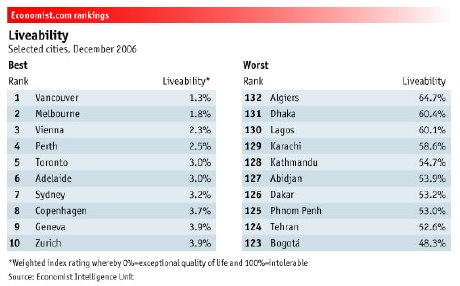
At the very top of the list are Vancouver, Melbourne, Vienna, Perth and Toronto, in that order, starting with the best. And at the very bottom are Kathmandu, Karachi, Lagos, Dhaka and Algiers, in that order, ending with the worst. (I have not yet been able to get hold of the full report so cannot say which other Pakistani cities are listed and at which rank; if any reader knows this, please do share). The weighted index is measured from 0 to 100 in per cent points – with 0% being exceptional quality and 100% being intolerable. Karachi’s Liveability is placed at 58.6% on this scale.
According to The Eonomist’s website:
With low crime, little threat from instability or terrorism and a highly developed transport and communications infrastructure, Canada and Australia are home to the most liveable destinations in the world… While liveability considers factors of recreational and cultural activity, the “big city buzz” can hamper the scores of some cities, although not to the extent that a city will present significant challenges. Global centres such as New York, Tokyo, London, Hong Kong and Paris may find themselves let down precisely because of their size and attractiveness. Traffic congestion and higher crime rates associated with large urban centres have, to some extent, offset the obvious cultural gains of living in such locations. This has also been compounded by fears that large centres like London and New York will remain targets for high-profile terror attacks. Despite this, most major centres do not present any significant challenges to liveability.
Of the 132 cities surveyed, only nine cities present the worst-case scenario in which most aspects of living quality are severely restricted, reflecting general improvements on a global scale in areas such as education, health care and infrastructure. Four of these are in Asia, mainly South Asia. The other five are in Africa (accounting for three) and the Middle East (accounting for two). The threat of terrorism and civil unrest is a major contributing factor to the cities that suffer from the worst liveability scores, as are poor development indicators. Algiers is the least liveable destination in the survey, with a score of 64.7%.
It is, of course, sad but not really surprising that Karachi comes out where it comes out. As this blog has discussed on so many occasions, it is a city (like many other in Pakistan) beset with problems. Traffic congestion, infrastructure collapse, bad planning, unprepared for its own weather, a near-perpetual energy crisis, political unrest, terror incidents, and much more. Of course, as we have also highlighted, Karachi also remains a city that is alive with colorful memories, intellectual discourse, incredible food, a zest for life, talented people, some really far out attractions, a fascinating history, buzzing markets, wonderful architecture and much more.
Those who love Karachi love it despite its faults and because of its zest (here and here). But our love for this metropolis must never be at the cost of ignoring the real problems that it faces.
It would be too easy to concoct theories about how this ranking is some grant Western conspiracy against Karachi, against Pakistan, against Islam. It is not.
You can quibble about whether Karachi is the 4th lowest ranked or should be the 8th or the 10th or the 20th. But you cannot deny the fact that it has some very serious problems – as do, but more than, all other major cities in Pakistan. These are not problems that can be solved by erecting tall towers. They need deeper, more meaningful and more real solution… not just from government, but from all of us. The question, of course, is not just why the ranking is what it is, but what it would take to improve it.
Note: Thanks to TeethMaestro’s post at Karachi Metroblog for alerting me to this.




I agree with the ranking. Karachi is a mess, the occasional tourist, or even most residents dont get to see the real karachi, with over 60% of the population living in slums, its un liveable in every possible way.
I like mustafa kamal, i think he is dynamic and forward looking. but i cant help but be pessemistic about its future.
Karachi’s problems are complex and beyond fixable by any one person. I agree with that observation. But I find that a lot of the problems / issues could be solved if the people of Karachi took some responsibility for them, instead of being a silent spectator.
For example, on each visit to Karachi, I am amazed by the massive homes of the rich in “posh areas” like Defence and Bath Island (love that term) with pristine driveways, and beautiful lawns, while their streets are pot-holed and in deplorable shape. So what if the government cannot come and fix your streets? These people have the means ($$$) to put together some funds and get the street fixed themselves. Fix your streets, fix your street lamps if they are broken, stop throwing your trash in every empty plot that happens to be in your neighborhood!
Teach your children the purpose of a trash can. Use it yourself whether you’re at home or at Zamzama having dinner. Don’t litter and then blame the government for not cleaning up your mess.
I think if more people took responsibility for their own actions, many of these problems can be somewhat resolved. True – not spitting pan on the sidewalk isn’t bringing electricity to your home, but at least I would be spared looking at the disgusting mess, or stepping into it.
One man, one action, one day at a time – plant a tree (or even a small gamla), clean up a sidewalk, don’t throw that pan wrapper out of your car window. Be kind to those around you and say “shukria” – yes, that includes your maasi and your driver and the waiter who just served you food.
Adil Bhai
thanks for this timely and thoughtful post. In the recent years the near collapse of Karachi’s security and services has caused immense suffering to its citizens not to mention the harm that it has caused to Pakistan’s economic backbone.
KESC despite privatization is in a mess thereby undermining the mantra that free market experts have always chanted. A minor rain and the city is at a standstill – and let us not even talk about the politics and the insecurity – too painful.
However, I have problems with these surveys that always present ‘reality’ with a slant. Recently, another survey put Pakistan in a failed state category only next to Afghanistan, Somalia and Iraq. Only ignorant, myopic researchers (as they call themselves) can reach some conclusions.
Karachi is in a mess but it is not beyond solutions. Let’s hope that the fothcoming elections return MNAs and MPAs who will deliver!
Making Karachi functional and liveable is an urgent national priority..
First of all sometimes these rating dont make lot of sense. I think they give moutain view Colorado(smaller city) better rating then city I live ‘Boston’. Big cities have problem which dont exist in small cities.
Well i will say following things are extremely wrong with Karachi which are better in other big pakistani cities..
1 Power outage: ( no excuse)
2. Traffic( I think Karachi is having its own “Big Dig”. I do support city government decision to dig karachi now. It will pay back in comming years).
3. Crimes: Well crime rate in karachi is much higher then US cities. They are simply not reported. 1/4th of my relatives have been robbed by robbers.
3. Jihadis and ethinic millatias. (from last 10 years situtaion is better but there is a potential that problem can come back.)
4. Kachi Abadis: People from all over pakistan come to karachi for jobs and millions are living in kachi abadis.
5. Pollution: There are few parks in karachi. Last government( Namat-ullah khan of Jamat Islami) had made some progress but lot more needed to be done.
BBC documentary on Karachi
Karachi Uncovered
Part 1:
Part 2:
Part 3: