Adil Najam
 The frustration and anger that one finds in the comments on the Emergency imposed by Gen. Musharraf in Pakistan is mirrored everywhere. In every conversation one has with any Pakistani anywhere. I was in Pakistan till last weekend and this pent-up feeling of frustration was evident in every conversation even before the Emergency was imposed.
It is, of course, a complex feeling emanating from the complex dynamics of our complex politics. At its very core, however, is the burning desire to be able to “do something” about what is happening made all the intense by a sense of helplessness about exactly what it is that we as citizens might, in fact, be able to do that might make a difference.
Since Saturday every conversation I have had with Pakistanis ends in exactly this question. What can we do? I have an in-box full of emails asking me to sign a petition, attend a meeting, say this or that to the media if I speak to them, join a protest, pass on a message, do this or that on ATP, join a conference call to plan a strategy, send out notes to my contacts, and so much more. There have been call after call from friends and acquaintance many of whom not even Pakistanis who just want to talk and share the intensity of their disgust at how the events are unfolding.
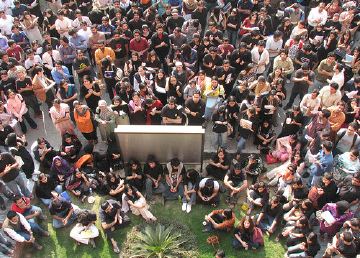
Of course, at the basest level doing anything – anything at all – has a cathartic effect and makes one feel that at least we did not do nothing. But the desire to do something is more intense. The desire not to just be a spectator to history. The desire to have contributed something, somehow. As one watches the heroic struggle of the lawyers, and now the students, to stand up and speak out – despite the brutality they are met with – makes this desire even more intense.
We each do what we can. We speak out to the media (I have had more than a dozen media interviews and comments already, we give talks (I have been giving multiple talks on this a day), we send out messages of support to those on the front lines in Pakistan to let them know that they are not alone, we sign petitions, and above all we hold hands in solidarity and vent our feelings where ever we can – on blogs, on phone calls to friends, in gatherings. All of this helps some, but one keeps wondering if it really makes a difference to the big picture?
Even if it is not, it is clearly worth doing. But can more be done? What? How? We would like to hear from our readers on that. Please let us know what is already happening as well as suggest what more could happen.
 Are there to many petitions going around; so many that they might lose their efficacy? Are some of us crossing the line between that which is anti-Musharraf and that which is anti-Pakistan? Even if they mean the same thing, strategically would a message that is pro-constitution, pro-democracy, pro-Pakistani resistance be better than one that is anti-individual? How can one best support those lawyers and students and others who are on the front-line of action, especially those who are not physically there? What, if any, are the dangers of focusing our attention too much of external actors rather than those in Pakistan itself? How does one explain to the media and policy-makers abroad that the events we are seeing is not the failure of a nation (the Pakistani people) these are the failure of a person and a particular government? (I personally have been saying to friends and to the media that I remain bullish on Pakistan and bearish on Musharraf).
These and many others are the questions that boil in ones head. There must be other questions too. Share these with us, but more importantly point us towards answers. Share with our readers what you are doing. How others can help. What should be done.
Note to commentors: My own views on the subject have been pretty clear and I feel no compulsion to either defend them or amend them. While I consider thsi emergency an anti-Pakistan and anti-Pakistani act, I do not doubt the patriotism or integrity of those who disagree. Pakistaniat is based on the premise that there can be, have to be, multiple views and they all must be respected, even when we disagree with them. Those of us who resent the emergency because it has tried to silence certain voices cannot then silence or disempower those who disagree with our views.
I say all this because over the last few days we have had to moderate out too many comments. More, in fact, from people we might agree with than those who we do not. One realizes that the moment is tense and passions are flared, but we stand committed to implementing our comment policy as best as we can. We have moderated, and will continue to do so, not because of content but because of infringements of our comment policy. We are, and will remain, especially careful about inappropriate language, personal attacks, inflammatory and disrespectful tactics, uncivil and slanderous language, and irrelevant diatribes. Please help us in not moderating your comment out by resisting these things. (And, please stop sending us notes about why you can misbehave because someone else did; we try to catch these things as best as we can and even if we miss them sometimes that does not give others a liscence to misbehavior). We remain committed to having a civil discourse and no matter whether we agree with you or not, no matter if you are an old friend or anew acquaintance, we will do our best to maintain that civility. If and when we feel that we are unable to do so, we are more likely to just close down the blog then to give in to people’s tantrums and badtameezi.




Lots of good ideas here. I would also like to add something very basic but very important. Looking at some of the comments here and what I hear from people, it is clear that we still need to be educated about why democracy, rule of law and constitution are important for a country. I find it depressing that in this day and age I still hear some Pakistanis who are not appalled when their basic human rights are suspended, judiciary is sidelined and freedom of expression is suppressed. Especially disturbing is the fact that I have encountered more of such people among the so-called “educated” people. I think there is a lot of work that needs to be done to really educate our brothers and sisters. Any effort in this regard, both in the short-term and the long-term, would be worthwhile too in my opinion.
What we should not do;
1
To Habib,
Fully agree with you, whatever the shortcomings of Gandhi, he did teach the world a thing or two. Unfortunately, the Gandhian Philosophy is not for the uninitiated mind, and it requires tremendous resilience and sacrifice. It is not as simplistic as blowing yourself up like the taliban.
Though I seriously doubt that many will be able to implement his style successfully as it is not trivial to figure all that out without a deep conviction in the non violent methodology, but maybe it’s worth giving a try.
Ali Mirza,
Chapeau, Monsieur !!
merci
lots of people are sharing lost of god ideas onthis… here is from an email I got:
Please take flowers & notes of support (just a couple of lines would
be great) to the judges. It is important because these judges have
withstood the pressure to take oath under the PCO. They’ve never taken
any political stands before and are not sure what they should be
doing. It’s impt for them to feel the support of the people.
Particularly impt for those who are not so well known or well
connected. Earlier we sent out the points arising from meeting the
judges by various members of this group (may be useful to refer to
that when drafting a note). Anyone can call, introduce yourself as a
concerned citizen and go see them to express solidarity.
Below, the updated list of justices of the Sindh High Court who have
not taken oath under PCO (removing Zia Pervez who is apparently
sitting in Islamabad requesting that he be given the oath)
1. Sarmad Jalal Osmany Hs no 6, Kh-e-Qasim, Phase VIII, DHA 5846615, 5340332
cell 0304-204-5550
2. Anwar Zaheer Jamali M-30/1, Kh-e-Ittehad, Phase VII, DHA 5340147, 5340156
3. Mushir Alam 56 Depot Line, Soldier Bazar 2229476, 7218983
4. Rahmat Hussain Jafferi 81/D, Bath Island 5833091, 9250185
5, Khilji Arif Hussain 8-B, Phase 1, Main Korangi, Defence Rd, behind
Caltex petrol pump 5382713, 5882183
6. Amir Hani Muslim BG-02, 12 CL-8, Pursa Heaven, Civil Lane Quarters 5656857-8
7. Gulzar Ahmed 52-Am 1/1, 3rd Sunset St, Phase II-ext, DHA 5802100, 5384325
8. Maqbool Baqar 71-N, Block 2, PECHS 4312391, 4385655
9. Mohd Ather Saeed, A Wahid E-25, Block ‘F’, North Nazimabad 6644164, 6646280
Plus the following new judges (non-PCO) (thanks Kamran):
1) MR. ZAFAR AHMED KHAN SHERWANI
B-8, SECTOR Z-1 GULSHAN -E-MEHMAR SCHEME 45 KARACHI
tELEPHONE NO. 6351848 AND 6350453
2) MR.JUSTICE ARSHAD SIRAJ MEMON
F-13 BLOCK 4, HATIM ALAVI ROAD, CLIFTON, KARACHI
TELEPHONE. 5868561 –
3) MR.JUSTICE SALMAN ANSARI
BANGLOW NO 23/B GOR BATH ISLAND CLIFTON KARACHI
TELE . 5823990
4) MR JUSTICE ABDUL RASHEED KALWAR
VILLAGE QAZI LAL BUX KALWAR, TALUKA MIRPUR MATHILO DISTRICT GHOTKI
TELEPHONE .0723-708179 — 0723-703134