On the same day (Feb 11, 2008) when South Bound Lyari Expressway was inaugurated, another important project of Pakistan reached its opening milestone. This one is called the DHA Desalination and Power Plant. It is the first project of its kind in Pakistan which desalinates water from the Arabian Sea for human consumption as well as provides Electrical Power to the KESC Grid.
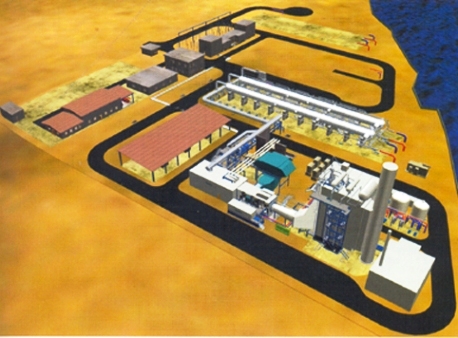
The Capacity:
The capacity of the Power plant is 94 MW (Mega Watts) and that of the desalination plant is 3 MIGD (Million Imperial Gallons per Day). Electrical Power generated here is supplied to the 132 KV (kilo-volt) KESC grid whereas the Desalinated Water is supplied to CBC/DHA for local distribution.
The fuel for the Power Plant is Natural Gas which will be provided by the Sui Southern Gas Company Limited (SSGCL) via 20″ diameter pipeline. The Electrical Power is generated by two turbines. One is Gas fired with the generation capacity of 67MW. The other is Steam fired with the generation capacity of 27 MW.
Who Did What:
The project is carried out by DHA Cogen Limited (DCL). It is a Public Limited Company which was incorporated in the city of Karachi on January 19, 2003. The company is a joint venture between Defence Housing Authority, Karachi (DHA) and Sacoden Investments, Singapore (SI). The contract for building the Power Plant was given to Siemens AG Germany (SAG) who also supplied the two turbines used in the plant. The Desalination Plant is built by Alfa Level, Copenhagen, Denmark (ALC) and the civil works is carried out by Siemens Pakistan (SPK).
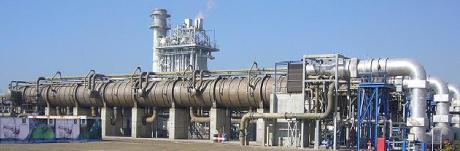
Following is the photo of DHA Desalination Plant
The Civil Works component of the project was a huge task in itself which included the necessary support infrastructure in terms of fuel gas supply, seawater intake, 132KV Sub Station, water treatment, under ground storage, workshop, stores, control room and administration offices.
The Processes:
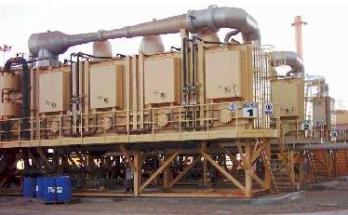 A neat thing about this project is that a by-product of power generation i.e. steam is used as a fuel to desalinate water. The two power turbines of the Power station are connected together (as a single shaft configuration) along with a Heat Recovery Steam Generator (HRSG). The steam turbine is designed to exhaust steam directly to the two MED (multi effect distillation) plants to provide energy input to the MED desalination process.
The photo to the above right shows MED desalination plant installed at HUBCO Karachi. It is similar in MED processes but much smaller in design to the DHA Desalination plant.
Another Success Story of Pakistani Engineers
Here I also want to mention yet another success story coming out of Pakistan’s Public universities. The local project Manager of Siemens AG Germany overseeing the work on the Power Plant is Mr. Yasir Jilani, a EE graduate from the NED University of Engineering and Technology, Karachi. I want to present it yet another success story of Engineering graduates coming out of Pakistan’s public Educational System.
Location of the Plant
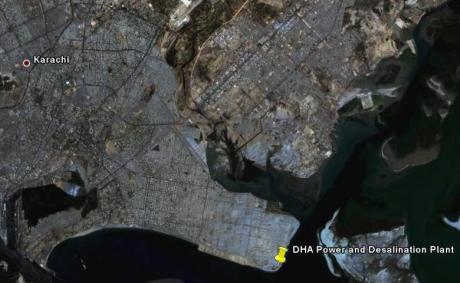
Plant is located at the southern tip of DHA phase VIII. Google Earth has not been updated for Karachi for many years now therefore it still shows a flat ground in most of DHA phase VIII. The pointer in following image shows where the present day plant is located
In an age when Pakistan is facing serious power shortage, this plant is certainly a welcome addition.
Pakistan’s Other Water Desalination Plants:
1. A desalination plant was installed in 1987 in Saindak Copper Mines in Balochistan. This plant uses the brackish water Reverse Osmosis (BWRO) process.
2. Another desalination plant was installed in 1995 and commissioned in 1996 at the HUBCO power station outside Karachi. This plant uses Reheat type Multi-effect distillation (MED) desalination.
3. KANUPP near Karachi operates a Sea Water Reverse Osmosis (SWRO) desalination plant to meet its operating requirements.
References:
1. DHA Cogen Limited
2. Dawn Newspaper Report on Plant Inauguration
3. Google Earth






Excellent article. You run a great blog
Moin
http://www.moinasnari.wordpress.com
@very smart, if low tide takes water’s dead level back to 2km then it will be a concern. I am not familiar with specs on what is the minimum water level needed for operation here. The 2 km low tide retreat sounds too much to me. Are you sure about it?
There is also a chance that the change in tide pattern is due to land reclamation going on in the area. Anyways, it is not an excuse. If true, a solution must be sought. Laying a pipe may be one solution. If I think out loud, then digging a deeper channel by some sort of dredging may be another solution.
Last year, the small port of Pasni in Balochistan got silted with sand so bad that it rendered it un-operational. I’ve heard govt is now using dredging there to deepen the channel. Port Qasim and KPT both employ full-time dredgers (except they work in a bit deeper water). Something like that could be used here depending on water depth around the plant. Do you know what is the average water depth around the plant’s water intake?
@ Yousuf: You are right. I also believe dependence on Sui Gas should be minimized in all future power projects. This natural resource of Pakistan is depleting fast. Novel sources like ‘power from solid waste’ OR cleaner sources like ‘wind’ should be explored. Wind is in abundance in coastal areas.
@ Sajid: I have heard there is a “Remineralization” plant also included in the desalination project, which will make the water pottable or fit for human consumption.
@Wasim. Yaar, my info comes from public sources like company website and news items. I won’t take personal credit there
What are the operational costs?
Will it drive the cost of electricity up?
Owais Bhai,
Good news and I marvel at your plethora of talents, you know so much!
Feimanallah
Wasim