Adil Najam
Reader Umair alerted us to the Pakistani auction website Bolee.com, whose front page (yesterday) was advertising a “Kidney for Sale” (there were three Ads for this, but all from the same person). Search for the website on Google and you will see a bold “Welcome to Pakistan’s First Auction Site.”
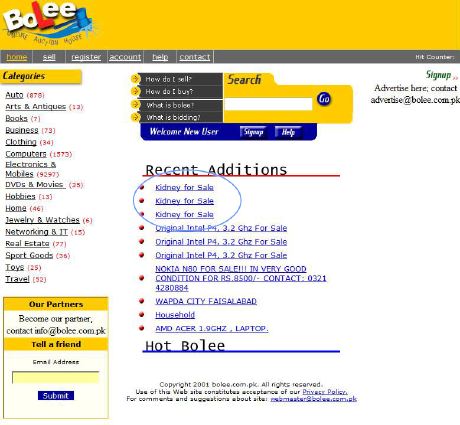
There are, of course, a number of other Pakistan auction website, some seemingly having much more to offer but, luckily, no kidneys. We have carried a post in the past about someone wanting to sell his kidney to make ends meet, but this Ad on the auction website reaises so many issues and questions that one is left speechless!
Luckily there were no bidders on the kidney when we checked (and captured this page image). The description read:
I am 26 yaer old healthy person & want to sellout my healthy one kidney for AB+ compatible person, My demand is Rs.600,000(Operations & other medical expenses”ll be beard by kidney purchaser).
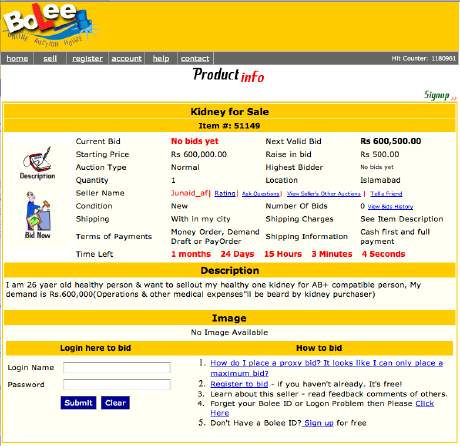
Frankly, its too distasteful a predicament for one to find the Pinglish in this description (“yaer”, “sellout”, “healthy one kidney”, “expenses’ll”, “beard”) funny.
This is not just about an internet site and a rather ridiculous, maybe friviluous, notice on it. The problem is real. And the problem is much bigger.
 For example, a recent scholarly article in Transplant International by researchers from the Sindh Institute of Urology and Transplantation (SIUT) points out that Pakistan has now emerged as one of the largest centers for commerce and tourism in renal transplantation:
In recent years, Pakistan has emerged as one of the largest centres for commerce and tourism in renal transplantation. Kidney vendors belong to Punjab in eastern Pakistan, the agricultural heartland, where 34% people live below poverty line. We report results of a socioeconomic and health survey of 239 kidney vendors. The mean age was 33.6 ± 7.2 years (M:F 3.5:1). Mean nephrectomy period was 4.8 ± 2.3 years. Ninety per cent of the vendors were illiterate. Sixty-nine per cent were bonded labourers who were virtual slaves to landlords, labourers 12%, housewives 8.5% and unemployed 11%. Monthly income was $US15.4 ± 8.9 with 2–11 dependents per family. Majority (93%), vended for debt repayment with mean debt of $1311.4 ± 819. The mean agreed sale price was $1737 ± 262. However, they received $1377 ± 196 after deduction for hospital and travel expenses. Postvending 88% had no economic improvement in their lives and 98% reported deterioration in general health status. Future vending was encouraged by 35% to pay off debts and freedom from bondage. This study gives a snapshot of kidney vendors from Pakistan. These impoverished people, many in bondage, are examples of modern day slavery. They will remain exploited until law against bondage is implemented and new laws are introduced to ban commerce and transplant tourism in Pakistan.
The authors of the article, including the head of SIUT have since launched a very worthy campaign against the illegal and inhuman trade in kidneys from Pakistan and all the ways in whcih this exploits the already poor and vulnerable. There is talk now of a law to legalize such trade and in the rush to focus on teh so called “benefits” of selling one’s vital organs, there is little attention on what this means for those whose poverty will make them the victims. A recent article in The Paksitan Link explores these questions:
Health experts are concerned about Pakistan’s unregulated and fast growing kidney transplant trade, where foreigners can buy kidneys from impoverished Pakistanis in contravention of established medical norms. With more than a dozen hospitals across the country involved in this unscrupulous trade, Pakistan has become the new Mecca for people seeking kidney transplants from across the world.
Transplants are a lucrative business for Pakistani doctors, hospital staff and fixers who exploit the gullible and the needy. So much so that in some Pakistani villages, most people survive on one kidney. In Mominpura village in central Punjab, nearly 80 per cent of the residents have sold one of their two kidneys. Only children, the old and the sick have been spared the scalpel. “Anyone above 16 is taken to a hospital for a possible transplant,” claims a villager.
According to people involved in the kidney trade, besides Pakistan, China is the only country in the world where illegal and unrelated donor organs are transplanted. In China, kidneys are taken from prisoners on death row. “Any transplant that is unrelated is unethical,” believes Dr Anwar Naqvi, a senior surgeon at the Sindh Institute of Urology and Transplant (SIUT) in Karachi. Naqvi is campaigning against unrelated transplants in Pakistan.
Take 22-year-old Sumaira of Mandiala Wala village located 30 kilometers east of Lahore in Punjab province. She is no different from the hundreds of villagers here learning to live on one kidney. In Sumaira’s case the choice wasn’t easy. She and her family could either stay in bondage for life to a brick kiln owner, or she could sell one of her kidneys and pay off the family’s mounting debts. Sumaira decided to donate. In January 2002, she was brought to a hospital by her parents. “There was a maulvi (religious head) in our area who took us to the hospital in return for a fee,†says Sumaira’s 25-year-old brother Mohammed Safdar.
The staff conducted pre-operative tests on Sumaira and she was sent home after signing an agreement with the hospital management to donate one of her kidneys. A month later, she was summoned by the hospital: a recipient had been identified.
In the clandestine kidney market, if a kidney is sold to a local recipient, the donor gets US $1,600 but if sold to a foreigner, the payment is double. As a goodwill gesture, the recipient is introduced to the donors before the transplant. But in Sumaira’s case, her 32-year-old recipient, Thor Anderson, a property developer, born in Denmark and living in London, avoided meeting her due to the prevailing anti-West sentiment over the Iraq war. Of the US $3,200, Sumaira’s family used US $1,600 to repay loans. Over US $500 went to a broker, with US $250 spent on post-operative care. They were left with US $750, a sum that didn’t last long, considering Sumaira’s large family. It is now her brother’s turn to join the long queue of poor donors willing to sell a kidney for money. “It is not risky at all,†Safdar contends.
In the West, the vast majority of donor kidneys are taken from people killed in accidents. But as the number of patients has spiraled the world over, the transplant business in poor countries continues to expand. Also, in some countries, as in the UK, recipients have to know the ‘live’ donors, and cannot pressure them. This makes legal transplants difficult in such countries. Patients, therefore, travel to poor countries where there are either no laws or no regulation.
Sadly, most people are no better off after the sale despite the risks. Sughra Begum sold her kidney for just US $1,300. Her husband, Muhammad Yar, had also donated his kidney four years ago to repay a loan from their landlord, but the middleman made off with the money.
That’s when Sughra decided to sell her kidney. Though they managed to repay the landlord, the operation took a toll on her health. Due to her constant illness and her husband’s critical condition, they were forced to take another loan and are back in their landlord’s clutches.
According to data compiled by the Pakistani organization, Postgraduate Doctors Middle East, in the year 2001 there were 1,244 kidney transplants, of which relatives donated 611, spouses 80 and unrelated donors 533.Due to an increase in donors, several hospitals have started offering less for the kidneys.
SIUT’s Naqvi dreads the future. “The very wealthy will end up as buyers of the organs being sold by the very poor. Such an unequal distribution of health benefits and burdens will be completely unjust,” he says.
When people become compelled to sell their vital organs on the internet or to unscrupulous traders, it says volumes about just how vulnerable their lives and livelihoods have become? It says as much, or more, about the society that allows this to happen? But does anyone in our society care?




For a nation whose leaders have not much problem selling the honour and lives of its own nationals, and have forced the nation as a whole to carry the Kashkole, I’m not so sure what other choice some of the poor people have left. I’m not sure if selling of ones kidney, under the circumstances, is that much unexpected. Given the circumstances, it’s not that much more despicable than selling one’s eggs; adoption for money; paid sperm donations, etc. One is allowed to eat an otherwise haram animal if not doing so would mean certain death. So one can agree that it’s horrible, it’s shameful under certain circumstances, but your lead topic of the day might as well have been the lead news story about Pakistan – the debate about the first US ground assault against Pakistanis, including innocent victims, or the impending take over of the reins of Pakistan by one who was thought of until recently as a criminal or dubbed Mr. 10%. For Mr. 10% to become 100%, or what lies ahead for Pakistan as a consequence, is also newsworthy and worthy of our discussion, IMHO.
The rapidly rising unemployment and skyrocketing inflation together have dramatically increased hunger and poverty among the most vulnerable in Pakistan. At 33%, the sum of unemployment rate and inflation, known as the misery index, stands at its highest level in Pakistan’s history, and it is likely to increase social strife and hurt the chances of recovery.
There is no relief in sight as President Zardari takes oath of office as President and chief steward of Pakistan’s economy.
Please read more at: http://southasiainvestor.blogspot.com/2008/09/declining-economy-hurts-pakistani.html
There are many Pakistanis who argue that we must give democracy half a chance to cope with the challenges even if it means going through a slump in exchange for sustainable power of the people to govern themselves. Unfortunately, people like Gul Rehan and Momin, who can least afford it, end up bearing the brunt of such sacrifices. The “civil society” and the “fearless pro-democracy leaders” usually do not forgo their meals to achieve democracy.
I am all for sacrifice, I just wish that the sacrifice be shared more equitably by all of the people. We should all help however we can through various charitable institutions. But I think the “pro-democracy leaders” such as Aitazaz Ahsan, Nawaz Sharif, Asma Jahangir and others who have contributed to the current economic decline have a special responsibility. They can and should use their celebrity status to raise awareness of the issues of poverty and joblessness. They should help organize efforts to build a safety net for the most vulnerable. This would demonstrate their sincerity of concern for the poor and the disenfranchised.
Sir,
The selling and purchasing of body parts by two consenting adults belonging to a nation which has collectively sold its soul, conscience and honour to the devil has not surprised me ——has not surprised me one little bit.
Your most obedient servant.
My kidneys are starting to hurt reading this post..
What a brutality. In the end everybody dies no matter what. It never seizes to amaze me how violent, selfish and brutal a human can really become provided the unfavorable circumstances. Man’s instinct for survival is so strong and yet its so meaningless. We all die no matter what.
There is definitely a demand, more and more people having kidney failure or malfunction with their only hope is a donor. I guess the only way to fix this is to fix the system where nobody is a slave, every life is equally valuable, and may be then we can have honorable donors and legitimate recipients. Crazy subject…
I think that by putting the Bolee website picture at the top part of the story has been lost. What is most frightening are the details in the second half of the report about just how much of this kidney selling is happening in Pakistan. That does suggest how bad things are. I hope they are able to stop this law on legalizing this type of trade.