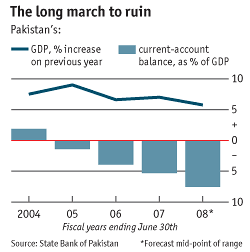
 Ours is a mismanaged country but one with potential to amply fulfill the needs of its citizenry. In so far as our economy goes, there is nothing that is wrong with it structurally.
Prima facie Pakistan’s current economic difficulties emerge out of high import bill and corresponding lack of investment. The huge rise in the oil price internationally over the last few years along with an international crisis of agriculture production has affected this country just like it has affected all countries around the world.  For us, it also has to do with the unique geo-political role that we are forced to play without an effective negotiator on the top.
The recession in the West has given us breathing space. The oil price is now back down into the US$60 to a barrel range on the international market. This is – as with all capitalist systems- an automatic correction of what was an unusually high increase in the costs of fueling the global economic system.
As it stands right now, Pakistan’s policy makers shall find a greater cushion than they expected. If some of the price decline is passed on to the consumers in Pakistan, it will slow down the inflation rate considerably. The 30% to 50% food inflation rate over the last few weeks will go down to 12% to 16% in the coming months. Even if it isn’t passed on, the correction vis a vis import bill is going to be substantial. The policy makers thus have a menu of options available.
An important factor would be increase the tax base to include agricultural income. Similarly, selective weekend taxes for petroleum products, as much as several hundred percent, will help bring both the burgeoning fuel demand and reduce pollution. Similarly for power, instead of load shedding during the work week, it would be better to increase the tariff by significant amount on Sundays. At the very least our policy makers should heavily tax imported products and luxury items for which there are local alternatives.
Pakistan’s economic growth will slow down from between 6 to 7 percent to between 4 to 5 percent. To achieve a growth rate between 4 to 5 percent in times of a global recession is no mean achievement and it reaffirms the point made earlier. Similarly, the State Bank’s decision to increase money supply by cutting in interest rates and cash reserve requirement indicates that the policy makers tend to agree that Pakistan’s current crisis is not demand pull (since the economy is slowing down) but is cost push due to external factors. The immediate and possibly temporary reaction to State Bank’s decision was the appreciation of the Pakistani rupee which has generally been seen as welcome. Pakistani rupee will stabilize as the situation globally favors the developing world.
Ultimately the real solution for our economic woes, to use the hackneyed phrase, lies in increased foreign direct investment.  Since 2001, Pakistan had received only up to US$ 64 billion inflows, which is – no matter what people say- a pittance compared to our potential. As an English-speaking nation of 165 million industrious and talented people, Pakistan presents an excellent opportunity for any foreign investor but for three major drawbacks.
One, we assume and project the same assumption on to foreign investors that that investments in Pakistan and India are mutually exclusive and since we view everything in comparison to our giant neighbor, we tend to underestimate ourselves increasingly so in the last decade and a half. Second, and more conclusively it is terrorism that has dulled Pakistan’s foreign investment in every sector including sport and tourism. In 2004-2005, Pakistan was an exciting tourist destination with Basant festivals, Polo matches and Cricket. Today foreign sports teams are very rightfully apprehensive of visiting the country and almost every Western embassy has a travel advisory out. The Marriot bombing has all but completely brought not just international but domestic commercial activity to a halt. And finally, it is the infrastructure. For all of the last government’s purported achievements in the economic sphere, their inability to create power solutions for an annual demand for electricity growing at 7-10 percent.
How does one do it though is a tricky one. The first two are political issues. India’s existence as a bigger nation in our neighborhood need not be a threat to us. Indeed if Pakistan were to play its unique role as a neighbor of one emerging global economy like India, while courting Asia’s foremost power house China and manage to keep its ties with the US as its Major Non-Nato Ally at the same time, it is highly probable that under a democratic regime, Pakistan can manage to create a trillion dollar economy in two decades or less.
But this means a solutions or management of all existing disputes but most importantly the water crisis. The most crucial issue however will be what role Pakistan plays in the Iran-US. Instead of waiting for the time where US gives Pakistan an option similar to the one it was given in 2001, Pakistan should play a pro-active role in bringing Iran and the US together by playing exactly the kind of role it played in the 1972 between China and the US. It would not be out of place to attempt once again to revive the long dead Regional Cooperation Development organization or the RCD between Turkey, Iran and Pakistan which would guarantee greater regional stability and economic options for Pakistan. Winning the war on terror is going to be essential but the war itself ought to be fought on several fronts one of which has to be economic.
The fall out of the war on terror has been economic and our allies should compensate us for our losses. But perhaps the most important thing any of our allies can help us with is in the power sector. Ideally the US should have boosted us by providing us the same kind of civil nuclear deal that it has offered India but much of that is impossible at present because of the history of nuclear proliferation and now that Dr. A Q Khan has rescinded on his earlier confession. We still might get a nuclear deal from China. This is not all though.
Pakistan must make dams and make them quick. If Kalabagh is out of the question, then alternatives must be looked at and a quick decision taken on. Similarly the Iran-Pakistan pipeline is also essential and if India joins in, this pipeline might just be a pipeline of peace and prosperity in the region. All in all, if this democratic government was to play its cards right, it could raise up to another US$ 30-40 Billion in direct investment over the next 3 to 5 years and that would be more than enough to sustain and develop it.
The late US President Richard Nixon, one of the 20th century’s greatest statesmen, wrote in 1991 that Pakistan as a democracy, an important “modernist” Muslim state and a US ally was one of the most important countries in Asia, close relations with which were imperative for US’ own interests in Asia and the greater Islamic world. Unfortunately the policy makers in the US in the 1990s did not listen to him. Now more than ever it is clear that our allies need us more than we need them – it is this essential premise on which we should deal with the world with our head held high.
Indeed if nations were judged by how hard they were hit and still managed to move on, Pakistan has given a good account of itself going from one crisis to another in quick succession. But nation states, as with individuals, are judged not by how many crises it takes to bring them down but how far they travel on the road to progress and towards their stated aims and objectives. Without getting into ideological pretensions, the consensus that all major players in Pakistan’s politics have is that Pakistan ought to be: an economically viable state run by constitutional democratic means which was the original aspiration of the people of this country.
Our rulers have bungled up opportunities and have let the people down far too many times in the past. It is time for the current democratically elected government to take a long hard look at the situation and refrain from mock tough rhetoric that does no one any good.
Pakistan must seize the moment and take this as an opportunity to catch up.




We would like to hear how ibrahim and co would want to demolish the current system and put in its place a “fundamental and sound economic plan”.
Ofcourse my guess is that it would be a stock answer but I’d rather give them a benefit of a doubt and hear what they have to say.
PS:
Who said anything about getting 30 to 40 billion by killing people?
I was referring to foreign direct investment in sectors in Pakistan which have potential. Any person with even half a brain can figure it out … But certainly not those taught to think with a straitjacket around their brains.
Ibrahim,
Do you understand the term “structural” v. “Cyclical” in Economics.
I do concede that Pakistan’s low domestic savings rate is not a cyclical issue. But the problems you people are pointing out are not structural economic issues but political issues of priorities -misplaced as they are.
My suggestion is that people atleast acquaint themselves with the basic terms before shooting off in tangents.
If what I say was wrong, why has what I suggested above vis a vis food prices, petrol prices already begun to happen.
Ahmad Shahid:
My point about corruption was about corruption and not only about corruption under civilian govts. The link I ggave was just an example of a study estimating the impact of corruption; yes it so happens that a quick google in a hurry only gave me that one and it only covered the 1990s; a similar study of corruption under a military govt would also be interesting to see. Lets not unnecessarily turn every discussion into a military vs politician zero-sum game.
Your second point that India and China are growing even though they have a lot of corruption is somewhat interesting. However, this does not mean that corruption does not prevent them from growing faster.
By the way, following your line of reasoning, people can even argue that military spending does not really impede growth so badly since money that is spent within the country does go into the gdp and also has the usual multiplier effect. For example, if they continue the new GHQ building, it will also involve construction work for many labourers. Of course there is a flaw with this argument and I believe you are well aware of it already, so I won’t spend time on that.
Your third point: to get an exact estimate of the impact of corruption on the economy, we would need to get a corelation is fair enough. But then, the same point would apply to the defense budget, wouldn’t it? So why is there a singling out of the defense budget but a downplaying of the impact of corruption when both involve the issue of opportunity costs?
YLH wrote: if this democratic government was to play its cards right, it could raise up to another US$ 30-40 Billion in direct investment over the next 3 to 5 years and that would be more than enough to sustain and develop it.
And what cards does it exactly have in its hand, YLH? Most of this money can only be raised if GoP kills some more people for cash. But, of course, you should have no problem believing and propagating such tactics and thoughts.
Also, jusathot is on the mark. Whoever thinks Pakistan doesn’t have structural flaws is delusional. Most of the system needs to be dismantled before a more sound and fundamental economic plan can be put into place. Not doing so would be akin to pouring water in a bottomless bucket. No pain, no gain.