Adil Najam
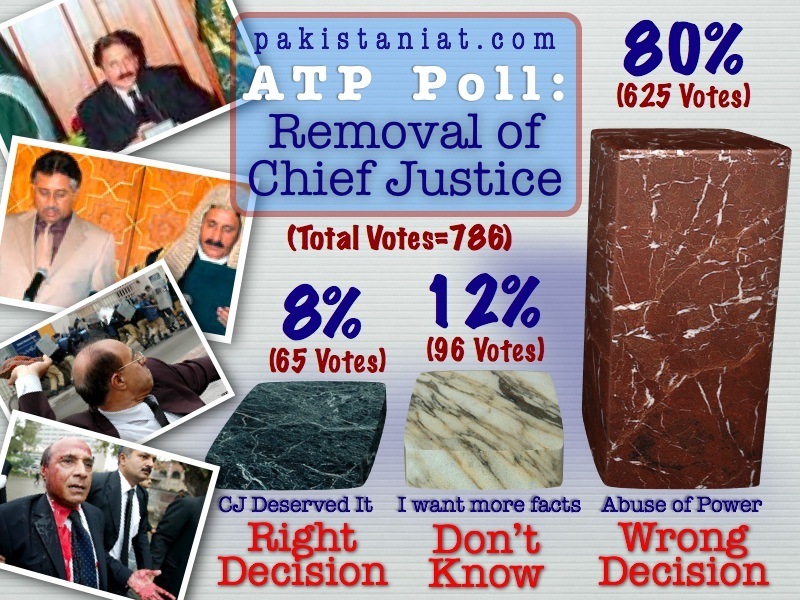
The news of Chief Justice Iftikhar Chaudhry’s reinstatement made one feel good. Real good. After a long time. It reminded one of all that we have been through. It reminded one, also, that exactly two year’s ago ATP had published the result of a Poll on whether the CJ’s removal was the right move. Maybe, the powers that were should have heeded our reader’s advice right then and spared themselves and everyone the ordeal:
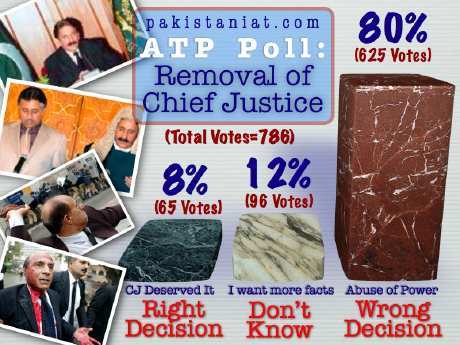
(This Poll was conducted 2 years ago)
As I mentioned on NPR’s show All Things Considered today (read and listen to story here), I think what has happened has been truly revolutionary. However, as one wrote yesterday, the story is far from over. It has just taken the newest twist. It is a good twist. But we know much more is to follow. But what?
We do remember, of course, that he had been reinstated earlier too – by his peers in the Supreme Court. We also remember that promises and announcements are made by our political leaders to be broken. We also note that in listening to the speech it is not clear exactly what the terms of the decision are and exactly what the nature of the reinstatement will be. Also unclear is what the new power dynamics in Pakistan will be after this demonstration of the power of the people. It is very clear that this is a moral and political victory not of any political party or political leader but of the Pakistani people and of the Justice movement. But we also know that victory has a thousand fathers and many, including the vanquished will seek to take credit for it.
In short, more questions than answers loom before us and all indications suggest that things may become more unclear in the next many weeks than less.
 But let me be totally clear, this is good unclarity, even necessary unclarity. What we have seen today is truly historic. As I have argued many times on this blog it was proved again that Pakistan is a democratic society trapped inside an undemocratic State. For two years now a citizen movement – a movement of progressive, liberal, educated, non-violence forces – persevered in the face of hardship, jailings, persecution, and ridicule even of their friends. And yet they fought on – non-violently and in a principled way – for an abstract idea. The idea that institutions matter. That justice matters.
For this to have happened in a society where too many on the extreme are trying to make points by violence (as extremists tried to do again today), where zealots and miscreants murder and cut off people’s ears and noses simply because they do not agree with them, where innocent people are blown up because of one’s misguided sense of religiosity, for this to have happened and for such major change to have come about in a peaceful way makes one very very happy. Ecstatic really.
Jinnah’s spirit must be smiling today. I certainly am.
But tomorrow, we all have to start asking ourselves the question: What next? The answers won’t be easy, but one hopes that people will show the same clarity of purpose they did here. There will be many questions. Here are some I can think of. I am sure our readers will add more questions. I am hopeful that they might also guide us on a few answers:
- Will this become Nawaz Sharif’s victory? If so, what will that mean for the power dynamics of Pakistan. If not, what does that mean for the power dynamics of Pakistan?
- Asif Ali Zardari remains the President. Bruised, beaten and weakened. But President nonetheless. Gen. Musharraf made an art-form of retreating under pressure and each time things became worse. How will it play out now?
- What about the dynamics within the PPP. A number of senior PPP leaders have been sidelined or have dropped out (including Aitizaz Ahsan). Does this mean that they will be brought back in – or might force their way back. What does this mean for the future of the PPP; with or without Zardari?
- What about the current court, including the new inductees and the balance of opinion in the Court? How would a reinstated Chief Justice Chaudhry act in that Court, especially on issues of political significance? Will he be able to act or will the media made every case before him a circus?
- And even if everything goes without hitch, what is the future of the amazing Citizen’s Movement that has been constructed here? My own hope is that a new politics may emerge in Pakistan around the faces and frameworks of this movement and that it will remain true to its aspirations rather than succumbing to political temptations.
There are, of course, so many other questions.
But the real one remains: What next?




Thanks for sharing. See https://best-deals-demo.com/5372 — extra tips was useful for me. [TK20cB8uD00pAA]
One of the best reads I’ve had this week.