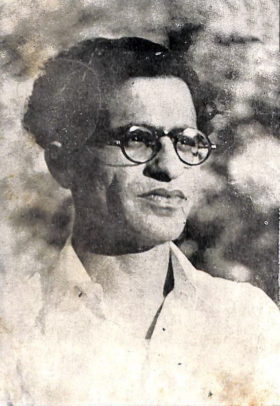
 [ATP had carried a short post at the time of Ahmed Nadeem Qasmi’s death; today we feature Raza Rumi’s more in-depth tribute to the poet]
Ab aik baar to qudrat javaabdeh thehre
hazaar baar ham insaan aazmaaye gaye
Now Nature must be held accountable at least once;
We humans have been held answerable a thousand times
Few men evoke such awe and respect as the departed poet and writer Ahmed Nadeem Qasmi who breathed his last on July 10 2006. His mastery over poetry he has been equally prolific in traditional ghazal and nazm and prose as a short story writer, journalist and literary critic – stand at the pinnacle of Urdu literature and he has contributed to the language over 50 titles.
Born in 1916 amidst the scenic Soon-Sekasar valley in district Khushab, nature influenced the evolution of Qasmi’s poetic sensibilities. Exposure to the grim realities of rural India’s inequities also played their part in his development as a writer; the underlying theme of his poetry is human dignity and his short stories – regarded as next in line to another master, Munshi Prem Chand, for their directness and simplicity – portrayed the woes of the Punjabi peasantry and their interaction with power structures. Following his matriculation from Campbellpur in 1931, around the time when he wrote his first poem, he moved to the Sadiq Egerton College in Bahawalpur and graduated in 1935.
Qasmi’s early short stories such as “Hiroshima say pehle, Hiroshima Kay Baad’ narrated the devastating effects of the Hiroshima bombing on a small Punjabi village which fed recruits to the British army. His other stories “Lawrence of Thalaibia” and “Rais Khana” attacked pirs and feudal lords for their relentless exploitation of peasants.
ai Khudaa ab tere firdaus pe meraa haq hai
tuune is daur ke dozakh mein jalaayaa hai mujheMy Lord! Now, I can rightfully claim thine paradise
You have burnt me in the hell of my times
Yet another field that benefited with Qasmi’s presence was journalism, both from his own writing and his work as an editor. By the late 1930s Qasmi was editing reformist magazines such as Phool and Taleem-i-Niswan. In the next two decades he edited renowned publications such as Adab-e-Latif, Sawera, Naqoosh, and daily Imroze – a leading Urdu daily which he left when Ayub Khan’s Progressive Papers Limited took over in 1959, despite encouragement to stay on – and finally a journal he set up himself, Fanoon.
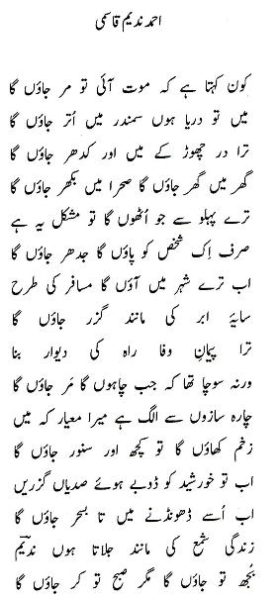 Qasmi’s writings in Imroze and later in the daily Jang have been noted as progressive critiques on social and political issues. His journalistic writing was terse and often bold compared to his peers and he never compromised on the principles he held close to his heart. His Imroze editorials opposing Ayub Khan’s martial law landed him four months of incarceration in 1958-9. Qasmi’s last column for Jang in 2006 argued that the Constitution of 1973 was a consensus document and should not have been amended time and again.
Qasmi was awarded the Pride of Performance in 1968 and Sitara-e-Imtiaz in 1980. In 1974, he was appointed secretary-general of the Majlis-Taraqee-Adab – a Board of Advancement of Literature established by the government of West Pakistan in 1958 – and Qasmi worked in that position till his last.
The Progressive Writers Movement. The realism and literary expression against exploitation in Qasmi’s writing gained him respect among his peers and in 1948 he was selected as the secretary general of the Anjuman-e-Taraqqi Pasand Musannifeen (the Progressive Writers Movement) for Punjab from 1948 and in 1949 was elected the secretary-general of the organisation for Pakistan, a position he held for six successive years.
This wasn’t all good news for Qasmi, however, as the Progressive Writers Movement was linked to the 1951 Rawalpindi Conspiracy Case, and he was detained for six months under the Safety Act for his association with the group in 1951.
Qasmi gradually distanced himself from the Progressive Writers Movement, probably because it became difficult for him, as it did for a number of other writers, to work with some of the dogmatic communist members. He tried to steer the middle path, opposing the official orthodoxies on literature as well as the radicalism of some of his peers. There is no question that he remained a progressive writer all his life; however, he avoided the supremacy of “ideology” over creativity. For instance, his famous couplet angered many of his leftist colleagues:
Sabz ho, surkh ho, key unnabi
phool ka rang uski baas mein haiWhether it is green, red or magenta
The colour of a flower lives in its fragrance
Fanoon: A milestone. Qasmi started his own journal Fanoon in 1962, which survives today; and is still considered to be a major literary magazine. Fanoon became a vehicle for collating prose and poetry across the country and a major nurturing ground for emerging writers. The legendary friendship and support of Khadija Mastoor and Hajira Masroor and support to a host of other writers from Ahmed Faraz and Saqi Farooqi to Najib Ahmed and others is linked to Fanoon. It is heartening that Qasmi’s will has entrusted Fanoon to his protege and a well known poet, Mansoora Ahmed.
Since the 1960s, Fanoon has been the arbiter of literary merit. Amjad Islam Amjad, Ataulhaq Qasmi, Munnoo Bhai and Nazeer Naji proudly claim Qasmi’s patronage. Perhaps the most well known of protege was Parveen Shakir, who considered Qasmi her teacher and called him ‘Ammu.’ Her first bestseller, Khushboo, was dedicated to Qasmi. They fell out towards the latter part of Parveen’s short life; and Qasmi has related the whole story in a long article published after Parveen’s tragic death in December 1994. The reasons were more personal than literary.
Mansoora, the current editor of Fanoon and winner of the Adamji award for literature is Qasmi’s adopted daughter. But Mansoora was more than a daughter; a soul mate and a protege. She devoted her life to her father, who provided her answers for the meaning of life. Mansoora’s poem, suno baba (which she recited a few years ago on a lazy afternoon in my family’s Islamabad house) makes a critical point: Qasmi invested his life in people and yet all he gained were khotay sikkay (counterfeit coins) – a reference to his group of associates and proteges.
Khotay Sikkay. Qasmi was the proverbial candle of an infinitely wide literary circle; he attracted opportunists and genuine literati alike. This is what led to some criticism about the “company” he kept. Munnoo Bhai is believed to have remarked some years ago: “Qasmi Sahib is like a big banyan tree that has been taken over by jinns and bhoots (ghosts).” But the critics overlook the fact that Qasmi and his generation had an open door policy that was based on the fundamentals of humanism. They were also forgiving by nature and accepting of all and simple in their worldly ways. No wonder Qasmi died as a poor man despite half a century of a majestic career.
Nevertheless, the wide array of Qasmi fans, students and chelas led to much envy and gossip that later turned into literary feuds. The well known tussle between Anwar Sadeed (critic) and Qasmi group is well documented. Sadeed left no stone unturned to undermine Qasmi’s stature and literary merit. Similarly, another notable poet, Dr Wazir Agha,was a life-long rival of Qasmi and his publications made it a point to censure Qasmi and his cohorts as a matter of routine and principle. Muneer Niazi, another “big” poet, was also a “rival” of sorts.
Niazi, like Qasmi, was Lahore based and also recognised for his excellent poetry. There the similarities ended. Qasmi was more than a poet. He was a versatile writer and not simply obsessed with his written output alone: he was committed to grooming others. Hence his life long forays in journalism, literary movements, mentoring and publishing.
Qasmi’s essay on Faiz Ahmed Faiz published in an Urdu quarterly by Ata-ul Haq Qasmi (former ambassador to Norway and a noted Urdu columnist), in which he had been allegedly impolite about Faiz, became a source of much consternation among Faiz’s diehard fans. Qasmi was honest about whatever he felt. But he was misunderstood. Even his worst critics – long time rivals as well as Faiz fans – would confirm that Qasmi was not an arrogant and self-obsessed man, and very much a people’s person.
Qasmi’s own biological daughter, Naheed Qasmi, is a poet of notable merit. However, not much is known about his family and personal life since most of it was devoted to his peers, proteges and literary movements. As another commentator noted, the number of flaps and forewords he had written for in aspiring writers’ books would compete for an entry in the Guinness book of world records!
Zindagii shammaa kii maanind jalaataa hoon ‘Nadeem’
Bujh to jaaoon gaa magar subah tau kar jaaoon gaa
I have lit my life like a candle,
The flame would disappear but will burn till the morning
Try as he did to nurture the next generation of poets and writers, there will never be another Ahmed Nadeem Qasmi. His is not the death of an individual – it is the coming to close of an era which sent forth and bred literary giants encompassing the entire range of literature’s linkage with art and society. Urdu literature has virtually been left an orphan across South Asia. It remains to be seen how this otherwise threatened language will cope with the loss of institutions such as Qasmi and idols such as Faiz. Even greater is the loss for Pakistan’s diminutive intelligentsia as it has lost a committed man of letters.
Dawar-e hashr! mujhe teri qasam
Umr bhar mein ne ibadat ki hay
Tu mera namaa-e-amal tau dekh
Mein ne insaan se mohabbat ki hayO Lord of the Day of Judgment
I swear by you
I have worshipped all my life
Look at my balance sheet
I have loved mankind
Raza Rumi is an international development professional and an avid literati. A version of this essay was published recently in The Friday Times. More can be found at Raza Rumi’s blog: Jahane Rumi.
 Adil Najam
 even less becasue it is now irrelevant to the course that history has taken. But if they were here today to read this, I am very sure that both would understand. And that is exactly what this is about: Understanding.
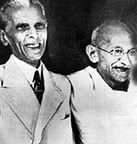 As a Pakistani I am in debt of Mr. Gandhi for the stand he took in trying to halt the horrible carnage that followed partition. Paying the ultimate price for that stand. My understanding is that the very first time ever that the Pakistan flag officially flew at half-mast was at Gandhi ji’s death.