Custom Search

The Temples of Katas Raj

Posted on December 3, 2006
Filed Under >S.A.J. Shirazi, Architecture, Culture & Heritage, History, Religion, Travel
31 Comments
Total Views: 23114

Share

S.A.J Shirazi

In October-November 2006, more than 200 Hindu pilgrims (yatrees) came from outside of Pakistan to visit Katas Raj.

The mention of Katas Raj, located in the salt range 18 miles south of Chakwal, is found in Maha Bharat written in 300 BC. The etymology of this place as narrated in the old edition of Tarikh-i-Jhelum (History of Jhelum) is that according to Brahaman belief, Shiv Devta wept so profusely on the death of his beloved wife Satti that two holy ponds - one at Pushkar of Ajmair and other at Katak Shell - came into being with his tears. In Sanskrit, the word  - Katak Shell - means chain of tears which later on was pronounced as ‘Katas’.


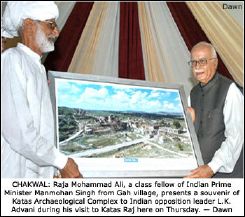
Leader of Opposition in Lok Sabha and President Bharatiya Janata Party (BJP) L.K Advani also visited Katas Raj to inaugurate the conservation work at Satghrah temple in June this year. The photo to the right is from that occasion.
According to Gen Cunningham, Katas was considered the second largest holy place in Punjab for Hindu pilgrims after Jawala Mukhi. It is said famous Pando brothers spent 12 years in Katas and built the temples of Satghara. It is said Al-Beruni also spent some time at Katas to learn Sanskrit in a linguistic university which, at that time, was established here. Temples at Katas have been transferred from the federal government to the Punjab Archaeology Department recently.

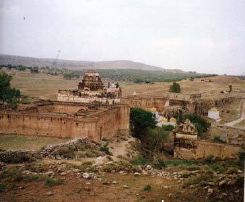
Katas Raj is also the place where Alberuni attempted to measure the circumference of the Earth, studied Sanskrit and wrote his renowned Kitab-ul-Hind (Book of Hind) which depicted the religion, scientific knowledge, and social customs of Hindus. Paras Nath Jogi drew his last breath on Katas. Jagat Guru Nanak Ji also visited the place on the 1st of Visakh. Katas came to be known as Nanaknawas and was a site of contemplation for many large groups of mystics, ascetics and jogis. According to Hindu beliefs, taking bath in the holy pond at the site washes away all sins and makes man innocent.


31 comments posted

Comment Pages: « 4 3 [2] 1 »

  1. March 8th, 2007 3:39 pm

    [...] We left Islamabad around 2 pm. We originally had plans to visit Rohtas, Katas Temple and Tulip restaurant at the Jhelum river toll point. It took us quite some time to reach Rohtas due to traffic enroute. Interesting point here is that we traveled the same road (G.T Road) that Sher Shah built over four centuries ago. [...]

  2. Shahid Nadeem says:
    March 6th, 2007 2:43 am

    History of Katas…….. Shiva’s valley
    The Katas site houses the Satgraha, a group of seven ancient temples, remains of a Buddhist stupa, a few medieval temples, havelis (means old but wide and huge compounded houses we saw and few took risk to climb on top of shivering roof where I requested them to come down since I wanted all to be safe home and be prepared for the next trip with me in Feb 25, 2007…!) and some recently constructed temples, scattered around a pond considered holy by Hindus. HISTORICAL BACKGOUND
    Most of the temples, located some 40 km from the modern city of Chakwal in Pakistan’s Punjab, were built during the reign of Hindu kings. These several temples were built around 900 years ago or more. Although, the earliest of the Katas Raj temples dates back to the latter half of the 6th century AD.
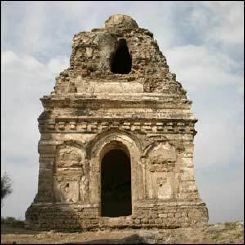
    The temples at Katas are mostly constructed on square platforms. The elevation of the sub shrines seems to form a series of cornices with small rows of pillars, crowned by a ribbed dome.
    The Ramachandra temple is situated to the east of the Hari Singh Haveli and is closed from all sides except for an entrance on the east. The double-storied structure has eight rooms of various dimensions on the ground floor and a staircase at the south leading to the first floor. The temple has two Jharokas (balconies) that have been severely damaged.
    The Hanuman temple is on the western extreme of a high rectangular enclosure with entrances on the south and the north. The temple’s ceiling is undecorated, and lime-plastered. The Shiva temple is also built on a square platform. Its entrance is a recessed round arch with faint cusps and a rectangular opening to the north.
    Katas Raj temple complex is believed to date back to the Mahabharata era. There are stories about the Pandavas spending time there during their long exile. The lake in the complex is believed to have magical powers and supposed to be where Yudhishtir defeated the Yaksha with his wisdom to bring his brothers back to life.

    RECENT DEVELOPMENTS
    Pakistan has decided to place idols of Hindu gods in the seven temples and restore them to their original state to attract visitors. The project for the conservation of the Katas temples and stupas would be completed in shortest possible time. The budget allocated for the project is Rs.51.06 million. India is making similar contribution to the restoration of the Angkor Vat temple complex in Cambodia. Revered in India, the temple was visited earlier by India’s former deputy prime minister L.K. Advani.
    The Punjab government will import idols of Hindu gods from various monuments in India to Pakistan for the restoration of the historic Katas Raj temples, The Katas site houses the Satgarha, a group of seven ancient temples, remains of a Buddhist stupa, a few medieval temples, havelis (means old but wide and huge compounded houses) and some recently constructed temples, scattered around a pond considered holy by Hindus. The government has decided to place idols of Hindu gods in the seven temples and to restore them into their original state to attract visitors. A three-member archeological team is set to leave for India today (Saturday) on an official visit. The team would visit various archaeological sites in India and collect idols of Hindu gods. The team will visit various historical sites in India such as the Taj Mahal, Agra; Fatehpur Sikri, Ajmer Sharif; Pushkar, Aurangabad; Daultabad; Ajanta; Varanasi between January 20 and 30.
    Main purpose of a Punjab Government tour would be gathering information about the gods, their rituals and decoration of their temples, which would be completed in February, and pictures and idols of the gods would be bought from India and designers would be hired to prepare replicas. The project for the conservation of the Katas temples and stupas would be completed in February. The total budget allocated for the project is Rs 51.06 million, he added.
    Apart from sculptures unearthed by the Department of Archaeology dating back to the 6th and 7th centuries, the Salt Ranges are dotted with Hindu temples, of which the most notable is the Katas Raj. Located 25 kilometers from Chakwal District, Katas Raj temples are notable in many ways.

    OTHER INTERESTING POINTS
    The temple was not abandoned by local Hindus when they migrated to East Punjab in 1947. Many legends sacred to the Hindus are associated with it, some of them involving Shiva himself. It has always been the site of holy pilgrimage. Even nowadays, through an agreement between India and Pakistan, Hindu worshippers perform a pilgrimage to the temple every year and bathe in the sacred pool around which Katas Raj is built.

    While Katas Raj has not received the publicity that it deserves, the two semi-ruined temples of the Hindushahiya period (650-950 AD) have been frequently photographed by newspapers and history journals. The remains are very beautifully carved and conform to the best in temple architecture.
    Katas Raj is also held sacred by Hindus for other reasons.
    Legend says;
    …… that the five Pandava brothers, heroes of the Sanskrit epic Mahabharata, stayed here for four out of the 14 years that they spent in exile. While it takes a little effort to get there by road - one has to go off the Grand Trunk Road - Katas Raj is partially visible on the train route from Lahore to Rawalpindi. It is a picturesque sight.
    Many local legends are associated with Katas, some linked with the five Pandava brothers, heroes of the epic Mahabharata, who (supposedly) stayed here for some of the years that they spent in exile. Another involves the death of Shiva’s wife Satti, so the story goes that when she died he cried so much and for so long, that his tears created two holy ponds - one at Pushkara in Ajmer in India and the other at Ketaksha, which literally means raining eyes, in Sanskrit. It is from this name that the word Ketas is derived.
    What was a holy pond for Hindus is today littered with garbage, while the pictorial images inside the temples have disappeared with ravages over time, and disregard of authorities. The temples of Katas can perhaps be saved from further damage if a boundary is constructed around the temple complex, and Hindu pilgrims are encouraged to frequent the place. Might such initial measures exert a moral pressure on those responsible for renovation would be the next question.
    The Salt Ranges have also been yielding prehistoric finds.
    While some local experts place the fossils discovered in the period between 6000 and 7000 BC, the fact remains that they have not yet been examined by trained paleontologists from the West. A large number of bones of the limbs and vertebrae of giant animals resembling the extinct mammoth and dinosaur, have been found at some sites. “An entire range of low mountains in the area appears to be fossilised, revealing to the naked eye layer upon layer of a variety of plants and soils,� says one writer.
    Prehistoric tools and weapons;
    Such as axes and knives made of granite, and artifacts like terracotta bangles and pottery have also been unearthed. The latter have been found to be similar to those excavated in Harappa, but have not been dated for want of expert opinion from abroad. The fascinating Salt Ranges have a vast archaeological treasure still hidden underground. Exploratory work that could expose evidence of an ancient civilisation here needs to be undertaken.
    Most of these temples were erected during the reign of the Hindu Shahias. The earliest of the Katas Raj temples date back to the later half of the sixth century AD. The temples at Katas are mostly constructed on square platforms with cantoned corner pilasters. The sub shrines’ elevation seems to form a series of cornices with small rows of pillars, crowned by a ribbed dome.
    As mentioned above, the Ramachandra temple is situated to the east of the Hari Singh Haveli and is closed from all sides except an entrance on the east. The double-strayed structure has eight rooms of various dimensions on the ground floor and a staircase at the south leading to the first floor. The temple has two jharokas that have been severely damaged. The Hanuman temple is on the western extreme of a high rectangular enclosure with entrances on the south and the north. The temple’s ceiling is undecorated, and lime-plastered. The Shiva temple is also built on a square platform. Its entrance is a recessed round arch with faint cusps and a rectangular opening to the north.. All these temples together make up the Katas temple complex that spreads over an area of a few acres.

    SHAHID NADEEM, taimur66@hotmail.com
    Nice writeup. First time I am hearing of these and glad to know that people are writing about these issues.

  3. Shahid Ndeem says:
    March 6th, 2007 2:39 am

    The Historical City of Chakwal

    Katas Raj

    It is located in the middle of salt range mountains 18 miles away from Chakwal city. The epic poem Maha-Bharat, written circa 300BC contains its references. The area is now known as Makhial. In olden days the place was called Kot Cheena where an annual festival was held in March-April where the pilgrimage performed holy bath in the waters of a pond called Katak-Shail or Ketaksha (flowing- tears or raining eyes) filled by the Lord Shev’s left eye and water filled in a pond called Pushkar or Pokhar at Ajmair (now in India) from Lord Shev’s right eye, as a result of the death of his wife Sati, daughter of Dikshia.

    The word Katak-Shail later on changed into Katsha or Kataksha and now Katas. This pond is locate 200 feet above sea level near Ganian rain / spring water way where its water was merged through a 122 feet long under ground water tunnel-way which was used for irrigation. The wall around the front of pond was built by Raja Pataik or Pattak who was a minister of some Dehli King; the wall is 2.5 feet thick and 19 feet high to protect water and its surrounding dilapidated buildings. Near Ganian water stream there are two hills about 200 feet high. On the southern hills the ruins of old town Kotera , now called Sadhu-Ka-Ghar (Sadhu’s house) was found. Here we also find ruins of Sat-Gharra Mandir (temple) which is considered to be the oldest temple of all. The famous Pandu brothers spent few of their 12-14 years here. Gen Cunningham cited some stupas (Buddhist’s temples) or some more mandirs (Hindu temples) here which were destroyed by the vagaries of weather and one can not forget the torrential rains of September 1948 which destroyed the local geo-contours.

    In recent days Pandit Mohan Lal from India, visited the place in November 1983 and cited the name of Lord Shankar or Lord Shev Maharaj for calling the place as Kay-TaiKash Raj “King of Snakes�. According to him the Lord Shankar, the King of Snakes, was born here which is why the Katas waters are found with snakes but un-harmful to anyone. The famous question-answer debate / discourse between Pandus elder brother Yaksha and local spiritual leaders, was also held at the same pond which is mentioned in the Maha Baharta epic poem.

    There is another reference given by in the travelogue of famous Chinese traveler Chinese traveler Hiuen Tsang, he visited the area circa 630 AD. The kingdom was spread over the period of circa 3500 years or so. On its west was Indus River, in the south there was a huge 200 feet high Stupa of the times of Ashoke Mahraja and here were 10 interconnected clean water ponds with fish. There were plenty of fruit tress whose shadows were reflected in those clean waters. He also mentioned that there was a place where the young called Sarman and the elder called Bkakshu, all semi nude, gathered for worship whose manners and out looks were akin to Buddhists except they were in white colour when dressed and were also keeping back head tied hair like Buddhists.

    Dr Stein who visited the area in 1889 perceived that Chinese traveler Hiuen Tsang cited place is today where Katas Temples are located. His letter of the accounts were published in the 4th volume of Voyaba Oriental general in 1890 which mentioned that there were a hill named Mortee where idols and scripted stone arks were found which were later on used in the construction of the then new bridge of Choa-saiden-Shah (as ordered by the Assistant Commissioner of Choa Saoden Shah……and what a pity…!) The hill was located almost where the Chinese traveler Hiuen Tsang visited the valley cited the location of worshippers etc. From here the archeological material was transported to Lahore on 30-camels back. The distance of present Katas and the Moortee hill is about 7 miles where ruins of a stupa are still seen in the shape of small debris. So Sangapura city of Chinese traveler Hiuen Tsang belonging to Jain religion was in the north of present Katas in the times of Raja Pattak who left the kingdom before Raj Mal. Raja Pattak is the same person buried near Arra village in Jhangar area, the grave is known as Pir Pattak a non Muslim respected saint still accepted by localites for offering holy visits.

    The present area distribution of Didtrict Chakwal included Dhan, Jhangar, Kahun & Nahar and Awan Karee were part of Sangapura Kingdom in 7th century AD and its capital was located 117 miles (700-lee Chinese miles) in the south-east of Taxila. In the north of capital city was Taxila , in the east was Indus river, in the south was river Jhelum. The Sanagpura Kingdom was spread in the radius of 250 square miles. There was a university almost equal to the status of Taxila University. The university was called Shakuntalla University where students from Buddhism, Jainism and Hinduism from Far East and Near-East used to study here. There were three old routs and highways existed centuries back which now includes following present cities.
    1. Kabeer-highway started from present Attock and passing through Talagang, Bharpur Kalan appering in the plains of kalu and connecting Bhaira highway at junction of Kalar kahar.
    2. Second highway connected Chappar-Basharat and fort Nandna with Kalar Kahar
    3. Third highway linked Chappar to Phdial, Padhari and Baran Garan traveling down onwards
    4. Forth connected Kalar kahar to Bhira, Pindi Bhattian, Lahore and Delhi cities of recent times.
    During the spread of population when the Dhan water got settled through “Ghori-Gala� this part of South Asia was ruled by the King Sher-Shah-Suri who regulated the road communication system of area including today’s Mandra-Chakwal road, Chakwal Khushab road, Chakwal Pindi road, Chakwal Mianwali road, Chakwal Jhelum road and Chakwal Pind Dadan Khan Road. The road communication system of that time linked the old Bhon market to Pushawatee, Taxila, Bhaira, Chinniot, Lahore and Delhi cities of recent times

    Malot Temples

    The Malot temples, built of local red sand stones of salt range mountains, are located located on the road leading to Malot village near Choi village. The road is linked with main Kalar kahar road from where it turns from Karuli Chawk towards Malot via Pakistan cement factory and Choi village along with coal mines. It is nine miles away in the south of Katas and same distance from Kalar kahar in the east. It is at the height of 3000 feet and the original spread of the fort was 2000 feet from east to west and 1500 feet from north to south. The inner most spread is 1000 by 500 feet. Gen Cunningham estimated the radius of 2.5 miles.

    The Malot was also called Namrod and Ramrod. Gen Abbot has mentioned its name as Shah Garh or Shai Garh but Janjuas name d it Raj Garh. The name is after the King of MalDev or Malu. The Rajput history claims its name Malot from the word Malik-Kot as they believed that the title of Malik was given to the one who accepted annexation to the Muslim King of Delhi although in reward the Malik enjoyed the autonomous status with full sovereignty in the assigned area. The Mughal King Babur’s travelogue “Tuzkai-Babree� attests to the corollary of Malik-Kot, Mal-Kot and then Malot. According to Ghadholak Rajput archives the city of Delhi was built around 994 AD and Malot was built around 980 AD. Gen Cunningham found the Malot Fort and Temples in a very bad shape even in 1848.

    The two present temples were looked after by the Brahman Bali Hindus till 1947. The Guru of Bali Hindus, Guru Tarlok Nath shrines were frequently visited by them. In the year 1527 Daulat khan Lodhi was forced by the royal forces of Mughal king Babur, to surrender. Mahan Singh, father of Maharaja Rangeet singh, also built a small fort here at Malot in early 19th century.

    Shev or Sab Ganga
    Near Dalwal (where a cement factory is located) in the east of Malot at 3 miles distances in the east the Buddhist temples are located at Sab-Ganga. It is made of red sand stone with triglyph arches and pyramedical moldings and on them animal’s pictures are carved. Near by, a potable water channel is flowing since centuries passing through a pond resembling to Katas pond. Major Abbot mentioned about a head of a statue resembling to Alexander. There is another temple located near a small pond along with some residential buildings which might have been used by the pilgrimages. This place is scenic and shady fruit trees are found. Now this place is called Malkana ocated 3 miles away to Maghal bus stand. The access is through an un-mettle road where trucks loaded with coal pass by.
    Pir Kadh
    The parable is linked with Shar Shah Suri and Mughal King Babur. The story goes saying that the area of Dhan, central Chakwal valley, was filled with water with unknown depth. The king during his second visit to the local area thought of the water but had no idea how to know the depth and disposal of water. He found that most of the area of recent Chakwal was covered by water. He thought to make way to run water but he had no idea where to start and surprised as how deep could be that water. A volunteer in his army offered a plan. He took a spear in his hand and got himself submerged into the water riding his horse. As he went further into the water he began to lift his spear so that the King might get the idea of the deepness of water. He was completely drowned in the water and couldn’t be found thence. But King had now a better plan. He ordered his men to cut off a big piece of mountain in the southwest of Chakwal. Hence the water was driven out of Chakwal. About 7000 men under the leadership of Sheikh Qutub uddin Paracha worked day and night to complete the task of pulling water from the central valley of Chakwal. while sitting at the peak of Diljabba mountainous valley the King saw 84 hurricane lantern held by the sons of Kangra, Jamun, Rampur Rayyasi and Pathankot areas, on seeing them the king was mesmerized by the sight and ordered establishment of 84 villages by allocating land to each. That place where the mountain was chiseled is known as “Ghodi Gala” even today, named after the volunteer who drowned alongwith his horse. This place is in “Peer Kaddah” located near the villages of Nochindee, Pindi-Gujran and Dharuggi- Rajgan falling under union council Mulhal Mughlan headed by Raja Arshad Mehmood, a young man making headway in local politics. Then King ordered to populate this area with eighty four (84) villages, that’s why this part of central Chakwal is also known as “Dhann 84″ or Dhanni. Today there are 172 villages in lieu of 84 due to population spread in last 450 years after spread of water through “Ghori-Galaâ€Â?.
    Sasi-Da-Kalra
    The village of Sha Wali mohammad is located in the North West of Chakwal. In the south of this village, today called Shah Mohammadi, about 3 miles away an old temple is located on a small mountain about 100 feet above sea level which is commonly called Kalar or sassi-Da-Kallara. The temple is made of bricks of the size 17.5 “long, 10.5� wide and 2� thick. The temple is located towards east. According to Jhelum district gazetteer 1884, a coin was found pertaining to Venka Deva age belonging to 8th century AD. The hill top is wide piece of land where ruins and dwindling graves are located here and there. According to Gen Cunningham the temples might had been built around 800-950 Ad as these resembled to Amb Temples located about 50 km in the south of this temple. All these temples pertain to Kashmirian architecture which is now also called Hindu-Shahia architecture.

    Monda Kariala Mound
    This mound is located near Bhun about 105 miles towards east. This mound is known in the revenue record as Pind Jahania or Thohawala Panda. According to Hindu links the palce was acalled Dropad Nagar where Arjun Pandu won Krishna Dropadi. People have found coins belonging to local Kings of Hindu Shahia times. Another witness is that this place was a palace of Raja Kaknia. Kaknia was a caste and Raja Kaknia was father in law of Krishan Maharaj. His five sons’ fought the war of Maha Bharat for Pandus.

    City of Neska Alexandrian
    Old history reveals that Alexander the great established a city by the name of Neska Alexandria in salt range which is erroneously placed in the village of Mong near Mandi Bahauddin although Mong has no relevance to salt range. Near Malkani Dhokon and Dharabee shrine on Kakar kahar road about 1 mile away in the west there are ruins of an old town called Neska. This place about 13 miles away to Chakwal is filled with scattered left over of a living city.

    Dhankar or Pind Kottan
    If we go towards Rohna Seydan from Bhun about 205 miles towards north-west we find two ruins of old habitation are found. One was called Pind and other was Pindi in the old revenew record the place has entered Pind Kottan, locally it is called Purana Pind. Gen Cunningham visited this place in 1888 and he mentioned this place as Dhankar. This place was very developed and economically prosperous. Here can find few old grapes and small shrine this place also refereed to an old building which is locally called Maree, which might have been the Palace of Sultan Jalaludin Khawarzem. He married here around the year circa 1215 A.D the Raja Karsaknain (Khokar Sukhnain) of Salt range. There is a village in the name Nain Sukh in the Tehsil of Chakwal.

    Coins of the Greek Kings of Bakhtari

    In the District Chakwal office Mohafiz Khana (safe house) there are 47 coins which are yet to be deciphered.

    The Fort of Nandna and 40-Spirtual Spirits

    Before Abu-Rehan-Albeiruni visited Malot, Kassak and Nandna to find out the measurement of the circumference of the earth, the local parable confirm that 40 Holy spirits in shape of human being use to live on top of the Mountain where Nandna Fort of Bhaggan Wala is accessed through a road coming nearby this village.

    Village Laphi (Wanhar)

    It is well known in the area that on arrival of Muhammad-Bin-Qasim in the year around 712 A.D, and famous “Lanee Brothers� settled in the present village of Laphi (Wanhar). Here, they built a grand building which was a state of the art by architectural standard. That building is no more in its existence.

  4. HASSAN says:
    March 3rd, 2007 10:59 pm

    I visited this a few years ago. Very depressing in maintainance.

  5. Humaira says:
    February 23rd, 2007 11:54 pm

    Nice writeup. First time I am hearing of these and glad to know that people are writing about these issues.

  6. Shahid Ndeem says:
    February 21st, 2007 10:54 pm

    History of Katas…….. Shiva’s valley
    The Katas site houses the Satgraha, a group of seven ancient temples, remains of a Buddhist stupa, a few medieval temples, havelis (means old but wide and huge compounded houses we saw and few took risk to climb on top of shivering roof where I requested them to come down since I wanted all to be safe home and be prepared for the next trip with me in Feb 25, 2007…!) and some recently constructed temples, scattered around a pond considered holy by Hindus. HISTORICAL BACKGOUND
    Most of the temples, located some 40 km from the modern city of Chakwal in Pakistan’s Punjab, were built during the reign of Hindu kings. These several temples were built around 900 years ago or more. Although, the earliest of the Katas Raj temples dates back to the latter half of the 6th century AD.
    The temples at Katas are mostly constructed on square platforms. The elevation of the sub shrines seems to form a series of cornices with small rows of pillars, crowned by a ribbed dome.
    The Ramachandra temple is situated to the east of the Hari Singh Haveli and is closed from all sides except for an entrance on the east. The double-storied structure has eight rooms of various dimensions on the ground floor and a staircase at the south leading to the first floor. The temple has two Jharokas (balconies) that have been severely damaged.
    The Hanuman temple is on the western extreme of a high rectangular enclosure with entrances on the south and the north. The temple’s ceiling is undecorated, and lime-plastered. The Shiva temple is also built on a square platform. Its entrance is a recessed round arch with faint cusps and a rectangular opening to the north.
    Katas Raj temple complex is believed to date back to the Mahabharata era. There are stories about the Pandavas spending time there during their long exile. The lake in the complex is believed to have magical powers and supposed to be where Yudhishtir defeated the Yaksha with his wisdom to bring his brothers back to life.

    RECENT DEVELOPMENTS
    Pakistan has decided to place idols of Hindu gods in the seven temples and restore them to their original state to attract visitors. The project for the conservation of the Katas temples and stupas would be completed in shortest possible time. The budget allocated for the project is Rs.51.06 million. India is making similar contribution to the restoration of the Angkor Vat temple complex in Cambodia. Revered in India, the temple was visited earlier by India’s former deputy prime minister L.K. Advani.
    The Punjab government will import idols of Hindu gods from various monuments in India to Pakistan for the restoration of the historic Katas Raj temples, The Katas site houses the Satgarha, a group of seven ancient temples, remains of a Buddhist stupa, a few medieval temples, havelis (means old but wide and huge compounded houses) and some recently constructed temples, scattered around a pond considered holy by Hindus. The government has decided to place idols of Hindu gods in the seven temples and to restore them into their original state to attract visitors. A three-member archeological team is set to leave for India today (Saturday) on an official visit. The team would visit various archaeological sites in India and collect idols of Hindu gods. The team will visit various historical sites in India such as the Taj Mahal, Agra; Fatehpur Sikri, Ajmer Sharif; Pushkar, Aurangabad; Daultabad; Ajanta; Varanasi between January 20 and 30.
    Main purpose of a Punjab Government tour would be gathering information about the gods, their rituals and decoration of their temples, which would be completed in February, and pictures and idols of the gods would be bought from India and designers would be hired to prepare replicas. The project for the conservation of the Katas temples and stupas would be completed in February. The total budget allocated for the project is Rs 51.06 million, he added.
    Apart from sculptures unearthed by the Department of Archaeology dating back to the 6th and 7th centuries, the Salt Ranges are dotted with Hindu temples, of which the most notable is the Katas Raj. Located 25 kilometers from Chakwal District, Katas Raj temples are notable in many ways.

    OTHER INTERESTING POINTS
    The temple was not abandoned by local Hindus when they migrated to East Punjab in 1947. Many legends sacred to the Hindus are associated with it, some of them involving Shiva himself. It has always been the site of holy pilgrimage. Even nowadays, through an agreement between India and Pakistan, Hindu worshippers perform a pilgrimage to the temple every year and bathe in the sacred pool around which Katas Raj is built.

    While Katas Raj has not received the publicity that it deserves, the two semi-ruined temples of the Hindushahiya period (650-950 AD) have been frequently photographed by newspapers and history journals. The remains are very beautifully carved and conform to the best in temple architecture.
    Katas Raj is also held sacred by Hindus for other reasons.
    Legend says;
    …… that the five Pandava brothers, heroes of the Sanskrit epic Mahabharata, stayed here for four out of the 14 years that they spent in exile. While it takes a little effort to get there by road - one has to go off the Grand Trunk Road - Katas Raj is partially visible on the train route from Lahore to Rawalpindi. It is a picturesque sight.
    Many local legends are associated with Katas, some linked with the five Pandava brothers, heroes of the epic Mahabharata, who (supposedly) stayed here for some of the years that they spent in exile. Another involves the death of Shiva’s wife Satti, so the story goes that when she died he cried so much and for so long, that his tears created two holy ponds - one at Pushkara in Ajmer in India and the other at Ketaksha, which literally means raining eyes, in Sanskrit. It is from this name that the word Ketas is derived.
    What was a holy pond for Hindus is today littered with garbage, while the pictorial images inside the temples have disappeared with ravages over time, and disregard of authorities. The temples of Katas can perhaps be saved from further damage if a boundary is constructed around the temple complex, and Hindu pilgrims are encouraged to frequent the place. Might such initial measures exert a moral pressure on those responsible for renovation would be the next question.
    The Salt Ranges have also been yielding prehistoric finds.
    While some local experts place the fossils discovered in the period between 6000 and 7000 BC, the fact remains that they have not yet been examined by trained paleontologists from the West. A large number of bones of the limbs and vertebrae of giant animals resembling the extinct mammoth and dinosaur, have been found at some sites. “An entire range of low mountains in the area appears to be fossilised, revealing to the naked eye layer upon layer of a variety of plants and soils,� says one writer.
    Prehistoric tools and weapons;
    Such as axes and knives made of granite, and artifacts like terracotta bangles and pottery have also been unearthed. The latter have been found to be similar to those excavated in Harappa, but have not been dated for want of expert opinion from abroad. The fascinating Salt Ranges have a vast archaeological treasure still hidden underground. Exploratory work that could expose evidence of an ancient civilisation here needs to be undertaken.
    Most of these temples were erected during the reign of the Hindu Shahias. The earliest of the Katas Raj temples date back to the later half of the sixth century AD. The temples at Katas are mostly constructed on square platforms with cantoned corner pilasters. The sub shrines’ elevation seems to form a series of cornices with small rows of pillars, crowned by a ribbed dome.
    As mentioned above, the Ramachandra temple is situated to the east of the Hari Singh Haveli and is closed from all sides except an entrance on the east. The double-strayed structure has eight rooms of various dimensions on the ground floor and a staircase at the south leading to the first floor. The temple has two jharokas that have been severely damaged. The Hanuman temple is on the western extreme of a high rectangular enclosure with entrances on the south and the north. The temple’s ceiling is undecorated, and lime-plastered. The Shiva temple is also built on a square platform. Its entrance is a recessed round arch with faint cusps and a rectangular opening to the north.. All these temples together make up the Katas temple complex that spreads over an area of a few acres. SHAHID NADEEM, taimur66@hotmail.com

  7. February 17th, 2007 1:27 am

    Nice photo from Katas Raj published in Daily Times (17 Feb 07) [Given title"Pundit Vanay Kumar Bansi plays Sunkh during ‘puja’ at the Katas Raj temples on Friday. Abid Nawaz"]:

  8. Nauman Anwar says:
    February 6th, 2007 2:53 am

    Yeasterday on Feb. 05 2007, I visited KATAS, although the work is in process for the stairs but no work is currently in progress on the building. I request the authorities to please look after such historical places

    Regards

Comment Pages: « 4 3 [2] 1 »


Have Your Say (Bol, magar piyar say)

Please respect the ATP Comment Policy.

Keep comments on topic; no personal attacks; don't submit indecent, inflammatory, slanderous, uncivil or irrelevant comments; flamers and trolls are not welcome; inappropriate comments will be removed or edited.

If you won't say it to someone's face, then don't say it here!

Readers who want to use a URL should please use the TINY URL program.

Thanks, and keep the comments coming!