Adil Najam
[UPDATE: Sadly, Ahmed Faraz died in Islamabad ]on August 25, 2008. Details here.]
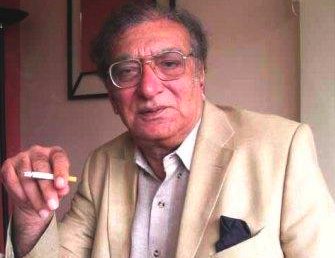
Despite an erroneous news earlier that renowned poet Ahmed Faraz had died in a Chicago hospital, the news right now is that Ahmed Faraz is still alive, but not at all well, struggling for his life in a Chicago hospital.
Here is the latest from The News:
CHICAGO: Renowned poet Ahmed Faraz is alive and still under medical treatment at a local hospital here, said his physician Tahir Rohail, brushing aside the earlier report of his death aired by state TV. He said Ahmed Faraz is seriously ill at a hospital in Chicago where necessary medical treatment is being provided to him.
Others are still reporting his death, seemingly based on a TV channel news item. It seems - we hope - that the TV channel jumped the gun on this and Faraz Sahib is still alive.
We have, of course, written multiple times on the legendary poet - including here, here and most recently here. I shake as I type this and I pray that we will NOT be writing about his demise anytime soon. For me Faraz has always been a fighter, and we are rooting for him in this fight too. Here is some of Fawaz the fighter:
We certainly pray that he is and that he will remain alive and kicking for a long time. But (earlier) reports, from people close to him, seem to suggest that his condition is very critical and it has been and remains a touch and go situation. He needs our prayers.




How do you email a story on this site to someone else?
I couldn’t find a “email this story” link anywhere.
I am so relieved to hear that the news earlier was wrong. I pray for his life and health.
It’s so irresponsible of PTV and other channels to announce someone’s death without ascertaining the facts, particularly when that someone happens to be Ahmad Faraz! Imagine the distress it must have caused to his family, friends and fans.
I saw Faraz 2-3 weeks ago at the mushaira organized by the APPNA in DC. He was the last one to recite his poetry, a little after 2 in the morning. He looked good, recited his poems mostly from memory, in his usual booming voice, drawing wild applause from the audience. He was a bit forgetful, and a little wobbly when he walked, but for those who know Faraz it was nothing unusual. Later, we heard that he was admitted to a hospital in Chicago but was doing well.
May he recover fast, live long, and continue to sing his song — the song of resistance to status quo.
Here are two pictures from DC mushaira:
Does anybody know which hospital in Chicago ? I live nearby so want to vist him..
Umair Bhai,
Tahir Rohail is Faraz saab’s physician/doctor in Chicago somewhere if you can find him.
Feimanallah
Wasim
Do you know which hospital in Chicago? I am in town.
Adil Bhai,
I hope you can update us all as we are all praying for Faraz saab. OP has taken cue from you to ask for prayers too here:
http://blog.otherpakistan.org/
Let us all pray for this son of the soil wherever we are.
Feimanallah Faraz Saab
Wasim
Here is the link to my interview with the legendary poet in 2001. Thanks. Siraj Wahab, Jeddah, Saudi Arabia
http://notesfromsaudiarabia.blogspot.com/2007/02/i nterview-with-ahmed-faraz-2001.html
Thursday, February 15, 2007
Interview With Ahmed Faraz (2001)
Note: Ahmed Faraz, the legendary Urdu poet, is a romantic genius. No two opinions about that. This is perhaps one of my best interviews to date. Maybe because I have a passion for Urdu poetry, especially romantic poetry. This was first published in the Jeddah-based Arab News in 2001. Ahmed Faraz was visiting Jeddah that year for an unforgettable mushaira organized by a good Pakistani friend of mine, Sher Bahadur Khan of PASCO (Pakistan Social and Cultural Organization). I also covered that mushaira for my newspaper. At the end of this interview, I am reproducing the mushaira report as well to give you an idea about its historicity. — Siraj Wahab, Jeddah, Feb. 15, 2007
By Siraj Wahab
JEDDAH, May 17, 2001 — Ahmed Faraz doesn’t look like the quintessential fire-breathing rebel that one would expect from some of his well-known couplets. For example:
Tu wahin haar gaya tha mere buzdil dushman
Mujh se tanha ke muqaabil tera lashkar niklaa
He is, however, extraordinarily mild-mannered, thoroughly modest and dreamily romantic. There are no airs about him despite the fact that he is the best of living Urdu poets. His metaphors evoke delicate images whether read in the dust of a village in Uttar Pradesh or in the posh surroundings of Karachi’s Defense Society. No wonder he is the toast of all “ghazal” singers in the subcontinent. These lines have been immortalized by Munni Begum in her soulful voice:
Phir koyi haath hai dil par jaise
Phir tera ahd-e-wafa yaad aaya
Jis tarah dhund main liptay huay phool
Ek ek naqsh tera yaad aaya
Aisee majboori kay aalam main koyee
Yaad bhi aaya to kya yaad aaya
Yaad aaya tha bichhadna tera
Phir nahin yaad ke kya yaad aaya
Yeh muhabbat bhi hai kya rog Faraz
Jis ko bhule woh sada yaad aaya
Faraz has given some highly original couplets to Urdu poetry — original in thought content and rich in diction. It was he who formulated the “you-too-Brutus” concept for the first time in a couplet:
Main margaya wahin ke saf-e-doston se jab
Khanjar badast tu bhi ravaan tha meri taraf
He has enriched Urdu poetry with some of his unique lines. Critics believe his poem “Salamti Council” — Security Council — should be counted among the best in any language and not merely in Urdu alone.
Phir chaley hain mere zakhmon ka madawa karne
Mere ghamkhwar usi fitna gar-e-dahr ke paas
Jis ki dehleez pe tapki hain lahoo ki boonden
Faraz was in Jeddah recently at the invitation of the Pakistan Social and Cultural Organization (PASCO) headed by Sher Bahadur Khan. It was indeed a rare pleasure to listen to him as he reminisced, recalling events which shaped his personality and sharpened his poetry.
“I was in Class 9 when I wrote my first couplet. Ramzan Eid was around the corner and my father had brought new clothes for all of us. My elder brother, Mehmood, who was in first year then, got an elegant suit while I got a ‘kashmira.’ In those days, the ‘kashmira’ was not a very sophisticated article of clothing of attire. I was extremely unhappy and these lines were the result:
Jab ke sab ke waaste laaye hain kapde sale se
Laaye hain mere liye qaidi ka kambal jail se
Loosely translated it means, “everybody got elegant clothes and I got a prisoner’s garment!”
However, it was a year later before Faraz received his first real inspiration to write poetry. “I was in Class 10 and there was a cousin of mine who was also in Class 10. Our parents thought we should prepare our exams together. She was very good in Urdu poetry and was able to quote hundreds of couplets off-hand. One day she asked if it was OK with me if we played ‘bait baazi.’ I was nonplussed and wondered what kind of game it was. She then explained to me the finer details of this literary game; I agreed to give it a try and lost miserably because I knew no couplets… She beat me hollow.
“This continued for a while until I decided to learn as many couplets as I could. Even then I lost. Finally, I realized that there was no way to win against her unless I started composing couplets on the spur of the moment. They were not great literary gems but they had meter and they rhymed. My cousin thought that the couplets were from recognized poets and accepted them.”
After a pause, Faraz lit a cigarette and switched into rewind mode again. “The real turning point though came in the early 1950s. We were at Edwards College, Peshawar and we had an invitation from a college in Gujarat. They were organizing a ‘mushaira.’ Our principal was an Englishman named Dr. Nobel. I used the little English I knew then to convince him to send us to the poetry contest. The principal agreed but wondered who the other poet from our school would be. There had to be a team of two so I composed a few lines for a friend of mine and asked him to go and tell the principal that he wanted to be on the team. The principal agreed and the two of us were off to Gujarat. Many budding poets there had come from Lahore. My poem on Kashmir was a big hit.”
Could he recall that poem?
“I just remember this line:
Takhreeb-e-gulistan hoti hai taamir-e-gulistan se pehle.
“My ghazal was also very well-received and we won the first prize. Our principal was very happy and there were huge celebrations.”
So when did he take up Urdu poetry as a full-time vocation? “Urdu poets had a very bad image then. They were synonymous with pan-chewing, sloppily dressed slobs living in a world of their own. It was at this time that we saw a new image of poets projected by the immaculately dressed Ali Sardar Jafri, Jan Nisar Akhtar, Sahir Ludhianvi, Kaifi Azmi. Unconsciously, I was drawn to being a poet.”
Faraz feels that Urdu literature parallels what is happening in English and French literature. “The problem is that our work is not being translated into other languages so the world knows nothing about what is happening in Urdu. I don’t think Faiz (Ahmed Faiz) was any less than Octavio Paz. If Paz can get a Nobel (Prize for Literature) so should Faiz. There has to be a concerted effort in this direction. There is a dire need for what I call cultural landscaping. People have stopped reading, which is sad. What is even worse is that comparative studies have become a thing of the past. We need to keep abreast of what is happening in other languages.”
Since Faraz is near the top of Urdu literature, it was natural to ask him for his opinion about Urdu poetry in both India and Pakistan. “There is some excellent poetry being written in Pakistan. India has not produced the kind of poets that Pakistan has during the last couple of decades. Forget about Mirza Ghalib. He was not truly from Hindustan. His ancestors came from Central Asia. Leave him aside for the time being. Take (Sir Muhammad) Iqbal — he came from Pakistan; Faiz — he came from Pakistan; (Noon Meem) Rashed — also from Pakistan; and Nadeem (Ahmed Qasmi, the only stalwart of both prose and poetry) — he was again from Pakistan. India has not produced any mainstream poets of the caliber of those I have just mentioned. Yes, the Indians are doing an excellent job in ‘tehqeeq’ (research) and in this they are way ahead of their Pakistani counterparts.”
No article on Faraz can be complete without his classic ghazal, “Ranjish hi sahi…” whose freshness has neither dimmed nor faded with the passage of time. It was composed almost three and a half decades ago. Gustave Flaubert, it is said, became fed up with his masterpiece “Madame Bovary” because it overshadowed his other works. We wondered if Faraz was jealous of his gem. “No way because the best is yet to come.” Mukarrar!
—-
Note: Following is the report on the mushaira that took place in Jeddah on Thursday, May 3, 2001. Naturally, Ahmed Faraz was the cynosure of all eyes at that memorable evening at the Saudi-German Hospital Auditorium in Jeddah. Everybody was fascinated by his poetry. And so was I. And it is reflected in this report that I wrote and which appeared in Arab News two days later on May 5, 2001. — Siraj Wahab, Jeddah, Feb. 15, 2007
—-
‘Itna Sannata Ke Jaise Ho Sukoot-e-Sehra’
JEDDAH, May 5, 2001 — He is one of the greatest exponents of Urdu poetry in all its forms. Gifted with a rare mode of thought and feeling about love and rebellion, he has given a new meaning to the craft of Urdu poetry. Ahmed Faraz gave a glimpse of his poetic genius at a mushaira (poetry reading session) organized here on Thursday night by the Pakistan Social and Cultural Organization (PASCO).
It was indeed a rare treat to listen to this towering Urdu literary figure whose inimitable work has inspired generations of Urdu lovers. He passionately spoke of the need for “cultural landscaping” in Pakistan. “We should rise above politics and come together to promote our culture… Such functions should be held more often as they are part of the cultural landscaping that I am talking about… This is the only way of correcting the negative image that our beloved country has acquired in recent years.”
Ahmed Faraz fans here in the Kingdom, whose numbers are legion, packed the Saudi German Hospital Auditorium and hung onto his every word and couplet with bated breath. They kept reminding him of his best poems and best couplets as they knew all of them by heart. Faraz did not let them down one bit.
This is how he described his incarceration during one of the military regimes in Pakistan. The clarity of thought and imagery and the symbols used in these lines speak volumes about the mastery that Faraz has acquired over the craft of creative writing in Urdu.
Itna sannata ke jaise ho sukoot-e-sehra
Aisee taariki ke aankhon ne duhaee di hai
Dar-e-zindaan se pare kaun se manzar honge
Mujhko deewaar hi deewar dikhayee di hai
Door ek faakhta boli hai sare shaakh-e-shajar
Pehli aawaaz mohabbat ki sunayee di hai.
There was a thunderous applause. And this was just the beginning. A product of the progressive movement that came to dominate Urdu literature in the 1940s and 1950s, Faraz then touched the hearts of his fans with some superlative ghazals.
Misaale dast-e-zulekha tapaak chahta hai
Yeh dil bhi daaman-e-Yusuf hai chaak chahta hai
Idhar udhar se kayee aa rahee hain awaazen
Aur us ka dhyaan bahot inhimaak chahta hai
Duwayen do mere qaatil ko sab ke shehr ka shehr
Usee ke haath se hona halaak chahta hai
That was just incomparable. Faraz then demonstrated his ability to turn words and phrases into things of beauty:
Ek to khwab liye phirte ho galiyon galiyon
Us pe takraar bhi karte ho kharidaar ke saath
Earlier, Dr. Peerzada Qasim held total sway over the audience with his refreshing lines. A poet seeped in the intricacies and nuances of Urdu language, he recited exquisite couplets. His depth of thought can be gauged from the following couplets:
Yaad kya daste hunar hai ke sanwarta gaya main
Us ko socha to use yaad hi karta gaya main
Ek tasveer banaayee thi mukammal na huyee
Ek hi rang lahu rang tha bharta gaya main
And when he started reciting this poem, the audience were swooning with excitement along every word:
Ruswaayi ka mela tha so maine nahi dekha
Apna hi tamaasha tha so maine nahi dekha
Us khwab-e-tamanna ki taabeer na thi koyee
Bas khwab-e-tamanna tha so maine nahi dekha
Pyaase to rahe lekin tauqeer nahi khoyee
Darya wo paraya tha so maine nahi dekha
His “Ek diya bujha huwa” was also very well-received.
Another prominent poet from Pakistan who captivated the audience was Zafar Iqbal. The audience burst into laughter when he said:
Na koyi baat karni hai na koyi kaam karna hai
Aur us ke baad kaafi der tak aaraam karna hai
And then Zafar Iqbal launched into serious stuff sending one and all into a crescendo of wah-wahs and serious introspection. One could feel the audience identifying themselves with these couplets:
Lafz patton ki tarah udne lage chaaron taraf
Kya hawa chalti rahee aaj mere charon taraf
Aasman par koyi tasveer banata hun Zafar
Ke rahe ek taraf aur lage chaaron taraf
Etebaar Saajid was also successful in driving home his point with some thought-provoking couplets:
Hai itna shor kissi se mukhatib bhi nahin
Jo sun sakte hain bas unhee ko sunayee dete hain
The consul general of Pakistan, Qazi Rizwan-ul-Haq Mehmood, took everybody by surprise when he recited a couple of very good couplets of his own:
Us ke dushwaar raste pe chalta huwa
Gir pada hun dubara sambhalta huwa
The consul general congratulated Sher Bahadur Khan on organizing such a beautiful function and said it should become a regular feature. He said he would be going to Abu Dhabi in June and therefore the event had come like an icing on the cake. He thanked the community for promoting the culture and ethos of Pakistan here in the Kingdom.
The mushaira was conducted by Muhammad Ali and it also included local poets in Munawwar Hashmi, Naseem-e-Sehr, Umar Saleh Al-Aidroos and Naeem Bazidpuri.
Posted by Siraj Wahab at 5:56 AM