Adil Najam
 Today is April 4, the death anniversary of Zulfiqar Ali Bhutto – founder of PPP, President and Prime Minister of Pakistan, and one of the most iconic figures (whether you like him or not) in Pakistan’s history. He was hung to death on April 4, 1979, during the military rule of Gen. Mohammad Zia ul Haq. In this historic video, Gen Zia-ul-Haq explains and defends the trial of Zulfiqar Ali Bhutto.
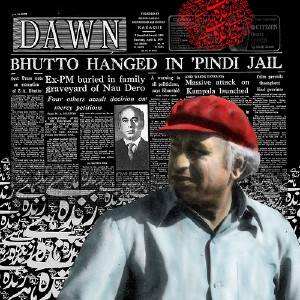 There is much, too much, in this video that is still pertinent today: the role of the military in politics, Gen. Zia’s promise of early elections, the role of a “free” judiciary, views on “justice must be done,” and so much more. Do please let us know what emotions this evokes in you.
For more on the life and death of Zulfiqar Ali Bhutto also see our 2008 post on his death anniversary and a post of historic photographs of Mr. Bhutto during this trial.




http://www.dawn.com/weekly/cowas/20080120.htm
DAWN – the Internet Edition
January 20, 2008 Sunday Muharram 10, 1429
The sowing & reaping of destiny
By Ardeshir Cowasjee
…
Mulling over the Bhutto era of late, I picked up a book I had not read for years as I recalled a particularly poignant and perceptive passage which has borne the brunt of time.
Perhaps the finest summation of the character and attributes of Zufikar Ali Bhutto came not from one of his fellow countrymen, but from a foreigner, who could stand back and objectively observe and comment. Morrice James of the British foreign office spent a total of nine years in Pakistan in various diplomatic posts. During the first half of the 1960s, he was Britain’s high commissioner in Islamabad and had ample time to observe, interact with and analyse the country’s most compelling and charismatic politician.
In his Pakistan Chronicle, published posthumously in 1993, Sir Morrice James, Lord St Brides, has this to say about Bhutto:
“Bhutto certainly had the right qualities for reaching the heights — drive, charm, imagination, a quick and penetrating mind, zest for life, eloquence, energy, a strong constitution, a sense of humour and a thick skin. Such a blend is rare anywhere, and Bhutto deserved his swift rise to power. From the end of 1962 onwards, I worked closely with him and it was a pleasure to deal with someone so quick-witted and articulate. We got on remarkably well…
“But there was — how shall I put it? — the rank odour of hellfire about him. It was a case of corruptio optimi pessima. He was a Lucifer, a fallen angel. I believe that at heart he lacked a sense of the dignity and value of other people; his own self was what counted. I sensed in him a ruthlessness and a capacity for ill-doing which went far beyond what is natural. Except at university abroad, he was mostly surrounded by mediocrities, and all his life, for want of competition, his triumphs came to him too easily for his own good. Lacking humility, he thus came to believe himself infallible, even when yawning gaps in his own experience (e.g. of military matters) laid him — as over the 1965 war — wide open to disastrous error.
“Despite his gifts, I judged that one day Bhutto would destroy himself — when and how I could not tell. In 1965, I so reported in one my last dispatches from Pakistan as British high commissioner. I wrote by way of clinching that point that Bhutto was born to be hanged. I did not intend this comment as a precise prophecy of what was going to happen to him, but 14 years later that was what it turned out to be.”
….
Sorry, did not mean to give the impression that ZAB’s judicial murder was ‘justified.’ A judicial murder never is.
There is no doubt that Maulvi Mushtaq was a ‘hanging’ judge and hated Bhutto and his Court was determined to find Bhutto guilty and hang him. However, the fact that ZAB was ‘judicially murdered’ does not absolve him of his earlier guilt. I am reminded of the saying that “they framed a guilty man” when it comes to Bhutto’s conviction–if not for Kasuri’s killing, for many others.
For example, IIRC, Zia actually wanted to have ZAB tried for Mengal’s son’s murder (? or another Balochi politician? can’t recall such ancient history now!) but Mengal refused to play along with Zia. There were also other such killings by the FSF.
Zia’s Martial Law regime was delighted to publish a White Paper on Bhutto and the FSF shortly after the coup. If I also recall correctly, PTV put on a show (called something like Zulm ki Dastaan–I’m sure that Adil can find some of them to put them on ATP–where they trotted out dozens of people who described how they were tortured by the FSF). While of course there were no doubt lies and gross exaggerations in both of these, there is also no doubt of the way ZAB treated his political opponents.
@Fuzair
I think we should stop looking for “saints”. And just because he was not a “saint” does not mean he should have been hung!
I am not a “saint” either, and maybe nor are you. But that does not justify his murder.
Dr Ghulam Nabi Kazi—apparently Pakistanis did not believe ZAB was Muslim, despite the Supreme Court ordered removal of LHC remarks regarding ZAB religion. After his death his private parts were photographed, to find out if he remained an uncircumcised Hindu. (Ref: Col Rafi-Uddin interview, on Express News TV program Front Line with Kamran Shahid. April 4, 2010).
I think it may be a good rebuttal for Gen Zia’s hyporcite comments about justice:
http://www.dawn.com/wps/wcm/connect/dawn-content-library/dawn/the-newspaper/editorial/a-tribute-to-zab-440