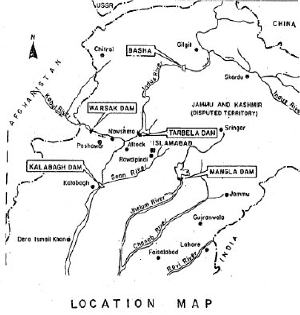
 Kalabagh Dam, which has been a dead project for all practical purposes, got a stir yesterday when Federal Minister for Water and Power Raja Pervez Ashraf said that the project has now been shelved for ever.
On the same day, another interesting development happened about NWFP where it was decided to change the name of NWFP (North West Frontier Province) to ‘Pakhtunkhwa‘
1. Kalabagh Dam
For the past few decades, both of these issues have always created passions and exposed the fissures in Pakistani society. The politicians from three smaller provinces have been unanimous in hailing the decision on shelving Kalabagh dam for ever, whereas JI and PTI have been very vocal against the decision. Infact, the opposition from Punjab has been so great that later in the day, Minister had to change his words and he clarified that the project was ‘on hold’ and not totally discarded.
PML(Q)’s role on this issue, however, made me smile. Their whole politics nowadays revolves around saying and doing opposite to what PML(N) and PPP say and do. If PML(N) says ‘X’ on an issue then PML(Q) right away says ‘NOT X’ without going in the merits. So while PML(N) is too busy with the lawyers, PML(Q) got the chance to do politics on the issue and their statements are all pro Kalabagh Dam today. One should ask PML(Q) what did they do about the project in the past 6 years? PPP who has substantial vote base in Sindh and NWFP can take this stand against the dam construcition and has done so.
Many people are also saying that the whole purpose of stirring a dead issue like Kalabagh Dam by the Minister at this point in time is just to cause diversion from other issues like price hike, energy shortage, lawyers etc etc.
During my undergrad studies, I once took a course called ‘Engineering Economics’. I don’t remember much from that course now except for one line from my text book. It went like this:
“Mega Projects of a country should be started immediately after planning is done otherwise they’ll end up becoming political issues”
Over the years this line has proved itself true over and over again. I think this is exactly what has happened to Kalabagh Dam project too. It has now become such a big political issue that nobody can dare to challenge it in 3 smaller provinces. And just like my Engineering Economics book said, as soon as Governement mulled on the decision of building the Kalabagh dam, the opposition against it grew stronger and stronger in Sindh and NWFP.

The idea of Kalabagh Dam was conceived in 1953 and until 1973 it was going to be a water storage place for irrigation purposes only. From 1973 to 1984, the design was changed to make it a multi-purpose mega dam. If completed it will be 260 feet high, will submerge 35000 acres of land, will generate 3600 MW of hydel power, store 6.7 MAF water for flood control and supply 12.8 MAF water to Mianwali, Khushab, D.I. Khan and Jhelum districts for irrigation.
In 70s and 80s my family used to subscribe to Urdu Digest. I very vividly remember that in summer of 1979, Urdu Digest had a special issue on Kalabagh Dam. The issue showed an artist’s imagination on title page and it was touted as the mluti purpose dam with multiple spillways for flood control, agriculture and Power Generation. 29 years have passed since that introductory report of the Kalabagh appeared in Urdu digest. What has happened since then? I believe nothing has happened on gorund as far as actual dam construcution goes. I do remember reading about some heavy machinery was once moved to the spot in one of the previous government (2005) and that is all.
I remember reading late Wali Khan (ANP)’s statement many years ago, that if Kalabagh Dam is built then nothing will be left of NWFP cities of Nowshera to Mardan. The water level of Kalabagh dam will be higher than these two cities and will cause severe water-logging problem in these two cities. So much so that they may turn into lakes. The claim of Wali Khan is however, refuted by the dam planners which point out dam’s altitude at 915 feet is lower than that of Nowshera at 938 feet and Mardan at 958 feet.
The Sindhi politicians are also against the dam becuase they think there will be not much water left in the system for Sindh’s needs. Already the water flow downstream of Kotri barrage is practically zero. The sea water has come inlands into River Indus delta and almost 2 million acres of arable land has been lost to Sea water there causing mass exodus of people to cities.
I’ve also seen photos of Lansdowne Bridge Sukkur from 1950s to present. In 1950s there used to be water under the bridge stretching from bank to bank. That water under the bridge has since flown away. Now all one can see is a big sandy desert under the bridge and then a narrow river slowly inching towards the delta (except for monsoon floods).
Over the years I’ve also traveled extensively in Sindh and wherever I’ve gone, I’ve seen slogans of
‘Kalabagh Dam naa-manzoor’ (Kalabagh Dam not acceptable)
written as wall chalking all the way from Kashmore to Karachi.
“baat se baat nikalti hai” (one thing leads to another) In August 2004, Chaudhry Shujaat Hussain was camaigning for Shaukat Aziz in Tharparkar, Sindh and there he gave this funny statement which has remained stuck in my memory. He said:
“agar aap ko Kalabagh Dam ka naam pasand nahi…naam mein kia rakha hai… meri taraf see aap is ka naam neela-bagh ye peela-bagh rakh deN..” (If you don’t like the name of Black Garden Dam… What is in a name? For what I care, you can rename the project as either Blue-Garden Dam or Yellow-Garden Dam)
So what do you guys think? I think the dam will never be constructed. It is a dead horse. The issue has been raised now to probably create diversion from other issues.
One point that does go in favor of building Kalabagh dam is the forecast that all future wars will be fought to control energy and food sources like fresh water resources, oil and gas reserves etc. If Kalabagh dam is built it may provide a water storage which may be needed soon as both Mangla and Tarbela are silting fast and may not live more than few years.
An informative editorial appeard in Dawn on May 28 on the subject. It is given in the reference section below. I suggest our readers to read it too.
2. Pakhunkhwa
When I first read this story, I told myself, “so what?”. Exactly. so what if NWFP is getting renamed Pakhtunkhwa? One of my favourite real life anecdotes goes like this. There was a Chemistry lecture going on in Karachi University. The teacher drew two molecules on the board and told the class to name them anything because it was not important. To this a guy from back benches shouted:
“Madam. in ka naam pappoo aur guddoo rakh deN”
Point is naam mein kia rakha hai? (What is so important about a name?). My personal read is this. After USSR’s demise ANP has lost its ‘kaaba’ and a source of ideology. They were looking for some issue on which to do politics. They got revived on new issues to do politics for two reasons. First was the renewed Pashtoon nationalism fueled by the on going war on both sides of the durand line, and second issue was created to rename the province as ‘Pakhtunkhwa’. This second issue is so big that ANP won the recent elections in NWFP, in part, on this slogan and in part because JI didn’t take part in the elections. Now that ANP is in power, they need action on this issue so that their constituencies can think that yes some real work is getting done, and hence raising of Pakhtunkhwa issue now.
I personally think there is no harm. If at all, it will strengthen the federation. If in Sindh, Punjab and Baluchistan multiple nationalities and ethnicities can live together without worrying too much about the province’s name then the name Pakhtunkhwa is a non-issue too. It will become an issue only if one wants it to be, and I hope it doesn’t happen. The name Pakhtunkhwa is also a ground reality. If you’ve ever been to Quetta, you’ll notice that 100% of the shops in Pashtoon area write their addresses on their shops ending in ‘junoobi Pashtunkhwa’ as the province’s name instead of Balochistan. So my point is that the name ‘Pashtunkhwa’ is already a ground reality. Lets not unnecessarily push back on it.
End Point:
The above are my opinions. I am however, not tied to them without reasoning. If somebody can educate me otherwise on why building Kalabagh Dam now is a good idea and why renaming NWFP as Pakhtunkhwa is not a good decsion, I will be open to change my views as a result of arguments and counter arguments.
Reference:
1. Dawn editorial: Beyond Kalabagh
2. Kalabagh Dam Political, Environmental & Humanitarian Disaster in Pakistan by Ayaz Latif Palijo
3. Infeasibility of Kalabagh Dam at www.dawn.com




Naming a Province or region is the right of the people living in that province. People from outside the province should respect their right to do so instead of sitting in judgment over them. What this analysis and many comments on the forum betray is that people from outside Pakhtunkhwa, mainly Urdu and Punjabi speakers, feel that they have a right to do so because they stand as guardians of Pakistaniat. I think it’s time they let go of their watchdog role in the interest of equality among federating units. As for the Hazara and other ethnic groups living in Pashtunkhwa, they have genuine concerns over the name issue but those issues have to be resolved through a dialogue between the ethnic groups living in the region not by the superimposition of a decisions from Islamabad as has been the norm for the past 60 years or so. One way to do this would be by giving equal priority to Hindko language and culture in the cultural agenda of the province and recognize its multi-ethnic composition instead of resorting to the failed policy of denying the province’s historical identity. In any event, this is an issue which needs to be resolved through a democratic dialogue between the constituent ethnic groups in Pakhtunkhwa.
As for Kalabagh Dam, the author’s ambivalence on the issue flies in the face of the very facts he cites. Kalabagh has been designed as a High Water Dam which implies that a minimal level/volume of water has to be stored there regardless of actual supplies of water available in the Indus River System. The key question to ask is whether the river system has enough supplies round the year to maintain water for electricity generation and release it downstream of Kalabagh for growers’ needs and downstream of Kotri into the sea for preventing the encroachment of Sindh’s lands by the sea. Even without Kalabagh we have problem of salinity and water logging downstream of Kotri, so what the situation would be with the construction of Kalabagh is anybody’s guess. In spite of these clear objections, and the long and bitter history of opposition to project by 3 our of 4 provinces, the writer’s comments that the government should have gone ahead with it years ago based on a Business Economics calculation betray a fundamental disregard to the working of the political system.
The writer also ignores the history of Indus river water distribution where Punjab, the upper riparian, has consistently ignored the rights of the lower riparians such as Sindh which it must respect under national and international law. For example, Chashma-Jhelum Link Canal (21000 cusecs) and Taunsa-Panjnad Link Canal (12000 cusecs) have been kept open for the last several years without prior consent and permission of the Sindh provincial government in flagrant violation of the inter-provincial agreement. What guarantee, if any, is there that it will not do the same with the distribution network of Kalabagh Dam given that it enjoys a simple majority in the national assembly and most of the ministerial slots in any government?
It is amazing how many Pakistanis refuse to reflect critically on their own position as members of particular regions and ethnic groups and continue to subscribe to dominant views which ignore the rights of other Provinces by invoking ‘the national interest’. For people who have been at the receiving end of the federal government’s policies, ‘national interest’ almost always translates as Punjab’s interests.
Early in 2005 I had written a letter in Daily Times on Kalabagh Dam. I would like to copy it here for it might answer some of the questions raised in this post and in some of the comments (sorry for taking so much space):
“Sir,
General Musharraf has been trying to build a consensus, in his own ambivalent style, on the Kalabagh Dam (KBD) for the last five years now. But the consensus doesn
The opposition to renaming NWFP does not come from Punjab, Sindh or Baluchistan. It comes from within NWFP. The Hazara minority (avout 25% of NWFP) is opposed. Should they be overruled?
The whole ANP Pukhtunkhwa angle requires some reading into…
I was writing a series on the history of the Pukhtunkhwa issue based on primary sources alone (without my own input or opinion) for a respectable mainstream newspaper. Suddenly it was discontinued. There are agendas working all around. Let us not be stupid for once… this is a cover up. It is responsibility to call a spade a spade…
In any event… without getting into conspiracy theories:
1. The People of NWFP should decide what the province should be called. The people of NWFP should decide by a popular vote… on this one issue.
2. For the record… Punjab and Sindh are not ethnicity based names… but rather ethnicities are based on regional names in these cases.
3. One wonders why the KK and others did not raise this demand when they had such a strong government in NWFP pre-1947?
Perhaps Sir Olaf Caroe had something to do with this whole idea in the first place… but lets not get into that.
I agree with Owais Mughal’s analysis.
Owais, do you have a link to the bigger sized version of the map?