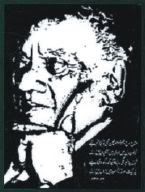
 The Mard-e-Momin as a form of national identity is overrated. So is the concept of the collective morality and the religious honor that gets everyone keyed up, ready to take up arms against an aggressor. The biggest aggressor, after all, remains poverty, bread within. Real tyranny is that which the state practices against its own citizenry, mostly by ignoring them.
Enough with the heroic machismo, I say. It hasn’t bought Pakistan any bread or butter, although it has surely strung us into becoming a state famous world over for its radicalism.
Zard Patto Ka Bann Jo Mera Dess Hai. Faiz Ahmed Faiz (1911-1984) brews in his poetry a gentle reminder of a wilting nation, he calls each of the forgotten, by their own name: the weary armed mother who can’t calm her crying child at night, the postmen, the clerk, the railway driver and the factory worker. These form the majority of our nation – they also form a group that we don’t like to talk about. Our ‘national poet’ Allama Mohammad Iqbal for instance has no mention of these no-name people. Neither does he mention shame, which is what a realistic self-introspection deserves. How can we talk of a national poetry without the people who form its working class?
Nisar teri gallion mey aye Watan, Key koi na saar utha key chaley. Faiz has asked for a soul check, a delving into what brings real honor to the country: protection of the rights of its citizens, a level playing field and recourse to justice. As a member of the International Labor Organization he was astute about the rights of the blue collar workers. His concept of patriotism wasn’t a jingoistic one. Evident in his piece mourning the death of the founding father Mohammad Ali Jinnah, he said: “Short-sighted fanaticism and heartless greed are preparing to plunge both the dominions into another suicidal devil-dance and the voice of the common man is getting feebler through exhaustion.”
Faiz’s nationalism focused more on the cultural aspects of what it was to be Pakistani, the art, the music, the folk tradition. In his compartmentalized life, between his work as a writer and his jail sentences, he was also the head of the Ministry of Culture in Islamabad where he established the Lok Virsa museum, chronicling the unique regional art embedded in our nationalism.
Umeed-e-Seher ki baat sunoo. Far from being a pessimist, he believed in the message of hope. Listen, he said to the dawn of the new morn.
What is missing today, especially among our youth is a concept to anchor them in. A cultural identity of what it is to be a Pakistani. Childishly we believe that fighting the other fulfills our need to congregate around a cause. Pakistan is in the search of Bulleh Shah, the Khudi of Iqbal, the voice of Reshma, the Horse and Cattle show, the Polo matches, the fashion shows, the billboards and the TV Serials, no matter how variant the spectrum, each contributant to the creativity form a mosaic of multiculturalism forms a piece of the modern Pakistan we have today. Anyone with a green passport can claim it as their own.
In the same eulogy Faiz adds that Pakistanis should, “complete the task that the Quaid-i-Azam began, the task of building a free, progressive and secure Pakistan, to restore our people the dignity and happiness for which the Quaid-i-Azam strove, to equip them with all the virtues that the nobility of freedom demands and to rid them of fear, suffering and want that have dogged their lives through the ages.”
The Pakistani cultural identity is infused with religious sentiment. It is important to divorce those two concepts because we have not one but many religious avenues which describe what it is to be a Pakistani, and these avenues cannot be excluded, because Pakistan was not created out of an exclusionary identity. Pakistan was formed for a minority community, through a democratic and constitutional process; it must therefore amongst all its principles uphold the protection of the underdog as its highest moral principle.
Tum yey Kehtey ho vo Jang ho bhi chuki, Jiss mey rakha nahi hey kissi ney kadaam. Vehemently anti-war, Faiz cautioned against those wars that were fought on the behalf of an unseen force, and lost at the cost of many lives and much blood. His focus instead was on educating the youth. As principal of a local school, he introduced at first education for women, brought enrollment to an all time high and instituted excellence at this school. His versatility as a nation builder was evident in the devotion with which he completed each assigned task, no matter what the field.
Bahar Aaee. Above all else, Faiz brought alive that Pakistan which bloomed endlessly, even after loss.




Watan Aziz on Faiz’s poetry before he launches an angry attack on it:
“I will admit I do not know his poetry.
Because I do not need to know his poetry.”
What amazing intellectual (and probably moral) dishonestly.
Disbelieving!
Confounding!
Astonishing!
Are we fools?
Which koolaid drink should we order?
Jarringly!
Incredulously!
Haughtily!
Groggily!
Flabbergasting!
Eye-popping!
Pretendingly!
Oleaginously obfuscating!
Mockingly!
For a list of better descriptors of his dhakosla, read full list in comments here: http://pakistaniat.com/2010/11/10/pakistan-taxes-2
An otherwise interesting piece wasted because of two needless sentences on Iqbal. If you really wanted to make that point then you should have expanded that and included comparisons of both works. Simply throwing a shurli for effect actually had the opposite effect.
This sophmoric idea that one of them has to be ‘bigger’ only if the other is somehow ‘lesser’ is not useful and only then attracts other useless comments like the ones from Watan Aziz etc. that go into mean-spirited attacks and distract from your purpose.
If a real comparison of the entire works of the two is done one finds that BOTH were writing about who they considered the ‘oppressed’ of their times. The Muslims in India at Iqbal’s time WERE the oppressed, at least in his view, so his core message was very similar to Faiz’s. Giving voice as well as hope to those who did not have it then. Their idiom is different because their times are also different. Iqbal writes in a Colonial period and his tone and tenor is civilizational (not to be confused by religious – something that the extreme right as well as the extreme left routinely does). Faiz is writing in the post-colonial and socialist tone and therefore his idiom is more socioeconomic. But the substance of both is about justice for the groups they consider oppressed.
Talking about this is 2010 we have no idea how Iqbal would evaluate Faiz’s work and impact. But we know exactly how Faiz would evaluate Iqbal. Faiz was in awe of Iqbal and would probably be writing now to tell you how you miss the point of Iqbal :-)
All that said, I am glad for the post because it made me think of all of the above and it is a more useful think to do than to talk about wikileaks!
Iqbal said,
jis khait say dehqaan ko mayassir nahin rozi
us khait ke har khosha-e-gundum ko jala do
the author is ignorant and used the secular mantra to get this shoddy piece published
Faiz, the poet of the “gitter-mitter”; even they do not name their sons, Faiz.
And he was a failure.
A failed coup.
A failed socialist.
A failed puppet of the failed Union of the Soviet Socialist Republics.
When he was not writing poetry, he was peddling scholarships for universities in the Soviet Union. The grateful Russians gave him the Lenin Peace Prize.
I will admit I do not know his poetry.
Because I do not need to know his poetry.
There is nothing he has contributed to my thinking because I do not think without hope. And I do not need to know about our people through him. All I have to do is to walk amongst them, breath amongst them, sleep amongst them and eat amongst them.
Faiz is the opiate of the “gitter-mitter”. They feel good and get a high and feel they have done something for the poor by doing “wawa” for the failed poet. As if they have any original thought for their struggle. If the socialists slogan was that the religion is the opium of the masses, Faiz was the pipe to the “gitter-mitter”; he kept them “content” by letting them sleep better with a thought that they have actually done something for the poor by attending his recitations! Alas, the next morning, the “gitter-mitter” went back to their routines of more theft, more loot, more hogging of the resources for the 3 cities of Pakistan.
I know ATP has high regards for him. On days, you can upto three thumbnail pictures of him on the sidebar. I cringe. And for a minute, I too got myself entrapped in the “hum dekay gay”. But thankfully, I snapped out of it. That poem is a failure. It is not a solution. It is an insult to life and liberty and free thinking of a person. That poem presents a solution beyond the capacity of man. A failure of man. A failed idea of a failed poet.
That said, I will honor him for speaking up for the Bengali brothers and sisters. I will honor him for for not bowing to tyranny.
But I am not sure if that was a matter of positioning or real convictions. There is nothing he has produced that gives me a sense that he spoke up for peoples in Parague. There is no representation that he denounced for the atrocities in Poland. I do not know if he jumped for joy or ran out in the streets denouncing when his Soviet paymasters invaded Afghanistan. Questions need to be answered about his Soviet involvement and his support for them. Was his love for the workers and the poor real or was it a charade? I say, if you find nothing against his Soviet paymasters when he (they) thought they were ascending, then it was a charade.
There is a revisionism going on as far as Faiz is concerned.
Yes, perhaps he deserves a space and a place. But it must be earned. And it cannot happen by put downs and labes of “manufactured”!
I for one, reject Faiz, whose reach is but the “gitter-mitter”. He offers nothing but despondency, hopelessness and no solution to the problems.
The “gitter-mitter” can have their opiate!
Unfortunately a basic mistake has been made by the author while talking about both Faiz and Iqbal.
Iqbal could not talk about the middle man (although I agree that he does to an extent, as some others have commented) since he had Muslims of India and the world to talk about.
Faiz, on the other hand, had the chance to talk about the middle man since Faiz is a post-partition poet and a class of poor, everyday, Pakistanis was taking shape during his times.
Poor comparison!
Just my 2 cents!