Adil Najam

I happen to be in Pakistan on this December 25 and have spent the last many days and specially today devouring the great out-pouring of ‘Jinnah-spection‘ that is on display all over the country, on television, in the press. As a Jinnah fan myself and having devoted so many posts on ATP on exactly the same question, part of me is delighted by the intensity and level of the discourse. More so, because I sense this is not just khanna purri, it is in fact real introspection. However, what struck me is that nearly the entire discussion is about figuring out the “real vision” of the Quaid-i-Azam, Mr. M.A. Jinnah. That after so many years we are still searching for that “vision’ is a statement not about Mr. Jinnah, but about our own national confusion.
Part of me feels that it is time that we acknowledge and confront our own national confusions without using (and misusing) Mr. Jinnah for our ideological skirmishes. Let the man be please. He did what he needed to do. And a did a remarkable job of it. What we did beyond that, was our doing and only we need to accept responsibility for it. Honor him for what he achieved, but please lets spare him the dissection; specially since the purpose seems to have little to do with understanding the essence of his achievements and much more with scoring points about what we are inclined to believe already and anyhow.
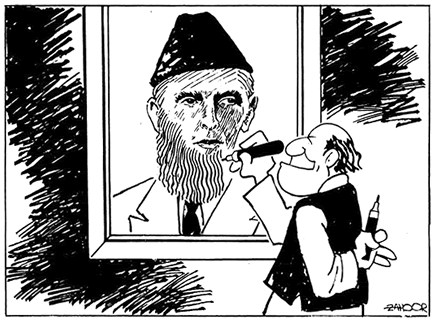
I should confess that this thought has been haunting me some weeks now, ever since I joined Dr. Akbar Ahmed at a recent panel at Harvard University marking Mr. Jinnah’s anniversary. Akbar Sahib is one of our leading authorities on the subject (including his movie and books on Mr. Jinnah) and in our conversation with the audience after his lecture the question of the “real Mr. Jinnah” came up again and again. As he pointed out, this question is not about Mr. Jinnah at all. It is about us ourselves. On this 25th of December as we celebrate Mr. Jinnah, it is time to recognize this fact. Let us please honor Mr. Jinnah for what he was, and not torture his memories with that which we ourselves have failed to become.
His achievements were a great blessing for all of us, but our failures are all our own. Let us accept that. To do so will itself be a first step in truly honoring him.




Nice Post
it is immaterial that what kind of Pakistan jinnah wanted, it is us the people of pakistan who decide that how to run Pakistan .. Pakistan can’t be run on the basis of what junnah wished, the essence of democracy is that WE decide on our OWN that how to run it
BTW, lets not laud Jinnah too much…. Don’t forget that by becoming the GG and using the reserve powers of the
Govt. of India Act 1935 to dismiss provincial governments he didn’t like, he is the real institutor of autocratic rule in Pakistan.
With all due respect, there are several people on this board who would do well to read some real history about Pakistan and toss Akbar S. Ahmad where he belongs–I’ll let you decide where that is.
Jinnah never wanted a ‘Pakistan,’ which was Chaudhury Rehmat Ali’s pipedream–and in any case explicitly EXCLUDED Bengal. Read the wikipedia entry (http://en.wikipedia.org/wiki/Chaudhry_Rehmat_Ali) on Rehmat Ali and you will see that maybe he was an opium addict after all once you see the maps.
Jinnah accepted the Cabinet Mission Plan as it gave him everything he actually wanted: maximum Muslim autonomy. The actual “moth eaten and mutilated” Pakistan he got was an abortion of a country from birth. Jinnah actually asked for the undivided Punjabs and Bengal; and it was pointed out to him that if the Indian Empire could be partitioned, what was Bengal and Punjab?
I suggest Jalal and Alavi as ‘antidotes’ to the BS we are taught about Pakistan.
The real culprit in this Islamization mess was Liaquat, with his Objectives Resolution crap which enshrined Islam and Sharia in the Pakistani body politic. If you want to read a real analysis of Islam and Pakistan (in the early years) I suggest Cantwell Smith’s chapter on Pakistan in his “Islam in Modern History” for an excellent account of the early debates and the extreme tensions between those who actually created Pakistan and the effing mullahs who tried to take it over. Then I’d suggest a read of the Munir Commission report, found on many Ahmadi websites.
The ONLY truly secular rulers Pakistan has had were Jinnah and then Iskandar Mirza, who actually openly espoused separation of religion and state, and then to a lesser extent Ayub Khan. The 1956 Constitution firmly enshrined the Islamic Republic nonsense, Ayub tried to delete “Islamic” but was too weak to hang a few mullahs; the way Gen. Azam Khan wanted to hang Maududi and Abdul Sattar Khan Niazi. The first amendment to the 1962 Constitution restores “Islamic” to the “Republic of Pakistan.”
Naan Haleem has replied well to S Bhatti’s not so intelligent comments.
The crises in Pakistan started with the toppling of the civilian government by Ayub Khan and have continued unabated ever since.Old politicians were put behind bars and new actors belonging to the all powerful land lords were brought in to to give muscles to Ayub’s regime. During 10 years of Ayub’s regime The Feudal lords consolidated their position and the Army consolidated its own. Now the result is there for everybody to see.M A Jinnah had nothing to do with this.