Today is a good day to talk about ‘Pakistaniat.’
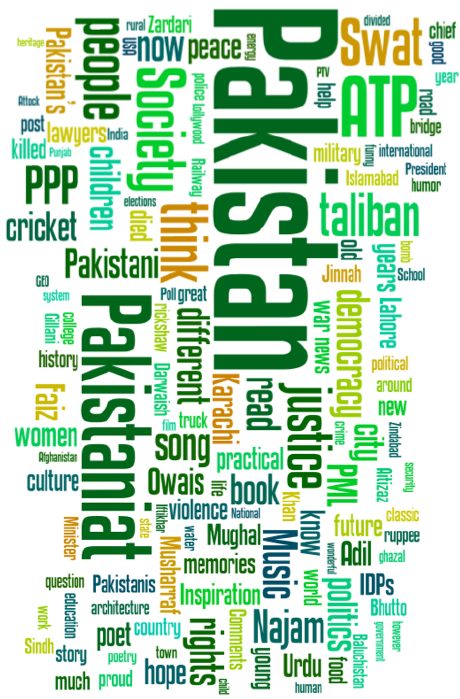
The name of this blog is ‘All Things Pakistan’ or ATP. But the title in the URL is ‘Pakistaniat’ which would loosely translate as ‘Pakistani-ness.’ The blog is named thus because it was borne out of a conversation with a friend on what makes a Pakistani a Pakistani. The purpose of this blog is to continue and broaden that conversation, to make it ongoing, and to involve more people in it.
Of course, there are many way to talk about Pakistaniat. In fact, that is all we do on ATP, all the time, and in all sorts of ways. One way to do so is through poetry. We thought maybe we should ask you to share with us a favorite verse, a sheyr, a nazm, a line from a song, anything that conveys some sense of something you would consider Pakistaniat… poetry that tugs at you on this Independence Day… the canvas is wide, choose whatever you may.
To set the ball rolling, let me offer some of my favorites.
Let me start with one of my favorite national song (see here for my all time favorite national song). It used to be played a lot around 1970 (I think the poet is Asad Muhammad Khan and was sung by Shahnaz Begum). I always thought that the essential idea behind it was quite unlike most national songs:
mauj baRhay kay aanDhi aa-aye, diya jala-aye rakhna hai
ghar ki khatir sau dukh jhailaiN, ghar tou aakir appna hai
On a more profound note, heere is a Dua (prayer) from Faiz. I absolutely love the line about “himmat-e-qufr millay, juraat-e-tehqeeq milay” (read the line before this one for context). Ameen.
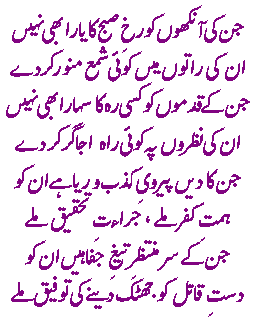
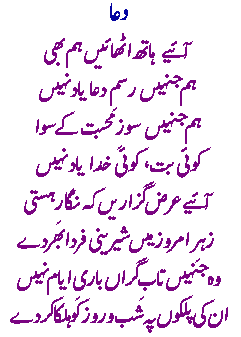
I found this English translation here but not sure by whom. My hunch is that it is not from Agha Shahid Ali (The Rebel’s Shilloute), but I may be wrong:
Come, let us join our hands in prayer.
We, who can not remember the exact ritual
We, who, except the passion and fire of Love,
do not recall any god, remember no idol.Let us beseech, that may the Divine Sketcher
mix a sweet future in the present’s poison
For those who can’t bear the burden of time,
the rolling of days on their souls, may He lightenThose, whose eyes don’t have in their fate, the rosy cheek of dawn
may He set for them some flame alight.
For those, whose steps know no path
may He show their eyes some way in the night.May those whose faith is following falsehood and pomp
have the courage to deny, the boldness to discover.
May those whose heads wait for the oppressors sword
have the ability to push off the hand of the executioner.This secret of Love, which has put the soul on fire,
may we express it today and the burning be gone.
This word of Truth that pricks in the core of the heart,
may we say it today and the itching be gone.
I apologize for posting this yet again, but this seems to be an appropriate place to revisit my video rendition of Faiz’s hum daikhain gay. I have discussed this poem’s importance to ATP’s ethos here and the original and Maniza Naqvi’s translation are available here.
Click on the arrow at the center of the image below
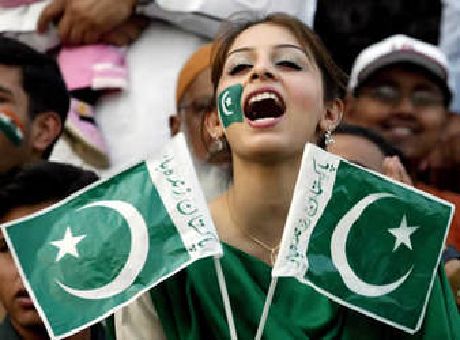
Main picture credit: Cricket spectator in Lahore (from Daily Times).




I was watching this long telethon type thing on PTV just now, and they were playing milli naghmay. One I had not heard and hence stood out, also because it was so profound. I think it’s by some famous poet, though I forget the name. And excuse me for any mistakes while quoting the verse:
Mauj barhay, aandhi aye
Yeh deep jalaye rakhna hai
Ghar ki khatir sau dukh jhailay
Ghar to akhir apna hai
Thanks for the thoughtful and touching posts related to independence day in the last few days. I think Pakistaniat is a wonderful term and its use should be actively encouraged and propagated. Pakistaniat is inclusive of all ethnicities and religions and this worldview is a step toward formulating a healthy Pakistani identity that is not exclusively based in religion but embraces the country’s diversity and celebrates its rich and multi-faceted culture.
Given the continuing march toward political instability in Pakistan playing out yet again the parody verse from the 80’s remains sadly pertinent.
Na tera Pakistan hai na mera Pakistan hai
Yeh uska Pakistan hai jo sadr-e-Pakistan hai
As for inspiring poetry and verses I have many favorites, some of which have already been mentioned. In particular I am always delighted when the nation pays homage to Mehdi Hasan; one of the finest singers produced by the sub-continent in the 20th century.
On this occassion though I would like to mention Iqbal’s ennobling verses that used to be sung in the morning by every municipal school going child in Pakistan (the english medium elites have always been exempt from doing what the commoners are required to do). Whenever I read or hear this “dua” I am always deeply touched by its humanism and transported back to a couple of times when I watched schoolchildren singing this on TV in their sincere, lilting voices. I particularly remember a Mohammad Nisar Hussain-directed PTV long play in which actor Abid played an old school teacher in which this dua was part of the background in the entire play.
Lab Pe Aati Hai Dua Banke Tamanna Meri
Zindagi Shamma Ki Surat Ho KhudaYa Meri
Ho Mere Dum Se Yun Hi Mere Watan Ki Zeenat
Jis Tarah Phool Se Hoti Hai Chaman Ki Zeenat
Zindagi Ho Meri Parwaane Ki Surat Ya Rab
Ilm Ki Shamma Se Ho Mujhko Mohabbat Ya Rab
Ho Mera Kaam Gharibon Ki Himaayat Karna
Dard Mandon Se Zaeefon Se Mohabbat Karna
Mere Allaah Buraayee Se Bachchana Mujhko
Nek Jo Raah Ho Uss Raah Pe Chalaana Mujhko
In the simplest possible way, Iqbal has communicated to children the basics of an ethical life; avoidance of iniquity in one’s personal life and active concern for the weaker members of society like the poor and the elderly.
To Pakistanis of all castes, creeds and ethnicities; Yom-e-Azadi Mubarak and to Indian readers of this blog Happy Independence Day.
I think being reflective on this day is a good idea. But the picture that Adil has chosen for up top also suggests that we are still confident and enthusiastic about Pakistan. That is also part of Pakistaniat too.
My first reaction is to say, ‘well we are not the only ones who have problems.. others have problems even bigger.. ‘ But the problem is that this argument is normally made by those who want to ignore our problems because others have them too. I do not want to ignore problems (thats why I like ATP). I want to look for solutions but I also want to look beyond problem to things that are good.
I was just scrolling down this blog for things that made me feel good about Pakistan and Pakistaniat. Lahore, because Lahore Lahore aye. Madam Noor Jahan. Faiz poetry. Nusrat Fateh Ali Qawalli. Our cricket team (even though they lost). Beautifully painted rickshaws. Inspector Jamshed. Things that have not been mentioned here before. PIDC paan in Karachi. Noori songs. PTV long drams from old days. So many things…
The most obvious poem that comes to mind on this day is, again, a poem by Faiz, titled, Subh-e-Azadi (Dawn of Freedom). But I would like to share with you folks another poem of Faiz, not quoted as often. It’s a bit pessimistic but relevant. (I wish I could write it in Urdu script)
Jab dukh ki nadya main hum nay
Jeevan ki naao daali thee
Tha kitna kas bal baaNhoN maiN
Lahoo maiN kitni laali thee
Yoon lagta tha do haath lagay
Aur naao pooram paar lagi
Aisa na hooa, har dharay main
Kuch an-dekhi majhdaarain theen
Kuch maanjhi thay anjaan bohut
Kuch be-parkhi patwaaraiN theeN
Ab jo bhi chaaho chaan karo
Aur jitnay chaaho dosh dharo
Nadya tau wohi hai, naao wohi
Ab tum hi kaho kiya karna hai
Ab kaisay paar utarna hai
A rough translation would be:
When we set our boat in these troubled waters
We were so confident, full of enthusiasm
We had youth, muscles, determination
A few strokes of the oars, we thought
Would take us to the other side of the river
But this did not happen !
For in every current
There were invisible undercurrents
The oarsmen were not skilled
Nor the sails straight
Whatever you say now, whomever you blame
The boat is where it was, and so is the river
Tell us now, what shall we do
Where do we go!
Actually we have forgotton to use the term ‘Pakistaniat’.Atleast I have never seen anyone using it on TV or print media.Its time we should.
As for all the ills ailing our country,I blame foriegn powers for making a mess of it so that we quit our efforts in uniting the ummah.
Remember Bhutto’s efforts in hosting the Islamic Summit in Feb 1974,the only occasion where all the Islamic heads of State joined together on a single platform and the unanimous resolution was to unite the Ummah into one powerful force.Pakistan was to lead the Ummah but what happened next is history.
You all know what happened to Bhutto.So that says it all about the ills ailing our nation.The foriegn powers are playing a role big time in divining the nation and making it weaker and weaker.