Adil Najam
Also see updated discussion and debate here and here. Hasba Bill discussion here.
Although it still needs to be approved by the Senate to become law, the passage of the Protection of Women Rights Bill by the National Assembly in Pakistan is a surprise and a milestone; even if it is one that leaves everyone concerned less than fully happy.
According to Dawn (16 November, 2006):
The bill… envisages a major relief by transferring the offence of zina-bil-jabr, or rape, from the 1979 Offence of Zina (Enforcement of Hudood) Ordinance to the Pakistan Penal Code (PPC) to spare a woman an automatic prosecution on the basis of assumed confession if she is unable to prove her charge of rape against a man by producing four witnesses of the crime. Rape will be punishable with 10 to 25 years of imprisonment but with death or life imprisonment if committed by two or more persons together, while adultery under the Hudood ordinance is punishable with stoning to death.
To check abuse of this ordinance and the Offence of Qazf (Enforcement of Hadd) Ordinance often aimed at settling vendettas and deny women basic human rights and fundamental freedoms, the new bill amends the Criminal Procedure Code to provide that only a sessions court may take cognizance of such a case after receiving a complaint. The offence has been made bailable so the accused do not languish in jails during trial. Police will have no authority to arrest any one in such cases without a sessions court’s directive, which can be issued only to compel attendance in court or in the event of a conviction.The new amendment moved on Wednesday by the law and justice minister provided for an imprisonment of up to five years and a fine of Rs. 10,000 for the offence of fornication, or consensual sex of the unmarried. But in what an opposition source called a ‘firewall’ built around it, the amendment provides for a similar punishment for an accuser failing to prove the charge and bars converting zina and rape cases under other laws into fornication complaints at any stage.
The provision about fornication, which the amendment originally described as ‘lewdness’, was one of the three recommendations made for inclusion in the bill in an agreement that PML president Chaudhry Shujaat Hussain and Punjab Chief Minister Chaudhry Pervez Elahi reached with the committee of ulema in September. The two other recommendations of that agreement not incorporated in the bill had called for making an offence of rape liable to hadd if it met the required criterion of evidence and that the Quran and Sunnah “shall have effect notwithstanding anything contained in any other law ” in interpreting and applying the Zina Ordinance.

Issues of womens’ rights has been a fiery ones and this bill has been mired in controversy from the beginning.
It is clear that the major proponents of change in laws believe that too many political compromises have been made by the government. According to a story in the Daily Times (16 November, 2006):
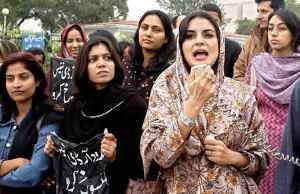
Hundreds of women rights activists on Wednesday held a demonstration outside Parliament House, denouncing the government’s “slack approach” on the Women’s Protection Bill (WPB) and demanding a total repeal of the Hudood Ordinance. The protestors demanded the government grant recommendations of the National Commission on the Status of Women and they rejected the amendments to the original bill, which they claimed were introduced at the behest of mullahs.
They claimed that the government had succumbed to the pressure of mullahs by accepting their amendments, which would knock the bottom out of the bill and make it meaningless. They held placards and shouted slogans, calling for the elimination of the Hudood Ordinance and condemning mullahs for “treading on human rights in the name of religion”. They said that the amended WPB would bring no relief to women and that the “mullah-recommended amendments” would make the situation from bad to worse.
They warned the government against “playing politics in the name of women”, who, they said, were already vulnerable to social injustice and domestic violence. Kashmala Tariq, a member of the National Assembly, also joined the protest and criticised the role of the NA Select Committee for amending the bill. She said the mullahs wanted to blackmail the government by an “abortive attempt” to play on the issue of the WPB.
At the same time, its opponents believe that the bill is a “shameful act.” However, the MMA leadership which had threatened to resign en masse if the bill were passed, has not yet done so. According to The News (16 November, 2006):
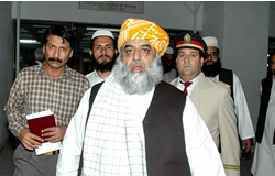
“We will not take any decision in haste to quit the national and provincial assemblies,” opposition leader in the National Assembly and MMA Secretary-General, Maulana Fazlur Rehman told newsmen at the Parliament House after staging a walkout from the House. “We will not tolerate any law against the injunctions of the Holy Qur’aan and Sunnah,” he said, adding that the MMA might give a call for a countrywide movement against the passage of the bill.
Meanwhile, in a rather bizarre display of theatrics, Chaudhry Shujaat – the leader of the ruling PML(Q) – has said that if the bill turns out to be contrary to Islamic teachings he would resign. The MMA views this as a sign of confusion within government ranks. According to a different story in Dawn (16 November, 2006):
President of Pakistan Muslim League (PML) Chaudhry Shujaat Hussain created a stir in the National Assembly on Wednesday by handing his resignation to Speaker But the Speaker returned the resignation to the PML chief before the house passed the Protection of Women (Criminal Laws Amendment) Bill, promising to consider it later… “I have been assured that there is nothing against the Quran and Sunnah in the bill,” the PML president said. But he said he would relinquish his lower house seat “if it comes out after its passage” that the bill was contrary to the Quran and Sunnah.
It is quite clear, however, that Gen. Pervez Musharraf views this bill as a major achievement and something that he wants to be remembered by. He appeared on national television soon after the passage of the bill. Indeed, as this account from Dawn (16 November, 2006) points out, he was a principal reason why this was passed in the current shape:
The government rushed a signal women’s rights bill through the National Assembly on Wednesday amid a boycott by religious parties and some drama after the draft survived a prolonged controversy and an apparent last-minute intrigue. Slogan-chanting members of the Muttahida Majlis-Amal (MMA) walked out of the house in protest before the vote on the Protection of Women (Criminal Laws Amendment) Rights Bill, which they said was contrary to Islamic injunctions about punishments for zina (adultery and rape). But, they appeared wavering in carrying out an earlier threat to resign from parliament.
The People’s Party Parliamentarians (PPP), the main opposition party, gave a rare support to the ruling coalition in passing the bill, which seeks to protect women from the widely complained misuse of the controversial Hudood ordinances about zina (adultery and rape) and qazf (false accusation of zina) enforced in 1979 by the then-military ruler General Mohammad Ziaul Haq. Members of the Pakistan Muslim League-N, a PPP ally in the Alliance for the Restoration of Democracy, spoke with the MMA against the bill but abstained from the walkout as well as the voice vote, which had no shouts of `no’ after the MMA stormed out unconvinced by a low-key government-sponsored amendment to the draft that was approved by a special house select committee in September but put off by a controversy over whether it conformed to the Quran and Sunnah.
Government spokesmen had earlier said the bill, taken up on Wednesday about two months after it was put on ice because of the controversy, would be passed by Friday. But the ruling coalition, led by the Pakistan Muslim League (PML), decided to finish the job in one day after President Pervez Musharraf apparently gave a pep talk to Prime Minister Shaukat Aziz and other party leaders at a dinner meeting on Tuesday night.
In what looked another attempt to ditch the bill, opposition leader and MMA secretary-general Maulana Fazlur Rehman called for postponing the vote after his denunciation of the bill as a `shameful’ attempt to alter the teachings of the Quran and Sunnah and to turn “Pakistan into a free sex zone” failed to cut any ice with the ruling coalition and met with strong rebuttals from Parliamentary Affairs Minister Sher Afgan Khan Niazi, Law and Justice Minister Mohammad Wasi Zafar and PPP’s Sherry Rahman.
Indeed, as the above account suggests, how the bill was passed and who supported it is as big a story as the bill itself. Gen. Musharraf even went as far as thanking the PPP – the major opposition group – for supporting in the government on this bill. A separate News Analysis by Zaffar Abbas in Dawn (16 November, 2006) suggests that this may even spell a new re-alignment in Pakistan’s national politics.
The new and amended version of the Women’s Protection Bill passed on Wednesday may not be a major landmark in the campaign against the country’s anti-women laws, particularly some of the controversial Hudood ordinances… [However,] the passage of the women’s rights bill has opened up new avenues for possible readjustments amongst the political groupings, and may pave the way for redrawing of the political battle-lines in the run up to the 2007 general elections. So, if efforts were already being made for some kind of realignment on the basis of political beliefs, if not ideology, the bill may provide the right excuse to give them a decisive push. In some ways, the passage of this bill could be a watershed in the country’s political history, and most parties in parliament seem to be well aware of it.
…Since President Pervez Musharraf wanted the bill to be passed without further amendments, the PML and its allies didn’t have much of a choice but to support the move. Still the Muslim League president, Chaudhry Shujaat Hussain, indirectly expressed his displeasure by offering to resign if, in his words, anything in the bill was found to be against the teachings of Islam. The Muttahida Majlis-i-Amal had earlier threatened to go for extreme action, indicating that its members might resign from parliament if, in the words of Maulana Fazlur Rahman, “such an un-Islamic piece of legislation is passed”. But his speech that marked the opening of the debate, though full of rhetoric about the bill being an attempt to create a free-sex society, was far from threatening. Qazi Hussain, who is believed to be a more radical hardliner among the Islamic alliance leaders, was conspicuous by his absence. And instead of resigning from the assembly, the MMA confined its protest to a token boycott. The PML (N) of former prime minister Nawaz Sharif was faced with a tough choice. When the bill was originally tabled some time back, one of the party leaders, Chaudhry Nisar Ali Khan, had hinted that their party might side with the MMA. However, at the time of voting, the PML-N decided to abstain. It was a clear move to express its annoyance over the PPP’s decision to support a government-sponsored bill but without threatening the break-up of the main opposition alliance, ARD.
Perhaps the boldest, and in some ways also the most controversial, move was that of Benazir Bhutto’s Pakistan People’s Party. It was not an easy decision for the party, which for the last many years had been campaigning for Gen Musharraf to step down… But many analysts say by taking such a crucial step Ms Bhutto has also sent an indirect message to Gen Musharraf and his backers about her renewed willingness to explore the possibility of a realignment on the basis of liberals and moderates taking on the Islamists in the next elections.
…the passage of the women’s rights bill by the National Assembly may have unfolded a new and perhaps a more treacherous round of politics in the coming weeks and months. How politics in the run up to the election shapes up could be anybody’s guess, but as things stand today, General Musharraf doesn’t look like a loser.
The debate on the substance as well as on the politics of this bill remains in flux, remains incomplete and will no doubt continue. It is a debate worth keeping an eye on. Certainly to see if it does actually impact Pakistan politics as some are suggesting; but much more to ensure that it does in fact, improve the state of womens’ rights in Pakistan and does not end up as mere political lip-service.
Also see updated discussion and debate here and here.




It was a pleasure reading this.