 Adil Najam
Yet another stalwart of Urdu literature is no more. Munir Niazi passed away at the age of 78.
As regular readers of this blog know, Munir Niazi is a particular favorite of mine. We have written about him and his poetry earlier (wondering whether it was him in the wonderful re-making of Mehdi Hasan’s ‘yeh watan tumhara hai‘; in thinking about song and poetry; and in terms of his literary rivalry with Ahmad Nadeem Qasmi, who died just a few months before him). We will, no doubt, write about it again later.
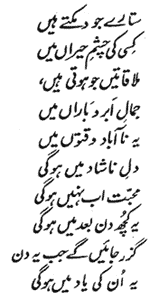 His ‘mohabbat abb nahiN ho gi, yeh kuch din baad meiN ho gi’ and ‘humaisha dair kar daita houN meiN’ are especially poignant and I find his following Punjabi qata so often relevant to my own travails:
kujh unj we raawaN aukhiaN sann
kujh gall icch gham da tauq ve see
kujh shehr dey louk ve zalim sann
kujh sanouN marran da souq ve see
Yes, the path I chose was hard
Yes, there was the noose of grief around my neck
Yes, the citizenry was also so cruel
But, ultimately, we too wanted to get killed
(coloquial for the last line: ‘we were suckers for punishment’; this is NOT a translation, just conveying the essential meaning)
Another favorite of mine is the following:
Kisee ko apnay amal ka jawab kiya daytay,
Swal saray ghalat thay jawab kiya daytay
Here are the details of his passing from The News (27 December, 2006; excerpts):
Renowned Urdu and Punjabi poet Munir Niazi died of cardiac arrest at Jinnah Hospital on Tuesday. He was 78. Family sources said Munir complained of some breathing problem on Tuesday noon and was taken to Jinnah Hospital where his condition deteriorated rapidly and he died during treatment. His Namaz-e-Janaza will be held at Alquds Mosque, Sector A1, Township Lahore at 2.00 pm on Wednesday (today).
The only child of his parents, Niazi was born in Khanpur (Hoshiyarpur, Indian Punjab) on April 9, 1927. After the creation of Pakistan, the family migrated to Sahiwal and settled there. While living in India, Munir also served in the Royal Indian Navy for some time. Twice married, Niazi was issueless. He started as an editor of a newspaper “Saat rang” (seven colours). Niazi has to his credit 14 collections of poetry both in Urdu and Punjabi. Shy, soft-spoken and a person of few words and great self-belief, he was a poet of distinction.
Munir Niazi had a vision of hope and love for his country and its people. Love, he said, is the most enduring quality and poetry reflects the most sublime side of life. His poetry influenced an entire generation of young writers and poets and they should be grateful to him for having set such an exceptional and powerful style in poetry. His works include “Dushmanoon Key Darmiyan”, “Mah-e-Munir”, “Aghaz-e-Zamastan Main Dobara” and “Aik Musalsal.”
Equally proficient in Urdu and Punjabi, Munir Niazi’s poetry had great depth and he advanced the tradition of realism with great sensibility and force of imagination. Words were always slaves to his vision, creation and criticism. In the sixties he also contributed songs to Pakistani films. “Us baiwafa ka shehr hay” sung by the late Nasim Begum for the film “Shaheed” still stirs up memories of a period gone by…. The film industry had its own culture and cruelties. Munir once narrated that for his famous song “Us bewafa ka shahr hai aur ham hain dosto”, he was promised Rs 2,000 but received only Rs 200.
He is acclaimed as a trendsetter with his unique diction, style and thought-content and made an enduring contribution to literature of the post-Independence period. Munir deeply influenced his contemporaries and later generations of poets and is respected by the reading public. His works have been translated into many other languages. For his literary achievements Munir Niazi was awarded ‘Kamal-e-Funn Award for the year 2002 by Pakistan Academy of Letters and the ‘President’s Award for Pride of Performance” in 1992 and ‘Sitara-i-Imtiaz’ in 1998.
Munir Niazi’s poetry will, no doubt, live on.




Inna lillahe wa inna alyhe rajeyoon
A tragic loss indeed … he served his age very well … I simply adored his poetry … and these lines from his Punjabi poetry are my all-time favs too …
Salamalikum,
Ø¥Ù
Munir Niazi was one of the sun between many stars.No doubt urdu has proud on him,Munir used simple words to say many things selection of simple and meaningful words was his speciality first nizm of munir I read when i was young and still i remeber all words
beilieve me,I read this poem when i was 18 this is the beauty of the poem and the words selected by munir that i still remember most of lines i am sure that all writen above are correct but it might be possible that i changed some thing if its true forgive me for my weak memory,
we have lost a great man who was not only the poet but a kind,sincer and a sensitive person who feel problems of common man in his own words.
[quote comment=”20639″]A tragic loss. This has not been a good year for Pakistan’s literary giants.[/quote]
The Clock stops!!!
“Zinda Rahain to Kiya He Maar Jaaein Hum To Kia”
Life of a mystic comes to an end.His works remain…
A tragic loss. This has not been a good year for Pakistan’s literary giants.