 Owais Mughal
I grew up playing tape ball cricket on Karachi streets. Every evening, I was usually the first one to put a broken chair as wickets in the center of the street, put tape on the balls, mark creases with a chalk, and put a stone as the bowling mark.
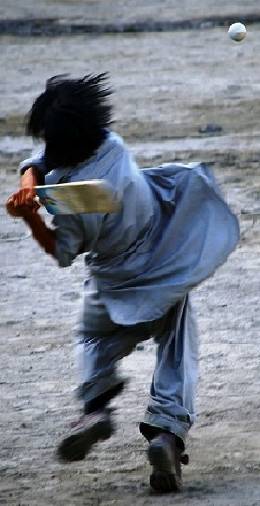
(Photo to the right is of a street cricket player from Chitral, Pakistan.)
Slowly other boys from the neighbor hood would come out and the game would start. In those early minutes of set up, a boy from the neighborhood helped me a lot. He was a domestic helper in one of the homes and used to get a permanently bald cut from the local barber. So people started calling him ‘ganjay’. And some with lesser formal education started calling him ‘takloo.’
After a Hajj season our cricket team suddenly got some more bald players who had recently became one after performing the holy ritual.
This caused a big confusion in our local team on how to distinguish between so many bald players.
After serious deliberation in a local ‘shoora’ (cabinet) meeting of neighborhood boys it was unanimously decided to name our original ganja guy as ‘Tikanjoo’.
The logic behind this nomenclature was:
Ganja + Takloo = Tikanjoo
Other guys also got some creative names like Ganja II, Kojak, Bald Eagle etc.
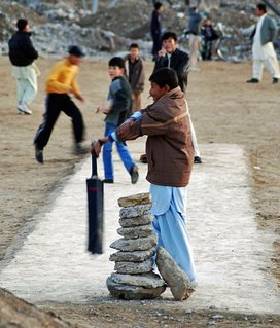
(Photo to the left is from Quetta, Pakistan and it shows ingenuity of players who have built the cricket wicket by stacking up stones.)
Now Tikanjoo had great passion for cricket. Sometimes I used to see him waiting for me to put wickets on the street so that he can get a break from his employers and come out to play. I would then send him to other houses in neighborhood to ring call bells and ask the ‘V.I.P cricketers’ who needed a daily invitation to play cricket to come out.
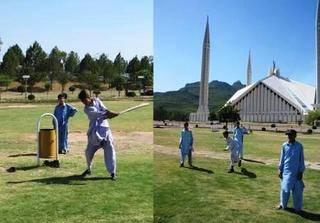
Tikanjoo bowled really fast jerk balls. He had a perfectly smooth run up of a fast bowler. He would run his 32 steps, jump in his stride but then throw tape ball like a stone released from a catapult with out circling his arm over. To get a better picture, imagine Shoaib Akhter bowling in a fluttering ‘shalwar qameez’ and wearing Bata’s ‘hawai chappal’ (flat open slip-ons.) But man o man, Tikanjoo was fast!
(I took this photograph in June 2005. Temperature at that time was 45 degree centigrade in Islamabad. It shows the passion of cricket. These players are using a trash can as the wicket.)
Poet Zameer Jaffri once said a ‘sher’ (couplet) about the West Indian fast bowler Wes Hall which perfectly fits the way Tikanjoo used to bowl in our steet. It goes like this:
shor utha ke Hall aata hai, khel ka intaqaal aata hai
Hall se pehle ball aati hai, ball se pehle Hall aata hai
If any batsman didn’t get out with technically correct bowling then we used to bring out our secret weapon. the Tikanjoo. Due to incorrect bowling action of Tikanjoo, batsmen would complain but in street cricket it was to no avail. After ‘Tikanjoo’ was unleashed then more often than not, he would get the wicket of the well set batsman.
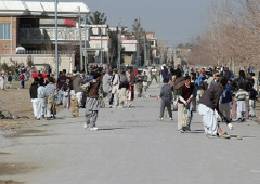 As a rule of street cricket, a direct hit in neighbourhood homes is considered out.
(Photo to the right is from Quetta, Pakistan. It shows multiple cricket games going on at the same street.)
If someone got out in such manner, we used to request Tikanjoo to be a useful member of the team and prove his loyalty by bringing back the ball. He would then climb walls, pipes, windows, anything and reach roofs in no time and retrieve the ball for us.
Then one day Tikanjoo found work in another neighborhood and left our locality. He was talked about for few days and then everyone forgot about him. We grew up into our current roles of life. Nobody knows what happened to Tikanjoo after few months.
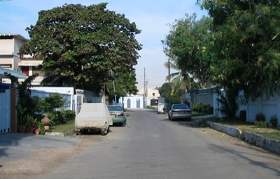 I hope wherever Tikanjoo is, he is fine and enjoying the cricket as much as he did in our childhood. He must be close to 50 years of age in 2018. At this moment I don’t even recall his real name but I just thought about him and it brought a smile to me and thus I wanted to share above lines with you.
(Photo to the above left is our street in Federal-B-Area, Karachi — where Tikanjoo used to bowl his super fast throws. The street looks deserted without a cricket wicket in the center and all the care free boys of yesteryears having grown up into men with responsibilities.)
Before ending this post, I also want to share a ‘sher’ which my friend Amjad Hussain first shared with me:
jab cricket khela karte the,
osay wicket banaya karte the
hum jis se pani peete the,
woh matka aakhir toot gaya




Another rule which I remember now was a single side run which was common in numbering format of cricket in which no batsman stands at non-striker end. You just have to run from striker to non-striker end and it’s considered a single run.
The toss system was also intresting. Instead of coins, we guys used to use pebbles.
Speaking of street cricket and not talking about knocking doors of people for asking balls. it used to be a wonderful experience,specially if your ball goes to a home where some hitler type aunty or uncle don’t get ready to return ball and you find no way other than cursing the person to mess with whole game :-)
Adnan,
Block 4 Nazimabad.
& you are right, maintaining scoring books was my first exposure of statistics (in its mildest form though).
The other very famous form of cricket in those days was double wicket tournaments, in which two allrounders in each side play against each other, they were given a fix number of overs to bat, every time a player was out a score of 2 or 4 runs was deducted from the score, the final score sometime could be negative as well!!
My favourite places to play in nazimabad were
annu bhai park (before MMA, MQM & shadi caterers occupied that very reasonable playing ground) & community centre in Nazimabad block 4.
I must say Owais, I am really loving this post & I do feel great contributing my commenst.
Oh yes another kind of street cricket, Curfew/strike cricket in 80s and mid 90s when deserted roads were the best place to play cricket for long hours in daytime.
Tamed: Where block of Nazimabad? I used to be in Nazimabad No.1 and there was a lane[I forgot it’s name] near Azeemi Dawakhana where there were arrangments for scoreboard and commentary. The style of scoring on notebooks was also a very intresting exercise.
Night cricket, street cricket
And Ramzan Cricket right after fajr namaz :-)
Adnan and Aqil Sajjad saheb. Good recall of street cricket rules. I enjoyed reading your messages. One-tip out rule was usually employed when playing in small places like inside the house or when batsmen were too good for the bowling side