Last week, I went to Washington, DC on personal business. I stayed at the Marriott Hotel, on Woodley Road, off Connecticut Avenue.
When I arrived at the hotel, and was taking out my luggage from the car, I could sense a commotion in the hotel — a kind of that you see at Penn Station in New York during the rush hours or, if you are not familiar with New York, at Islamabad Airport during the Hajj flights. People were milling around, dragging their luggage behind them, going up and down the escalators, and lounging around in the lobby of the hotel or wherever they could find a seat. They were mostly Pakistanis — men, some in their ethnic dresses; women in their usual colorful dresses; and a lot of children, from toddlers to teens. I soon found out why.
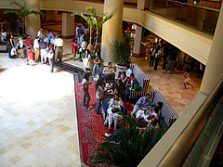
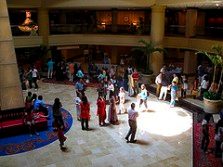
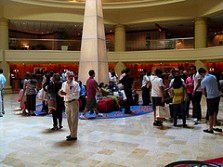
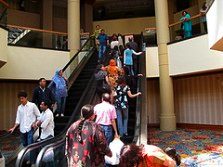
The Association of Pakistani-American doctors, APPNA, was holding its annual get-together at the hotel. Hundreds of doctors of Pakistani origin from all over the US, along with their families, had descended upon the hotel. They do this thing once every year in different cities.
Khalid Hasan, in one of his columns, describes APPNA gatherings as mela-i-mawaishiaan (cattle show). Even though the impact, initially, is a bit overwhelming, but I don’t quite agree with Khalid Hasan’s description. On the contrary, after the initial “shock and aweâ€, I started enjoying the energy and diversity of the scene.
Majority of the families who had converged at the hotel came from small-town-America where the total population of their respective towns, in some cases, did not exceed the number of people gathered at the conference. Therefore, the exuberance of the delegates and their families was understandable, even though it seemed to spill over at times.
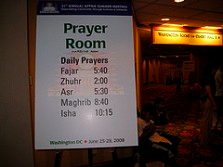
Among the many helpful signs installed in the lobby to direct the delegates to different areas of the hotel and meeting rooms, there was also one indicating the timings of the five daily prayers. Presence of religion in the hotel was palpable.
While I was walking down the corridor in search of my room, a man, obviously a Pakistani, with a sparse beard, emerged from his room. His trousers were rolled up above his ankles, water was dripping from his hands and arms, and droplets of water could be seen hanging from his beard. It was maghrib time. He asked me if I knew which way the qibla was. Without a second thought, I pointed to what I thought was the west, since in Pakistan the qibla is always to the west. He thanked me and quickly retreated into his room, presumably to say his maghrib prayer.
It was a little later that I realized that in the US the qibla had to be generally towards the east. I felt a bit guilty in misleading the good doctor, but consoled myself in the knowledge that I had given the information in good faith. To further pacify my conscience, I also reminded myself of the verse that says “to Him belongs the east and the west; so, whichever way you turn your face doesn’t really matter…†2:115
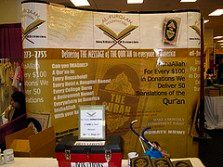
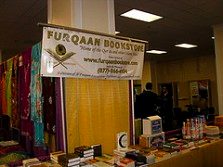
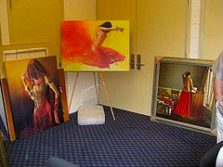
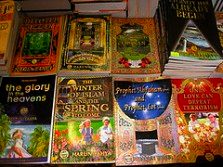
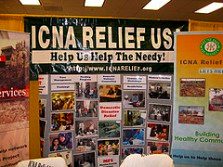
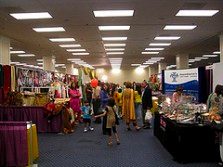
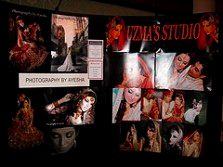
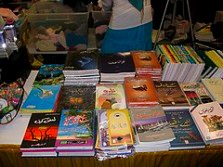
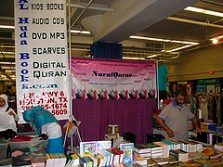
The APPNA managers had also arranged a delightful bazaar in the basement of the hotel. It catered to the needs of the delegates and their families, not only their worldly needs but also their spiritual needs. There were many stalls selling clothes and jewelry, and also many selling spiritual books and advice on cleansing the soul as well as the body. There were also stalls selling property in Dubai and advice on managing your money. The variety of products and services on sale was amazing! The women folks thronged the bazaar most of the time.
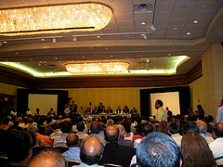
On the second day of the conference or the mela, there was a political forum to discuss the ongoing judicial crisis back home. APPNA had invited prominent politicians from Pakistan for this purpose. These sessions were open to everyone. Panelists included: Barrister Aitzaz Ahsan, Justice Wajihuddin Ahmed, Ahsan Iqbal of PML-N, Farooq Sattar of MQM, and Pakistan’s new ambassador in Washington, DC Mr. Husain Haqqani. The hall was full. All seats were taken. Many people stood in the back and on the sides of the hall.
It was clear that the audience was politically divided along the same lines that are etched so deeply on the political landscape of Pakistan. They expressed their views with the same emotions and anger that have been visible in Pakistan since March 2007, when General Musharraf sacked the Chief Justice. A large and vociferous section of the audience was for the restoration of pre-November 3 judiciary.
Aitzaz Ahsan was heard in pin-drop silence and received a standing ovation from the audience, both before and after his speech. He was even hailed as “Obama of Pakistan!†by someone in the audience.
Ahsan Iqbal of PML(N) was heard patiently. Farooq Sattar was occasionally heckled but managed to say what he had to say. However, all hell seemed to break loose when Mr. Husain Haqqani got up to speak.
Mr. Haqqani is a smart man. He speaks and writes well. I have heard him speak on TV and was always impressed by his clarity of thought and coherence of speech. He has written a great book, Between Mosque and Military, which, according to Stephen Cohen, is â€brilliantly researched and written book that should be required reading for anyone who wishes to understand this increasingly important state.†But on stage, in front of a crowd, Mr. Haqqani looked and acted more like a fighter rooster. He would try to put down his “opponents†with a sharp rebuttal or repartee. This technique might win him points in a school debate but did not win many friends among the APPNA doctors in the hall.
The acrimony generated in the political debate, however, seemed to disappear in the evening when, during a musical show, young Amanat Ali sang some fast paced songs, and the doctors broke into a wild bhangra in the hall that lasted past midnight.
I checked out of the hotel a day before the APPNA mela ended.

While going up to my room to collect my luggage, I entered an elevator, which already had some people (apparently Americans or Europeans) going up. Just when the doors of the elevator began to close, an exuberant Pakistani mother, in her colorful dress, accompanied by 3 or 4 excited kids, ranging in age from about 7 to 12 or 13, rushed in. We squeezed ourselves and pulled our tummies in to accommodate the woman and the kids. When everyone was in, and had pushed his/her floor buttons (the children having pushed more than one) the doors closed, and that usual awkward silence fell in the elevator. The mother broke the silence by loudly asking the children in English, like a schoolteacher would ask a class, “hey, let’s sing Pakistani national anthemâ€. The children bashfully looked at their mother with question marks on their faces. They didn’t seem to think it was a great idea to sing in such a closed space with strangers around. But the mother wasn’t deterred. Like the conductor of a choir, with one hand raised, she piped up with a full-throated ‘Paaak sar zameeen shadbaad … The children simply stared at their toes in embarrassment. The strangers in the elevator, more perplexed than bemused, slipped out of the elevator at the first stop. I listened to her solo performance in silence. Had she not been so out of tune I would have possibly joined her.
I guess patriotism, like nostalgia, affects you at odd times — and at odd places.
Overall, it seemed that the doctors had a good 3 days of R&R — recreation and religion, that is. What they need to do is, I guess, inject a bit of Renaissance and Reformation into APPNA to make it a really meaningful organization, both for the country of their choice as well as of their origin.
Photos for this post are by the author himself and the full collection can be seen here




It’s telling how any discussion about any topic among Pakistanis quickly turns into a debate about religion. Politics is not far behind. And then, of course, the mixing of religion and politics with all other aspects of life quickly creates mass confusion and the whole point of the post is lost. Are we capable of compartmentalizing our profession, religion, politics, business etc? Is the mantra of “complete deen” inescapable? Can we ever learn to think clearly? I have seen only one example which comes close to being focused on one thing without adulteration: OPEN Silicon Valley Forum 2008, not withstanding the unsuccessful attempts by some to politicize it.
@PMA
1. “You say nationalism is a divisive force. And religion is not? Historically more killing has gone on in the name of god than any other cause.”
Couldn’t agree with you more…
2. “You say that India is an enemy of Pakistan and I agree with you. Any Pakistani who thinks otherwise is a fool in my opinion.”
Couldn’t agree less…
Brother Ibrahim: Your point of view on Nationalism vs. Religion is in line with Asama & company and other Islamists. Pakistan has tried the route of Pan-Islamism and Ummah. It just did not work. It does not work. The world has not organized itself on the basis of religions. If that was the case then all Buddhists or Christians of the world would be one nation constituted of their coreligionists only. You know that is not the case. Then why Muslims of the world should be one nation. You say nationalism is a divisive force. And religion is not?. Historically more killing has gone on in the name of god than any other cause. You say that India is an enemy of Pakistan and I agree with you. Any Pakistani who thinks otherwise is a fool in my opinion. But what about the Muslims of India. Where would you place them. Friends or foes? We Pakistanis need to put things in perspective. Religion is a personal belief and must be kept that way. The sooner we separate religion and state the better it is for us.
Man this way really enjoyable article. You wrote it very well and it was funny, especially the lady who started singing the Anthem in the elevator. I bet you just made that up but it is funny. Thanks
Purpose of the post was not to be judgmental but simply to describe what I saw at the convention, as best as I could. Naturally, every one sees things through one