Adil Najam
There are times when it is not enough to feel outraged. One has to speak out. To express the outrage. To speak out, and to be heard, against that which is wrong. Indeed, there are times in life when it is difficult to determine exactly what is right. Reality, after all, is complex and nuanced. However, there are also times – more often than we think – when there is no ambiguity about what is wrong. Just plain wrong. Silence, at such moments – especially in the face of violence – cannot be justified. The least one can do is to call the wrong, wrong.

In the short life of this blog there have been many such moments. The disgraceful behavior of the police in pulling down the shalwar of a young man protesting his father’s disappearance. The killing of a woman minister in Gujranwalla just because she was a woman. Pictures of violence against women, including by so-called ‘celebrities’ like cricketer Moin Khan and squash player Jansher Khan. The criminal humiliation and murders of tailors and barbers just because they do not conform to some jahil maulvi’s misconstrued sense of religosity. The violence of self-righteous vigilantism. The brutality against lawyers and judges in the aftermath of the Chief Justice’s removal and subsequently since then. The Karachi carnage. The trampling of all political decency in the cause of personal ambition and thirst for power. And more.
If we, as Pakistanis, do not wish to be defined by the acts of the vile people who do such acts, define who we are as Pakistanis, then all of us must speak out in outrage against such acts. To speak with conviction and to speak as a prelude to action.
 Now is time, again, to do. One hears now of renewed violence against Buddhist relics in the Swat region by followers of the maverick extremist Fazlullah who has been enticing violence in multiple forms.
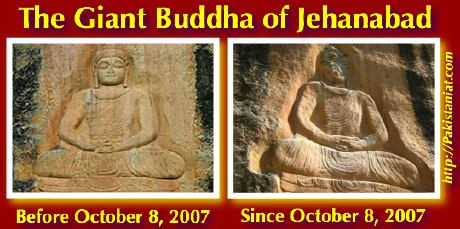
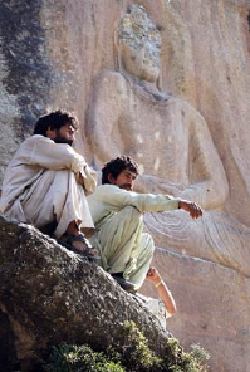
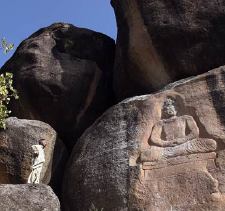
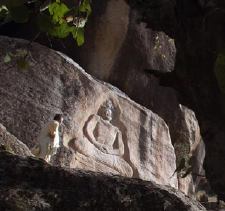
The most blatant mutilation of the giant Buddha of Jehanabad was back in October, but since then there have been renewed calls and attacks by militants on Buddhist relics and there is a serious concern that while attention remains diverted towards Gen. Musharraf’s struggle for his personal power, these historical treasures may be lost for ever. As we have written here before, the area is rich in historical heritage of the Gandhara and Buddhist periods, and there is a history of previous attacks on Buddhist symbols in Pakistan, in fact in the Federal Capital Islamabad.
Reporting on the October 8 desecration of the Giant Buddha, Archaeology reported:
The turmoil in Pakistan, especially the situation in Swat, has scholars concerned about the safety of the country’s artistic and archaeological heritage. Relatively peaceful until recently, Swat was a tourist resort with spectacular mountain scenery. It also has a rich cultural heritage, especially Ghandaran art and Buddhist monuments. Adriana Proser, John H. Foster Curator of Traditional Asian Art, at the Asia Society in New York explains, “This area of what is today northern Pakistan was along a major route of the Silk Road. Gandhara was one of the major sites of the Kushan period (first through third centuries). The art of the Gandhara area is extremely important because it shows the impact of Hellenistic and Roman influence ushered in through the conquests of Alexander the Great. The stylistic impact of Gandharan Buddhist art traveled vast space and time, reaching places as far away China, Korea, and Japan. The Gandhara region became part of the Sasanian Empire (224-642), which preceded Islamic rule in Persia, and consequently the arts of the region also influenced artistic developments in the Middle East.”
The consequences of prolonged political infighting in Pakistan, leaving Taliban-like militants unchecked may have dire consequences for this heritage. On Monday, October 8, dynamite was used to obliterate the face of a of 23-foot-high seventh-century seated Buddha carved into a rock face near the village of Jehanabad in the Swat Valley. This was the second attack on the Buddha. In early September, militants detonated explosives placed above and below the Buddha, but only damaged the stone rather than the sculpture. It appeared, according to police chief Mohammad Iqbal in an AFP story, “to be the work of the local militants who condemn these relics as being un-Islamic. It looks more like a symbolic attack to embarrass the government internationally.” A witness in Jehanabad says that the armed group entered the village Monday evening and announced their intention to destroy the Buddha. According to Aqleem Khan, a provincial archaeology department official who spoke to Reuters, the militants drilled holes into the rock, filled them with dynamite, then set off the explosion the morning of Tuesday, September 11. Abdul Nasir, a curator at the Swat museum, known for its collection of Ghandaran sculptures, told AP that “Islam teaches us to respect other religions and faiths, but unfortunately some elements are disturbing the peace in the Swat valley.”
“Any destruction of archeological and artistic sites such as this Gandharan Buddhist relief are an enormous loss for all who treasure historical records and significant and rare works of art,” says the Asia Society’s Proser. The attack recalls the March 2001 destruction of two giant Buddha statues in central Afghanistan by Taliban militants. “The destruction of the Bamiyan Buddhas was a political act in religious guise, greatly increasing the reputation of the Taliban among its target audience,” says Archaeological Institute of America vice president John Russell. “The AIA calls on all governments, and particularly in this case the government of Pakistan, to protect our shared world heritage from groups that exploit heritage for political gain by destroying parts of our common past.” Adds AIA president C. Brian Rose, “Destroying icons in the name of religion has unfortunately been a component of human behavior since antiquity. In areas of conflict, archaeological institutes throughout the world need to work in unison to document and protect cultural property that is at risk.”
The destruction of the Jehanabad Buddha is on the direct call from extremist mullah Fazlullah who has been spreading his message of hate and violence across the region. We have written before about the jahalat (ignorance) and violence that he has been preaching in relation to his opposition to children being vaccinated against polio and his violent measures against anyone – including tailors who stitch trousers and barbers who shave faces – who dares to go against his xenophobic version of religosity. Fazlullah’s movement enjoys local support from the so-called ‘Local Taliban’ but does not enjoy any support outside of the immediate area.
Fazlullah’s organization is banned by the government and there is military action being taken against him and his followers. However, this campaign is not very successful and the military is suffering significant losses. This is partly because of his local support, but even more because the action is itself half-hearted and strategically misconceived.
Importantly, while Gen. Musharraf is exactly right in diagnosing movement’s such as Fazlullah’s as one of the greatest challenges facing Pakistan today, the General’s obsession with wanting to remain in power has distracted him from taking meaningful action against such criminal actions. While those who believe that simply removing Gen. Musharraf will solve the problem are clearly wrong, it is increasingly evident that his departure is a necessary, but not sufficient, condition for meaningfully tackling this menace. It is now increasingly clear that even if Gen. Musharraf has the will to resist religious extremism, he no longer has the ability to do so.
There are, of course, many aspects to what is happening in Swat – not just related to Pakistan’s domestic politics but also to geo-strategic and global realities. My former colleague at Tufts University, Prof. Gary Leupp has written a thoughtful piece on the subject in CounterPunch, pointing out some of these aspects, drawing interesting chronological linkages, and pointing out that a disrespect for cultural heritage in times of war is by no means restricted to the Taliban. But none of this is or can be a justification for what is happening in Swat today.
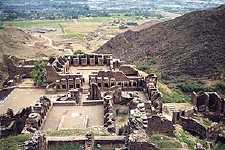
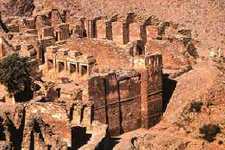
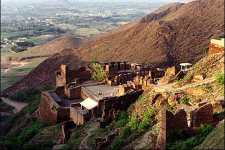
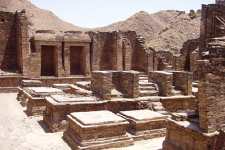
The treatment of these religious symbols and artifacts in Swat is but a small indicator of the rot of extremism that is setting in, but it is an important indicator. It is important not only because the world has its own sensibilities and is paying great attention. It is far more important because it seems that Pakistanis themselves are not paying enough attention. We need to do so. We need to speak out. We need to stand up. We need to do so not simply because of what might happen to our past heritage if we do not, but more because of what might happen to our own future if we don’t.
At stake here is not just an image on a rock-cliff or our image abroad, at stake here is our own image of who we are and who we might become if we remain silent in the face of injustice.




Lets not become paranoides !
@ Someone else is doing all this, and we all know them,
all the services know them and their groups, I shall
formally name them as they were behind Shia/sunni
troubles, they were behind Muslims/Chritians, they
recently tried Muslims/Hindus . Its all Anti-islam tactics
and propagandas !!! I wish they should be exposed and
punished
No Mr.Tariq, I am just talking against so called secularism and liberalism which prefers to promote actions against a religion just because they despise it. Following appeared in 22th Nov,2006 papers:
By Muhammad Anis
11/22/2006
ISLAMABAD: The management of Faisal Mosque, International Islamic University Islamabad (IIUI), has expressed its apology for the inconvenience faced by people who wanted to enter into the mosque Sunday, November 19, for Asr prayers.
On that day, Prime Minister of the United Kingdom, Tony Blair was scheduled to visit the mosque at 3:15p.m before a meeting with Pakistani scholars at the university. Due to a 15 minutes delay in his arrival and extra-ordinary security arrangements general public was barred from entering the mosque, however, Azan for Asr prayers was recited without using loud speaker and prayers were led by Prof. Abdul Jabbar Shakir, Khateeb of the Mosque and Head, Dawah Academy, that was attended by a number of the University teachers, officers, students and security officials present on the occasion. A group of visitors also offered prayers outside the mosque to compensate the inconvenience faced by the visitors. Azan for Maghrib prayers was recited through loud speakers and prayers were offered accordingly while the British prime minister was attending the meeting in the university.
and no humanity preacher and Liberal on this site thought to talk about it or destruction of a century old Ameer Hamza. There was nothing between lines.
@RE: where on earth you got idea that Jews are Not Destructing Masjid Aqsa? in which world do you live buddy?
ARY One World airing news as I speak sitting in San Francisco.Once again swat news is just another news. Life of innocents in Pakistan is just another news. But arrival of Bhutto and Nawaz is first news.
Usman well said.
There is no way to justify such deplorable acts; they deserve to be condemned by all reasonable people. The treasured artifacts of the Buddhist period in Pakistan’s northwest and in Afghanistan are the heritage of the entire humanity.
Sadly, there is no easy way to resolve this problem. The key is to somehow get through to these people. There is dire need to make use of any human resources who understand the tragic cruelty of such acts, are sympathetic, and can in some way mediate with the zealots and get them to stop .
There are calls to simply crush and vanquish the culprits in this forum. It is as unachievable as the idea of comitting genocide to save statues is morally repugnant. The Afghan experience clearly shows that use of excessive force simply radicalizes even more Pashtuns, thus compounding the problem. And yet a way has to be found to stop the extremism in this region.
There is a brief, but thought provoking, report filed by Khalid Hasan in the Daily Times today. It reports on the experiences and ideas of Joshua White who has spent time in this region. For those who may be interested, here is a link:
http://tinyurl.com/2h5436
People like Fazalllah in Swat are the greatest threat to Islam today. People who did this destruction of Buddha in Swat and those who support such actions are real enemies of Islam and their action only strengthen other enemies of Islam.