Adil Najam
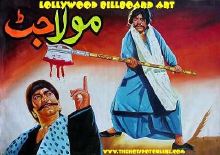 For a moment I flirted with the idea of using the title “The Greatest Pakistani Movie Ever?” (to match with the earlier ATP post on PTV show Fifty-Fifty). But even with the question mark at the end, that would have been unfair on the remarkable movies of the 1960s; particularly, for me, the Waheed Murad–Ahmad Rushdie hits.
That said, I do believe — and I know I am in a minority here — that Maulla Jatt is not just a remarkable but a milestone Pakistani film. Most people think of it as an ‘action’ film (and some would call it an over-action film), but for me it is a dialogue movie. Memorable for its dialogues and even more for how they were delivered by Sultan Rahi and Mustafa Qureshi.
This next clip is a good, although not the best, example of the barak (brawl) vernacular that is the hallmark of the Maulla series of movies.
Let me go out on a real limb here and suggest that Maula Jutt is to Pakistani cinema was Godfather was to Hollywood and what Shoalay was to Bollywood. I know, I know. That is too much to gulp. I am exagerating (on acting quality, for example); but only for effect! But play along and think of it….
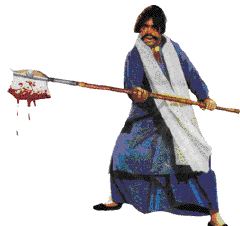 It is an action movie most memorable for its dialogue. It blurs the line between good guys and bad guys. It is thick with political and social commentary. And it leaves an imprint on everyday language that lives beyond the movie (“I’ll make them an offer they cannot refuse”, “kitnay aadmi th-ay?”, “nawa aaya hai, soonia?”).
Produced by Sarwar Bhatti and written by Nasir Adib, Maulla Jatt is not only the biggest box-office hit ever in Pakistan’s history (it ran for five years straight), it is also a cultural, social and political icon; for good and for bad.
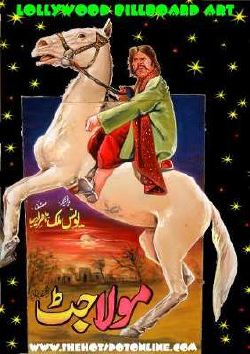 Released at the height of the Zia-ul-Haq regime, it was full of political innuendo. Die-hard fans will talk about how the message of the movie was that when faced with oppression we sometimes have to take things in our own hand (as Maulla does) but this is a painful process (hence Maulla’s constant desire not to have to use his dreaded ganDassa). At least, this is what the myth became.
Anyhow, I have a feeling I am going to get into trouble for this one; always happens when I mention Maula Jatt.
Amongst a large segment of our educated elites there is a deeply ingrained (and cultivated) feeling that Maulla Jatt is the height of the uncouth, of the ‘paindoo.’ No surprisingly, I find that most who hold this view have never actually seen the movie. So, be it. If paindoo it is, then paindoo I am!




Well, Sholay was a copy- of “Seven Samurai”- which I here was a copy of some Japanese movie. “The Good, Tha bad and The Ugly” was totally diferent from Sholay. I’ve read a lot about Sultan Rahi in “Herald” and was really sad when he was killed ruthelessly. ” Ather, “Indan movies” comprise of regional movies also and believe me, they are much better than Hindi movies from Bollywood. Hindi movies copy lots of songs from Pakistani movies, and I’m glad they do it otherwise I wouldn’t be able to listen to such beautiful melodious songs:) Nowadays I hear a song ” Chaandani Raaten” on FM radio channels a lot and I suspect the original belongs to Noorjahan. Can anyone clarify? I used to listen to a Islamabad radio programme, “Intikhab” in ’80s, just to listen to songs by Musarrat Nazeer. One song I still remember- “Chalen to kat hi jayega safar, ahista ahista”. By the way, Hindi cinema is really progressing nowadays. I just watched the latest Hindi flick named ” Ahista Ahista” featuiring Soha ali Khan anf Abhay Deol and it is a very sweet romantic story of two common, new age Indians. You would be surprised to see the grandness of Lal Killa and Jama Maszid captured in the camera. Highly recommended.
The beauty of this website is its uniqueness due to variety of post.A lovely post again.I never watched the movie but was it really a pakistani copy of “GOd Father”?
Syed Noor has done a lot of good work, my favourite being ‘Ghoonghat’. Choorian somehow did not live up to the hype as far as i was concerned, though it had some really nice songs. ‘Jeeva’ also had something to it, especially when seen in the cinema. But all my opinion is based on the time these films were first released and my then impressions, i dont know how I would grade them now.
I am afraid I have only heard about the grand fame of ‘Maula Jatt’ since it was a bit before my time, as in I was too young to have possibly seen it during the height of its popularity but there is an oft repeated family story that everyone used to tell of how my chacha who came to visit from America and had heard the movie’ fame went to see it, but couldn’t survive past the first half and had to retutn home.
I don’t think that these views are in minortity though. I have not personally seen Maula Jatt or any other Punjabi movie for that matter but I know Sultan Rahi and Mustafa Quereshi are legends in Punjab if not the whole of Pakistan. The reason these movies don’t get much of a name these days is probably because for quite some time, the newer generation has been moving further and further away from Punjabi. Its not taught in schools, its use is thought to be solely for ‘lower class’ or the uneducated ones. I know because I have gone through this. As a young Punjabi, I never spoke it as a child though I could understand it when my family spoke it around me but we are always taught to speak urdu, maybe because it was the franca lingua of schools along with english and Punjabi was considered to be disrespectful. I probably still don’t have a full scope of the issues behind this but in my understanding this is probably the reason for decline in popularity of Punjabi.
I first learned to speak Punjabi after coming to Canada, which I am still slowly getting used to. Its not that Punjabi wasn’t spoken at my house because it was the only language of communcation among adults.
Dear Adil, most interesting and you should not even think of “losing respect” by euologizing Maula Jatt. Just to add, this film was based on a short story – Gandaasa- written by [late] Ahmed Nadeem Qasmi. This partly explains the success of the film as it had a powerful storyline enabling the director to develop complex characters as opposed to the cardboard figures. However, the downside of MJ is that it created a genre that our film industry has not been able to undo despite the decades gone by.
This leads to the second point I want to make: Syed Noor has emerged as the only filmmaker who has the ability to come up with creative (as far as you can go in Lollywood) cinema. His films have experimented with several themes and styles (sometimes plagirised, one may add). In addition to the films listed above, his 3 films should be mentioned in the top category: Choorian (that was the most successful film in decades), Ghoongat and the recent Majajan. Choorian was inspired by the age-old Cindedralla story but the other two are fairly original and all three are slick. Majajan has also some good songs and you will be pleased to know that its hit number is Bulleh’s “teray ishq nachaya … thaya thaya”. This again confirms our observation that there is a revival of Bulleh Shah’s poetry in the popular cultural idiom.