Adil Najam
I have often wondered – and seriously – if Pakistanis read?


No, not whether they can read. Illiteracy being what it is in Pakistan, there are many – too many – who obviously cannot. But this question does not pertain to them. This is about those who could read if
they chose to do so. But who often do not. The question, of course, is “why not?”
I realize that I risk sounding either arrogant or uncouth by having phrased the question as I have. Of course, there are many many Pakistanis who do read and read voraciously. Some of them actually write and comment on this very blog. And, quite certainly, there are many many more individuals who not only read but are amazingly – even spell-bindingly – well-read. I can say in all honesty that some of the very best-read and the most widely-read individuals I have ever encountered anywhere in the world have been Pakistanis. People who always amaze me not only by the breadth of their interests but also by the depth of their intellect.
I am sure there are such amazingly well-read individuals in all societies. But the point I wish to make is not about individuals. It is about society. The question is whether we as a society place importance on the joys of reading? Whether we place premium on the intellect of the well-read? Whether we honor and cherish those who are well-read?
My own sense is that, as a society, we do not. And that is a pity.
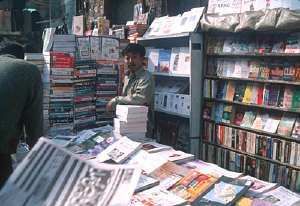 We can joke that in our language (Urdu) we do no “read” the newspaper; we “see” the newspaper. Akhbaar daikha, as opposed to Akhbaar paRha! But the problem is much more than just a joke. It amazes me no end how many of my “learned” friends will actually provide expert commentary on books they have not read. They will give you elaborate critiques based simply on the title or something they overheard someone saying on TV. Indeed, many will start their critique by telling you that they have not read the book and then go on to pontificate on exactly what it is saying and why that is right or wrong (see, for example, some of the comments here or here).
Note, for example, how our conversations (and comments on this blog and elsewhere) are always made with great airs of authority – for example, we don’t say “many people like this movie” we say “99 per cent people like this movie.” No one will ever ask how you came to know that it was, in fact, 99 per cent and not 98 or 89; nor why a wretched 1 per cent did not like the movie! Yet, our assertive and authoritative discourse lacks not just evidence but also reference. We can be prone to inventing facts and numbers to support arguments that we instinctively consider to be true. Yet, we do not seem to quote sources or even ideas too often – except, of course, the Quran (which so many of us so routinely misquote to mean whatever we want it to mean), the hadith, and messers Iqbal and Jinnah.
The exception, I should add in fairness, is poetry. That we do quote and most often quote properly will full reference. But there, too, the habit of reading poetry seems to be on the way out. One hopes that one is wrong in getting the feeling that the traditions of reading Urdu books – whether they be by Quratulain Haider or by Shafiqur Rahman or by Ishtiaq Ahmad – is also disappearing.
Our resident apologists will soon make the argument that there is too much poverty in Pakistan for people to be able to afford reading. But it is not the poor we are talking about. The rich seem to understand the power of thoughts and how it can help you become successful. Then there will be those who will shout out that reading is itself a Western conspiracy and an imposition of all outside ideas should be resisted. This crowd is best ignored entirely. But there will also be those who will argue that books, and therefore reading, is no longer needed because the internet has now arrived. To them, all I can say is please just read some of the comments on many of our posts and decide for yourself just what good the internet has done to either reading or writing!

By the way, as an aside, some commenters on this blog have suggested that I should stop writing posts and, instead, only write headlines; since too many commenters here obviously never read the full post and comment only on the headline – or, sometimes, just the pictures in the post. I must confess that this irks me too. However, the very fact that some readers would make such a comment proves that there are those who do actually read what we write. And that is enough incentive for us to keep doing so.
But enough of a rant from me. As I noted, I think the above is true in general but not true in particular. It bugs me so much, I think, partly because of my own professional training but also because I sometimes see myself slipping into the same quagmire.
 But the real reason for this long rant was to introduce a wonderful op-ed in The News (24 April 2008) by my friend Nadeem-Ul-Haque (formerly and currently of the IMF and in-between of the Pakistan Institute for Development Economics) which highlights the problem and, maybe, its cause much more eloquently than I have been able to. The op-ed is titled “No Libraries, No Books” and laments the state as well as lack of “real” libraries in Pakistan. There are, in fact, many nice libraries in Pakistan, but not too many functional ones.
Passages from Nadeem’s hard-hitting and heart-felt article are worth quoting extensively:
Libraries have been the hallmark of growing and progressive civilisations. Even in Sumer libraries of clay tablet writing have been found. Classical Greece and its love for books and learning gave us civilisation. Even the Persian Empire had libraries in Persepolis when Alexander attacked. Roman emperors too set up libraries to be remembered all over the empire. Then there was the famous library of Alexandria which till the early middle ages held most of human knowledge…. Civilised governments have built these repositories of knowledge as national monuments to show how important learning and knowledge is. These grand buildings and their large holdings will remain through history as testaments to these great civilisations many eons from now. Most serious countries have not only large national libraries but also large networks of local public libraries.
… In our history, we have built lovely official residences such as the President’s House, governors’ houses, the Prime Minister’s House and many other buildings, but no libraries. We have built many polo grounds and golf courses, but no libraries. Lahore, an ancient city of culture, now has more polo grounds than libraries. Lahore even has more offices for the chief minister (four in all) than libraries. Of course, the Chief Minister needs office space more than our children need libraries.
A search for libraries on the internet reveals only university and organisational libraries in Pakistan. When you go to university and organisational libraries, you see what a sorry state these are in. They hardly have a collection and are operated like bureaucracies with severe entry limitations and on a short working day, mostly during office hours.
We have no public libraries, beyond what the British left us. The Quaid-e-Azam Library in the old Company Bagh in Lahore (now Bagh-e-Jinnah) is nothing but a bureaucratic enterprise with severe entry limitations and hardly a serious collection. It even does not boast a website in the year 2008.
Our national library did not even get space on the main Constitution Avenue. It is tucked away behind the prime minister’s office as if we were ashamed of it. As its website puts it, it is in a plot of 500 by 100; a little over an acre is all the government could afford for a library. It took us 46 years to come up with the concept for a national library. Even today the National Library has 130,000 volumes, 555 manuscripts, 45 reels of microfilms, 48,000 microfiche cards, 845 magazines and 135 newspapers. What a testament of our great civilisation! I might add that this collection does not even compare to a reasonable sized public library in a civilised country.
In Pakistan I witnessed our bureaucracy and the Planning Commission in this game called “who can spend our development money the fastest on pet projects?” I saw many strange projects like megabuck universities contracted to unknown consortiums, bureaucracies setting up mango-pulp and football-making plants, textile cities, garments cities, and so many others. I asked and wondered why we cannot have projects for community libraries. Why can we not dedicate, say, about Rs50 million for a library in the top 20 cities of our country per year. That is only a billion a year. Not a large sum of money when you think of the vanity projects, VIP trips and the sums required to maintain our VIPs.
But then I was reminded of who demands books in Pakistan? When I go to my rich friends’ houses, I see no books. A million-dollar household with a hundred-thousand-dollar sports car outside has no books. Rich people who spend thousands of dollars on a dinner do not even spend 100 dollars annually on books. None of our political manifestoes even mention libraries. So perhaps the government is right. There is no demand for libraries in our country.
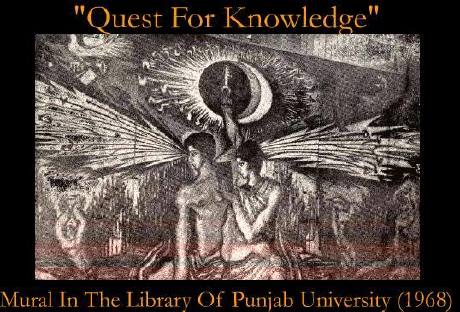
What Nadeem-ul-Haque is saying here is worth thinking about. But before anyone can think about this – or anything else – they will first have to read. And therein lies the challenge. The demand for libraries, after all, comes from the desire to read.



It reminds me one of my visits to NWFP Archives library Peshawar, the largest library in the province, some ten years back.
When I came out of the library after browsing through the shelfs, two of the employees stopped me and insisted that I should go through a body search. After a verbal brawl I complied and one of them searched me and after that said sorry to me.
However, it was an unpleasant experience and reflected the mentality of employees, who consider every entrant to that large building as thief. The library, which houses thousands of volumes, remains devoid of any visitors nowadays, and the volume are being eaten away by dust.
During the university days the library was occupied by the lovebirds in the morning and afternoon and was closed on 5:00 pm, which I think was suitable time to open it for the students, who would come to study after classes and a rest in the evening.
Our people consider well read as
In Block 20 of Federal-B-Area Karachi, there used to be a ‘mohalla’ library called ‘Zafar Library’. It was located in a house right next to a Cricket Ground. I used to play in that ground occasionally. While walking towards these two adjacent landmarks, it was always a struggle to choose between going to library or the cricket ground, but I must confess Cricket Ground always won the battle. Still we always used to discuss for a minute or two, should we play cricket or go to library? and cricket always won the battle.
“baat se baat nikalti hai” so I’ll continue my anecdote on this Zafar Library. While playing in the Cricket ground, Zafar Library used to be located at the exact square leg boundary. Whenever a bowler would throw a short-pitch or a bouncer ball, a good “pull” Or “hook” shot used to land on the roof of the Zafar Library :) So after a while we named the short-pitched balls as the ‘Zafar Library ball’. We used to warn a bowler:
“Oye Zafar Library waali baal na pheNk’
Or we would tease a batsman:
“yaar, ye tu ne Zafar Library waali baal miss kar di”
Today I read this library post from Adil, and got carried away in my own memories of libraries. Zafar Library was one of them :)
Ishtiaq Ahmed’s novels HAD to come up… did they not!
Ishtiaq Ahmed seems to be an old ATP favorite:
http://tinyurl.com/4swsjy
Owais and Shiraz:
You guys bring old and sweet memories.
Wow, I see that lot of us read Ishtiyaq Ahmed (Inspector Jamsheed). Amber Nag and Maria: I couldn’t complete the whole series. Do you remember how many novels were in the series because if my memory serves me, I missed the last ten and wish to complete it sometime in future :)
I had setup my own library too. It was a good business. That is how I financed my reading habit for a while until others caught up with me. One other thing I used to do was to rent to others in the family. That way I wouldn’t have to pay a dime in rent. That was lots of fun.
A great post on a very important topic.
I remember growing up with a passion of books and megazines. All my peers were involved in books sharing.
We did not have a public library in our small town , so we started our own.
We named it SHAHKAR Library. I remeber posting publicity fliers. We ran it for a couple of years and then closed it as we ran out of all the inventory and money.The main reason, I beleive was our school. Though it was a government school but we had a great deal of stress on litrature and books. We used to have literary societies and reading and writing competitions.
It was COOL to own, read and share books and megazines.
But in the last 20-30 years many factors have caused a decline in reading books and lack of libraries including TV,
video and computer games, internet and digital gizmos. No one has time for paper media.
Too bad.